Basic Approach
MITSUBISHI MOTORS Group is aware of its responsibility towards traffic safety as an automaker, and we have identified “Delivering products which help prevent traffic accidents” as a key part of our sustainability activities.
Approximately 1.19 million people were killed in traffic accidents worldwide in 2021. Although the annual number dropped by around 5% between 2010 and 2021, many lives are still lost every year.*1 Reducing the number of traffic accidents and, in turn, traffic accident fatalities is an urgent matter globally. A target was adopted for Target 3.6 of the Sustainable Development Goals (SDGs) at the 74th UN General Assembly held in 2020. This target calls for halving the number of global deaths and injuries from road traffic accidents between 2021 and 2030.
The Group has set our safety philosophy towards a car society with zero traffic accidents. Our work on this area is expanding in two aspects: development and dissemination of safety technologies and also education of road traffic safety.
- 2023 World Health Organization
Management Structure
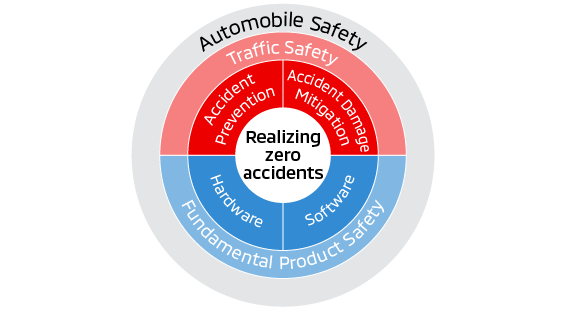
Automobile Safety Philosophy Framework
With regard to product development, the product safety committee has established guidelines and a strategy for safety technology development based on the MITSUBISHI MOTORSʼ safety philosophy. The committee also formulated an automobile safety philosophy framework as our approach to safety technology. We are conducting initiatives primarily focused on three points:
- Technology to help prevent traffic accidents (active safety)
- Technology to mitigate damage from traffic accidents (passive safety)
- Mitigation of dangers, both in hardware and software, in the situation of daily use (fundamental product safety)
We are also working to enhance the management structure by educating R&D personnel, promoting awareness of the safety philosophy and automobile safety philosophy framework.
Development of Safety Technology
By reflecting a variety of safety technologies in our products, The Group aims to help our customers drive with peace of mind, confidence, and comfort.
Active Safety Technology
We are working to develop and install various active safety technologies to help to eliminate traffic accidents preemptively.
MITSUBISHI MOTORS Safety Sensing [MMSS]
Using millimeter-wave radar and cameras, these technologies help to detect the risk of accidents and help prevent, avoid or mitigate damage.
Examples of Active Safety Features
| Function | Description |
|---|---|
| Forward Collision Mitigation System |
Monitors the distance and relative speed of vehicles, pedestrians, and people riding bicycles that are detected ahead. It also monitors pedestrians at night. When the system determines that there is a risk of collision, it alerts the driver with an alarm and information screen display, and activates brake control to assist in collision avoidance or reduce collision damage. |
| Emergency Assist for Pedal Misapplication | Helps to detect obstacles such as walls when moving forward or backward, and vehicles and pedestrians when moving forward. If the accelerator pedal is pressed too hard due to a misstep or other operational error, the system alerts the driver with an alarm and information screen display. It also suppresses motor output and activates brake control to assist in collision avoidance or to mitigate damage due to collision. |
| Lane Departure Warning System and Lane Departure Prevention Function | When the vehicle is detected as about to depart from its lane, the system alerts the driver by causing the steering wheel to vibrate. The system also briefly controls the brakes to help the vehicle return to its lane. |
| Automatic High Beam | Helps to detect the brightness of the road ahead, oncoming vehicles, and the surrounding area. By switching between high and low beams, the system enhances visibility in the distance and reduces the chance of forgetting to switch beams or the need to operate the system manually. |
| Forward Collision Prediction Warning |
Helps to detect relative distance and relative speed to the vehicle ahead and, when detected, alerts the driver when it is judged that there is a risk of collision. |
| Traffic Sign Recognition System |
Helps to recognize traffic signs showing speed limits and other information and displays this information on-screen and on the head-up display. |
| Driver Attention Alert | When the manner in which the steering wheel is operated causes the system to detect that the driverʼs attention is faltering,the system sounds an alarm and displays a warning message on the information screen, suggesting “Why donʼt you take a break?” This helps prevent accidents caused by driving fatigue. |
- On-board functions and detection targets vary depending on the vehicle model. These systems are driver aids only and are not a substitute for safe and careful driving or visual confirmation. Under certain circumstances, these systems may not detect other vehicles, pedestrians, or objects correctly.
Scope of Support Cars Expanded
Safety support cars are vehicles equipped with advanced technologies that help to support safer driving. It is a new automotive safety concept, as an effort to help prevent traffic accidents among senior drivers, being promoted in Japan through collaboration between the government and private sectors.
Vehicles are classified into the following categories: “Safety Support Cars” or and “Safety Support Cars S” (Basic, Basic +, and Wide) depending on the features in each vehicle. We are expanding our lineup of Safety Support Car S Wide Models.
List of Car Models (As of April 2025)
| Safety Support Car S Wide Models | OUTLANDER PHEV model, ECLIPSE CROSS PHEV model, ECLIPSE CROSS gasoline model, TRITON. DELICA D:5, DELICA D:5 URBAN GEAR, DELICA D:2, DELICA D:2 CUSTOM, Delica Mini, eK X EV, eK X, eK WAGON, eK SPACE, TOWN BOX, MINICAB EV, MINICAB VAN*, MINICAB TRUCK*1 |
|---|
- Some grades are excluded.
In addition, MITSUBISHI MOTORSʼ forward collision mitigation braking system and pedal misapplication prevention device have been certified as achieving a certain degree of performance under the Ministry of Land, Infrastructure, Transport and Tourismʼs “Advanced Safety Technology Performance Evaluation Certification System”.
Certified Models (As of April 2025)
| (Forward Vehicles) Forward Collision Mitigation Braking System (Pedestrians) Forward Collision Mitigation Braking System |
OUTLANDER PHEV model, ECLIPSE CROSS PHEV model *2, ECLIPSE CROSS gasoline model *2, DELICA D:5 *3, DELICA D:5 URBAN GEAR *3, eK X EV, eK X, eK WAGON, eK SPACE, Delica Mini, DELICA D:2, DELICA D:2 CUSTOM, MINICAB TRUCK *4 |
|---|---|
| Pedal Misapplication Prevention Device | OUTLANDER PHEV model, ECLIPSE CROSS PHEV model, ECLIPSE CROSS gasoline model, DELICA D:5 *5, DELICA D:5 URBAN GEAR *5, eK X EV, eK X, eK WAGON, eK SPACE, Delica Mini, DELICA D:2, DELICA D:2 CUSTOM, TOWN BOX, MINICAB VAN *6, MINICAB TRUCK *6 |
| Vehicles which Pedal Misapplication Prevention Device can be retrofitted | eK WAGON (2013–2019), eK CUSTOM (2013–2019), eK SPACE (2014–2020), eK SPACE CUSTOM (2014–2020), MIRAGE (2012-2023), DELICA D:5 (from 2007) |
- For some grades, forward vehicles only
- Forward vehicles only
- For some grades only
- Forward only
- For some grades only
Body Structures
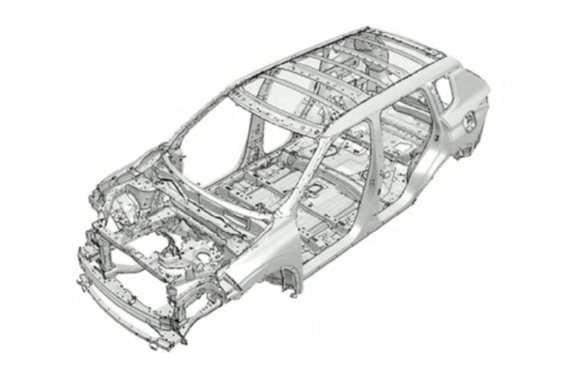
RISE Body used in the “OUTLANDER PHEV model”
In the event of a collision, it is crucial to have a vehicle body structure that mitigates the impact on passengers and provides adequate space. We have adopted the Reinforced Impact Safety Evolution (RISE)*7 body, and enhance collision safety performance in all directions: front, rear, and sides.
For example, the “OUTLANDER gasoline model,” which launched in North America in April 2021 and the “OUTLANDER PHEV model,” which also launched in Japan in December 2021, use a front-to-rear straight frame structure that can help to efficiently absorb collision energy. The vehicle cabin uses hot-stamped ultra-high-tensile-strength-steel to enhance passenger safety while reducing weight in addition to conventional high-tensile-strength-steel.
MITSUBISHI MOTORS is also pursuing safety technology with regard to pedestrians, as well as drivers and passengers. For example, we have adopted energy-absorbing structures in the hood, cowl top, windshield wipers and other parts to mitigate injury to pedestriansʼ heads. Energy-absorbing structures that help to protect pedestriansʼ legs are used in bumper faces and headlights, and so on.
- RISE:Reinforced Impact Safety Evolution
RISE Body used in the “OUTLANDER PHEV model”
Models Adopting (As of April 2025)*8
| Reinforced Impact Safety Evolution (RISE) | OUTLANDER PHEV model. ECLIPSE CROSS PHEV model, ECLIPSE CROSS gasoline model, TRITON, DELICA D:5, DELICA D:5 URBAN GEAR, Delica Mini, eK X EV, eK X, eK WAGON, eK SPACE, MINICAB EV |
|---|
- Excluding models provided by OEM
Third-Party Evaluations of Safety Performance
Mitsubishi Motors has earned high marks for safety in automobile assessment programs conducted by Japanʼs JNCAP*9 and other public agencies in Japan and overseas.
- NCAP:New Car Assessment Program
Key Evaluation Results(as of April 2025)*10
| Third-Party Evaluation |
Rating | Model | Number of vehicles with the highest rating/number of vehicles evaluated |
|
|---|---|---|---|---|
| Japan | JNCAP | 5☆ | OUTLANDER PHEV model ECLIPSE CROSS gasoline model eK X EV |
3/5 |
| ASEAN | ASEAN NCAP |
5☆ | TRITON XFORCE ECLIPSE CROSS gasoline model |
3/4 |
| Australia | ANCAP | 5☆ | OUTLANDER PHEV and gasoline models TRITON(*12) |
2/2 |
| United States | NCAP | 5☆ | ECLIPSE CROSS gasoline model |
1/4 |
| IIHS(*11) | TSP+ | - | -(*13) | |
| Latin America |
Latin ANCAP |
5☆ | OUTLANDER PHEV and gasoline models L200/TRITON |
2/2 |
- Excluding models provided by OEM
- The US Insurance Institute for Highway Safety (IIHS) conducts a comprehensive evaluation of safety performance. TSP+ (Top Safety Pick+) is the highest rating
- Double-cab models are eligible
- No vehicle models were evaluated in FY2024
Mitigation of Dangers in Daily Use
On the hardware (physical) side, MITSUBISHI MOTORS uses flame-retardant materials, employs isolation structures on high-voltage components and uses other technologies to enhance safety and security.
On the software side, we use firewalls on vehicle networks and employ encrypted communications to reduce the risk of cyber threats via electrical equipment mounted in vehicles.
Traffic Safety Education and Promotion
We seek to reduce the number of traffic accidents by conducting traffic safety education and promoting awareness. In these ways, we are working to raise safety awareness throughout society. We also aim to reduce the number of traffic accident fatalities and injuries through collaboration among industry, government, and academia.
Dissemination of Traffic Safety Information

We disseminate information on website on the proper use of equipment and other topics that require driversʼ special attention so that drivers will use automobiles more safely.
Promoting Collaboration among Industry, Government, and Academia in the ASEAN Region
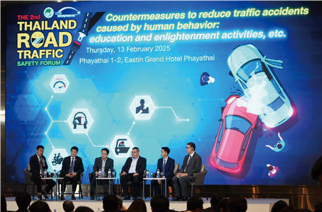
Panel discussion at the 2nd Thailand Road Traffic Safety Forum
We participated in presentations and panel discussions on countermeasures to reduce traffic accidents caused by human behavior at the Thailand Road Traffic Safety Forum, the second meeting of which was hosted by the Thailand Accident Research Center (TARC) and held in February 2025. This forum brings together government agencies involved in road traffic safety in Thailand, such as the Ministry of Transport, the Ministry of Public Health, and the police, as well as universities, research institutes, and automakers, to discuss ways to reduce the number of traffic fatalities. By actively promoting such industry–government–academia collaboration activities, we contribute to research, analysis, and the formulation of measures to reduce the number of fatalities and injuries resulting from traffic accidents, including fatal accidents involving motorcycle riders, which are uniquely common in the ASEAN region.