Basic Approach
The MITSUBISHI MOTORS Group believes ensuring the health and safety of employees is the foundation of corporate activities. Accordingly, we are undertaking related measures on an ongoing basis, including through offices for on-site cooperation.
Management Structure
At MITSUBISHI MOTORS, the “Central Production Committee” comprises the lead officer, heads of production sites, and labor union representatives. The committee meets annually to assess the status of measures taken over the year to address such issues as occupational safety, traffic safety, natural disaster preparedness and health and productivity management and sets quantitative targets for health and safety in the coming year, defines priority measures and takes action to achieve the targets.
Each time a workplace accident occurs, the situation is reported to the Representative Executive Officer, President & CEO and other members of senior management, and we respond according to their instructions such as ascertaining current conditions and introducing measures to prevent recurrence.
With regard to material issues such as occupational health and safety, the Sustainability Committee confirms the risks and opportunities identified from a long-term perspective by those responsible for each materiality initiative. It also deliberates and decides on initiative targets and uses the PDCA cycle by checking progress toward those targets. Furthermore, we have a structure in which the overall status of sustainability activities are deliberated and reported at Board of Directors meetings.
Initiatives to Ensure Workplace Safety
The Company works to create safe and secure workplaces where all employees can dedicate themselves to their work with a feeling of reassurance. In particular, we strive to prevent accidents in production sites, which are where most workplace accidents occur. In order to prevent these, we make an allemployee effort to identify whether or not there are unsafe conditions and make improvements. Additionally, we create safe workplaces by carrying out mutual safety checks at production sites by senior officials and workplace supervisors to identify hazards. Other measures include adopting improvement proposals and requests raised by employees.
We conduct “safety training schools” at business sites to give participants experience with dangerous situations. At some business sites we have “danger prediction schools” to improve participantsʼ ability to predict danger. In FY2024, 796 people attended these schools. In addition, 67 employees participated in outside hands-on training sessions to increase their sensitivity to potential hazards that could be present on a daily basis.
In addition, 11,979 employees participated in other programs, including explanations of guidelines for chemical substance managers in conjunction with the revisions to the Industrial Health and Safety Act and training to obtain other safety qualifications.
In FY2024, our overall accident rate was 0.16, which is lower than both the average for the Japanese automobile industry, at 0.41, and our own target of 0.26. We see this as a demonstration of the results of our efforts since FY2023 to thoroughly review and reinforce basic safe behavior such as through companywide point-and-call activities. However, in FY2024, we were unable to completely eliminate accidents, and 6 accidents did occur. We are conducting various initiatives to foster greater safety awareness.
To ensure the safety of workers at production sites, we follow risk assessment procedures based on the Industrial Health and Safety Act when installing or modifying equipment to prevent occupational accidents. Through a process covering the perspectives of risk discovery, analysis, and evaluation, appropriate countermeasures are implemented for the identified risks.
As for assessing our compliance with safety-related laws and regulations, in the Group, employees in each workplace use checklists to conduct self-checks and to conduct reciprocal checks on other workplaces to ensure thorough compliance. We are increasing the thoroughness of our compliance. In FY2020, we checked technical centers and parts centers. In FY2021, we expanded the scope to include affiliates in Japan. In FY2024, we completed physical checks at all affiliate locations. At our overseas plants, compliance assessments were performed at Mitsubishi Motors (Thailand) Co., Ltd. (MMTh), PT Mitsubishi Motors Krama Yudha Indonesia (MMKI) and Mitsubishi Motors Philippines Corp. (MMPC).
Promoting Health and Productivity Management
At MITSUBISHI MOTORS, we believe the well-being of each and every employee is a driving force for enhancing corporate value and achieving sustainable growth. We regard the preservation and enhancement of employee health as one of our important management challenges. Led by “The Health Declaration” below, we are working together as one company at our domestic locations to promote health and productivity management. In March 2025, we were certified as a “2025 Certified Health & Productivity Management Outstanding Organizations” in the large corporation category of the certification system organized by the Ministry of Economy, Trade and Industry and the Nippon Kenko Kaigi, for the second year in a row.
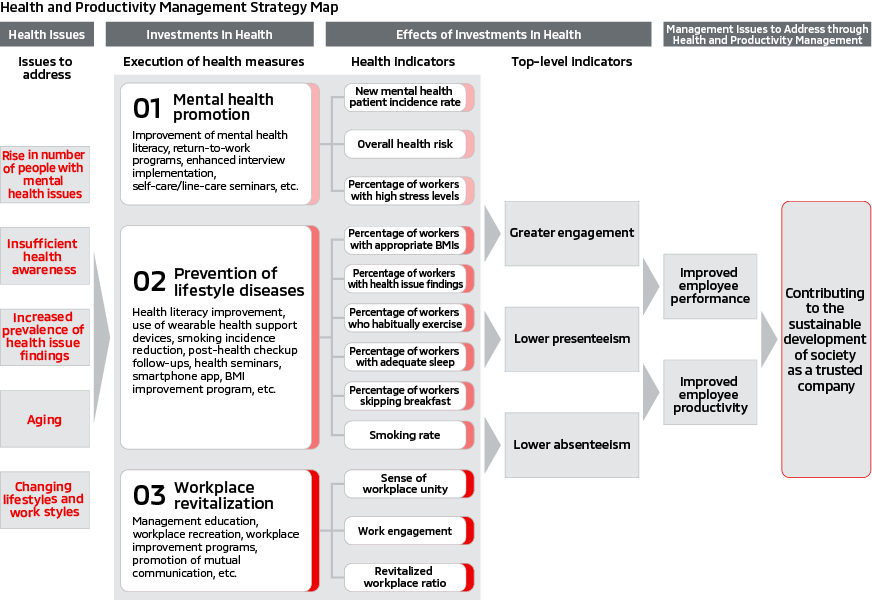
As part of our efforts to promote health and productivity management, we have identified issues that we aim to resolve through health and productivity management and created a health and productivity management strategy map to clarify our health and productivity management strategy and story. The health and productivity management strategy map defines three pillars of health and productivity management measures: “Mental health promotion,” “Workplace revitalization,” and “Prevention of lifestyle diseases.” Furthermore, to assess the effectiveness of various health measures, health indicators are set as KPI, concrete initiatives are implemented, and these initiatives are evaluated and improved.
Mental health issues have accounted for roughly half of all absences due to illness in recent years, we have positioned mental health measures as a company-wide priority issue and we offer personal consultation regarding concerns, provide mental health education and offer support programs to improve the workplace. Measures for making improvements to the workplace environment include training to improve communication in the workplace, such as assertive communication and resilience, as well as workplace environment improvement programs. However, in FY2024 the number of new employees absent from work due to mental illness increased 13% compared with last fiscal year, and work continued to account for around 80% of all cases. Accordingly, in FY2025 MITSUBISHI MOTORS will continue to prioritize prevention with the aim of encouraging care of subordinates by superiors and improving workplace environments. As a self-care measure, we have established external counseling services as a point of contact for employees to easily consult with someone about their concerns. We also conduct interviews with industrial doctors and counselors for employees who are believed to have high levels of stress based on the results of the annual stress checks. In addition, we provide “all-hands counseling” for employees who have just joined us, who are not used to their work and do not feel comfortable asking for advice, in an effort to prevent the onset of mental illnesses.
As a measure for helping prevent lifestyle diseases, we have introduced personalized support regarding diet and exercise to employees under age 40 with a BMI of 25 or above in order to reduce their future health risks and we are implementing a BMI improvement program. In addition, starting in FY2024, we have begun providing health columns and streaming in-house online health seminar videos via a smartphone app, and we are striving to improve the health literacy of employees.
“The Health Declaration” of MITSUBISHI MOTORS
The foundation for our employees having fulfilling work and personal lives is the mental and physical health of all employees and their families as well as the creation of an environment that allows them to work enthusiastically. MMC will actively promote each employeeʼs health.
Safety measures when being assigned to overseas positions
We have created a framework and system of health management that enables employees appointed to overseas positions and family members who accompany them to stay healthy and enjoy peace of mind. We recommend that employees receive vaccinations for measles, rubella, viral hepatitis, and other infectious diseases that are global health issues but which can be prevented through vaccination, and we bear the expenses involved in vaccination.
Labor-Management Relations
We support the basic principles of the Universal Declaration of Human Rights, the Core Labor Standards of the International Labour Organization and the OECD Guidelines for Multinational Enterprises. Furthermore, by complying with national labor laws and regulations at each business location, we guarantee fundamental labor rights to employees.
Our labor agreements recognize the labor union as having the three rights of labor (the right to organize, the right to collective bargaining, and the right to collective action).
Membership in the labor union (MITSUBISHI MOTORS, excluding officers and management)
| April 2023 | April 2024 |
|---|---|
| 100% | 100% |
Status of Labor-Management Communications
The labor-management council is regularly held as an opportunity for labor management discussions. These discussions aim to share information about issues such as working conditions and the working environment, and labor and management then work together to solve these issues.
In particular, at a “central management council” that meets three times a year, we share information about the management environment, short-, medium-, and long-term company policies and directions. At this meeting, labor and management take part in spirited discussions on measures to invigorate various policies, the utilization of human resources, and other issues. Including this meeting, in Japan, discussions were held between our headquarters and union headquarters, and many discussions were also held between offices and union branches in each business site.
For important topics such as major changes in working conditions, we organize a labor-management expert committee and make decisions after careful consideration and discussions and management.
We are also working to build good relationships with labor unions at overseas affiliates in accordance with the labor laws and regulations of each country. No serious violations of worker rights or labor disputes have occurred at any of our locations as of the end of FY2024. In addition, to prevent inhumane working conditions or excessive working hours, we have engaged in repeated labor-management consultations and thoroughly managed working hours.
Number of discussions between our headquarters and union headquarters (Japan)
| FY2023 | FY2024 |
|---|---|
| 62 | 57 |