Structure of the Environmental Plan Package
Anticipating a time 30 years in the future, in October 2020 MITSUBISHI MOTORS formulated the Environmental Plan Package, which defines the directions and targets of its environmental initiatives. This package establishes the foundation for our directions on environment-related management strategy, outlining our objectives for realizing a sustainable society, including one that is carbon-neutral, as we conduct our business activities. The Environmental Plan Package comprises the Environmental Policy, which we have revised to incorporate our medium- long-term perspective; the Environmental Vision 2050, which sets out our vision for society to be achieved by 2050 and directions for our initiatives; and the Environmental Targets 2030, which clarifies specific initiatives to be achieved by 2030 in accordance with this vision.
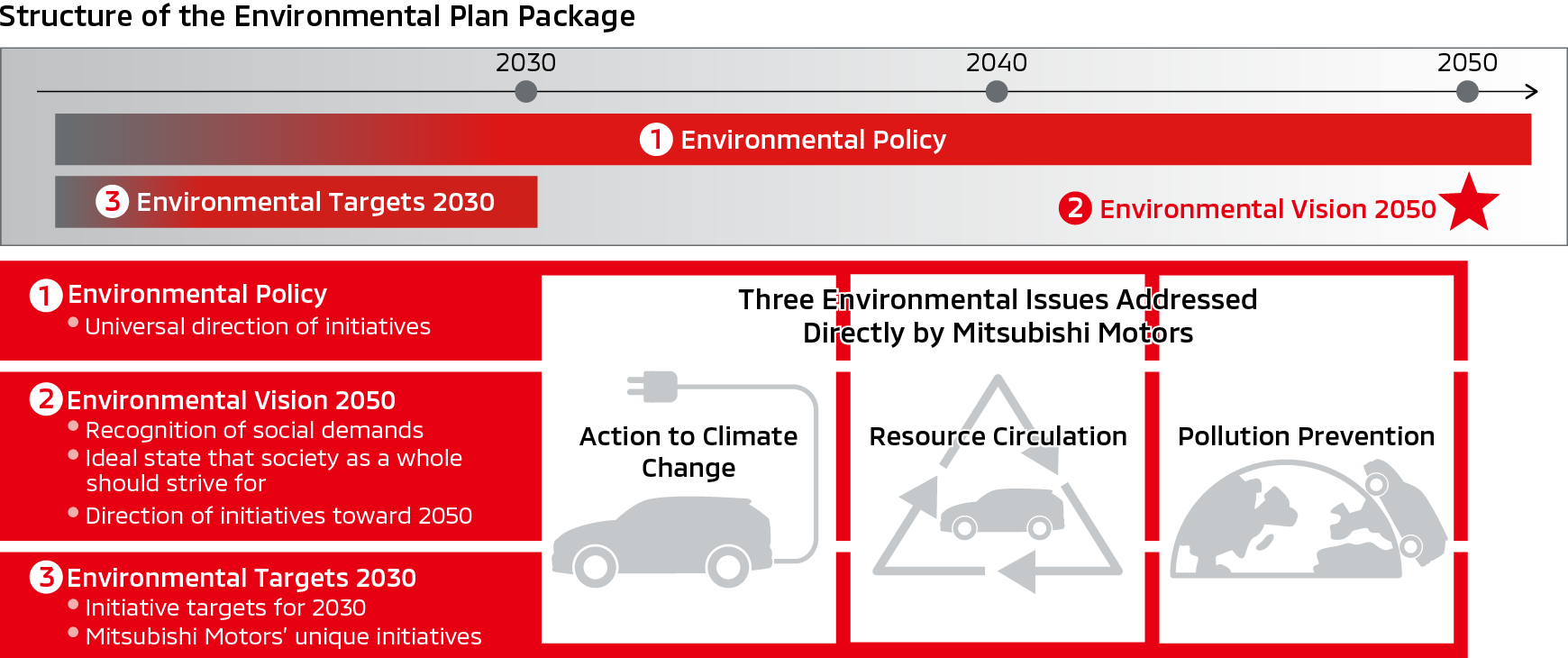
Environmental Policy
We have been acting in accordance with its Environmental Policy, which was formulated in 1999. However, in the 20 years that have passed since that time the operating environment has changed, prompting us to revise the policy in 2020 to reflect current social trends. We recognize that responding to environmental issues in our business activities is essential, and so have newly incorporated a medium- to long-term outlook into our policy.
Focusing specifically on climate change, resource depletion and environmental pollution, we aim to contribute to the preservation of water resources and biodiversity through initiatives in these areas.
Environmental Policy
Mitsubishi Motors recognizes that responding to environmental issues through its business activities is essential. Accordingly, we will engage proactively in specific and effective measures from a medium- to long-term perspective. (Directions of initiatives)
- We will face three specific environmental issues headon: climate change, resource depletion and environmental pollution.
- Given that 2050 is an important landmark for climate change on a global scale, we have clarified levels to be achieved, in 10-year increments, and are pursuing initiatives to this end.
- We will respond to environmental issues through the following activities:
- Unique environmental contributions through our products
- Initiatives at each stage of automobile production, sale and use
- Collaboration with business partners, affiliated institutions, governments and local authorities
- Initiatives targeting environmental issues rooted in the local community
- Initiatives to determine and reduce environmental impact of all related business activities
Environmental Vision 2050
Our Group has formulated Environmental Vision 2050, which defines the society we aim to realize by 2050 and the direction of our initiatives with respect to Climate Change, Resource Circulation, and Pollution Prevention. As part of our Climate Change initiatives, we have declared our commitment to achieving carbon neutrality.
Environmental Targets 2030
We formulated Environmental Targets 2030, which are targets to be addressed in line with the direction of society and initiatives to be pursued, as set forth in our Environmental Vision 2050. In formulating the targets, we referred to scenarios published by the IEA (Internal Energy Agency) and the IPCC (Intergovernmental Panel on Climate Change), as well as international frameworks such as the SDGs and the Paris Agreement.
We revised the Environmental Targets 2030 in February 2023 through the resolution by the Board of Directors and set even higher targets in our “action to climate change” to demonstrate our commitment to achieving carbon neutrality. The target CO2 emissions of Scope 1*1 and Scope 2*2 are established in reference to the target level of 1.5°C, which is based on international climate science.
- Scope 1:A company’s direct emissions (such as from burning fuel)
- Scope 2: Indirect emissions, resulting from electricity, heat or steam provided by another company
Environmental Vision 2050 & Environmental Targets 2030
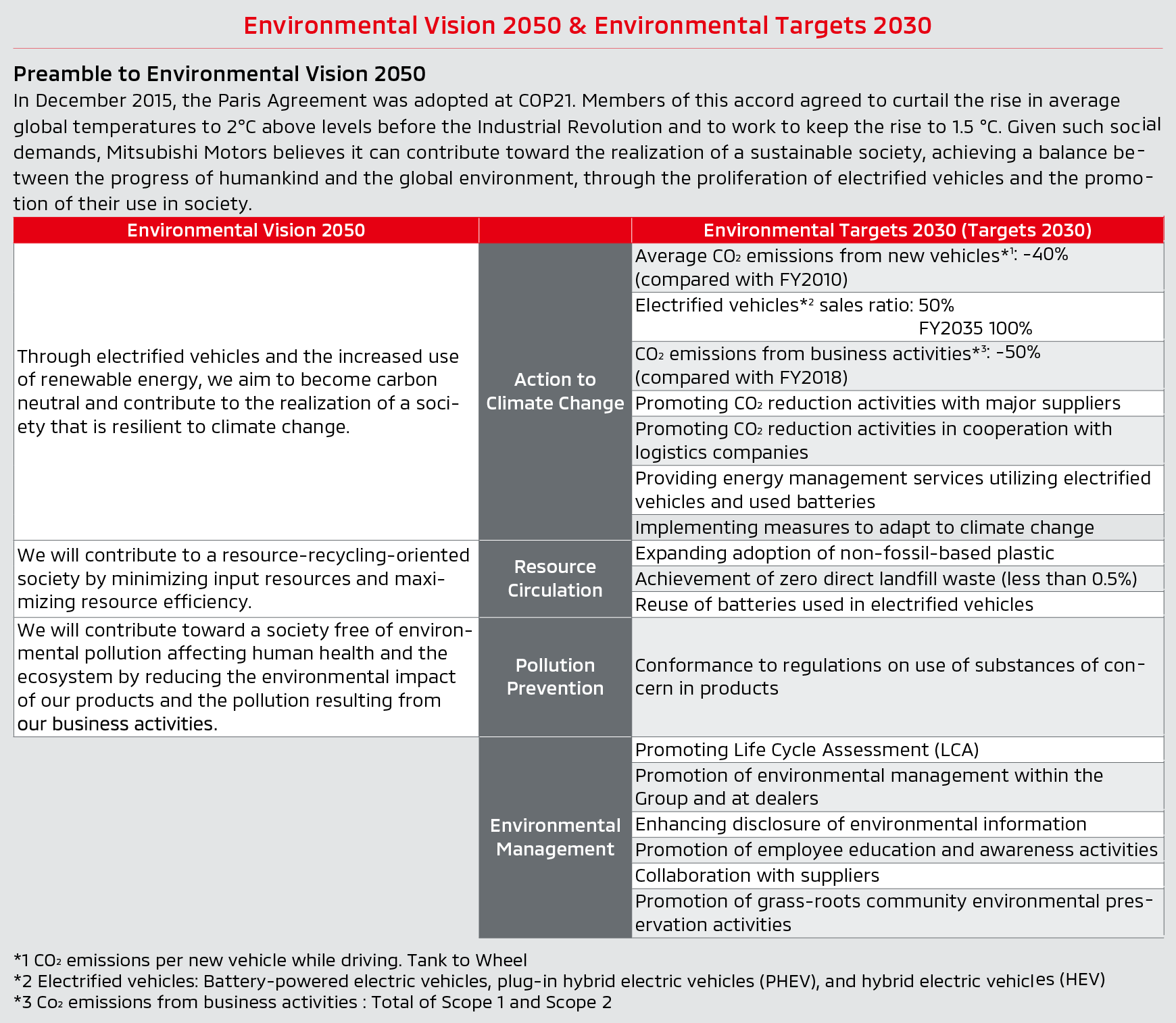
Principal Results for FY2025
-
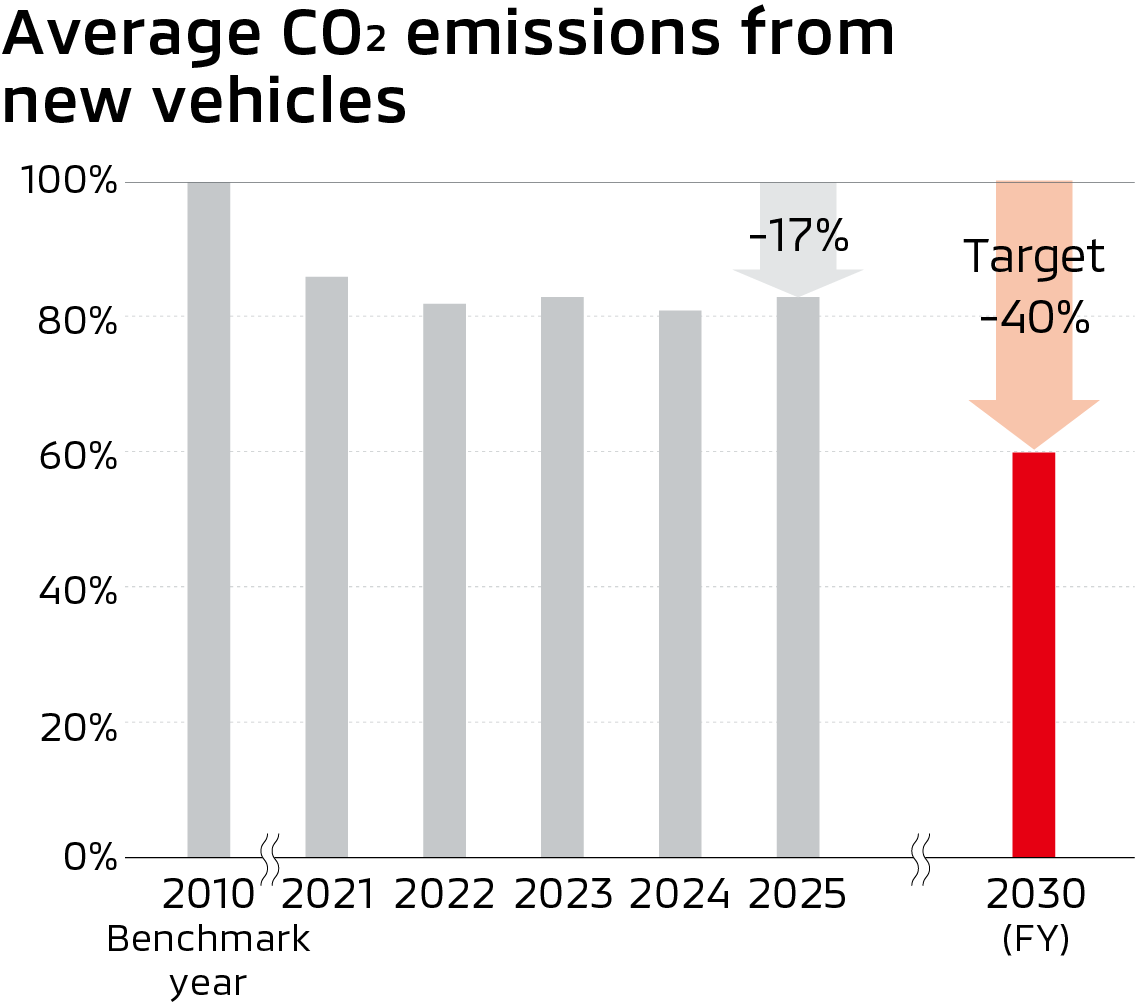
-
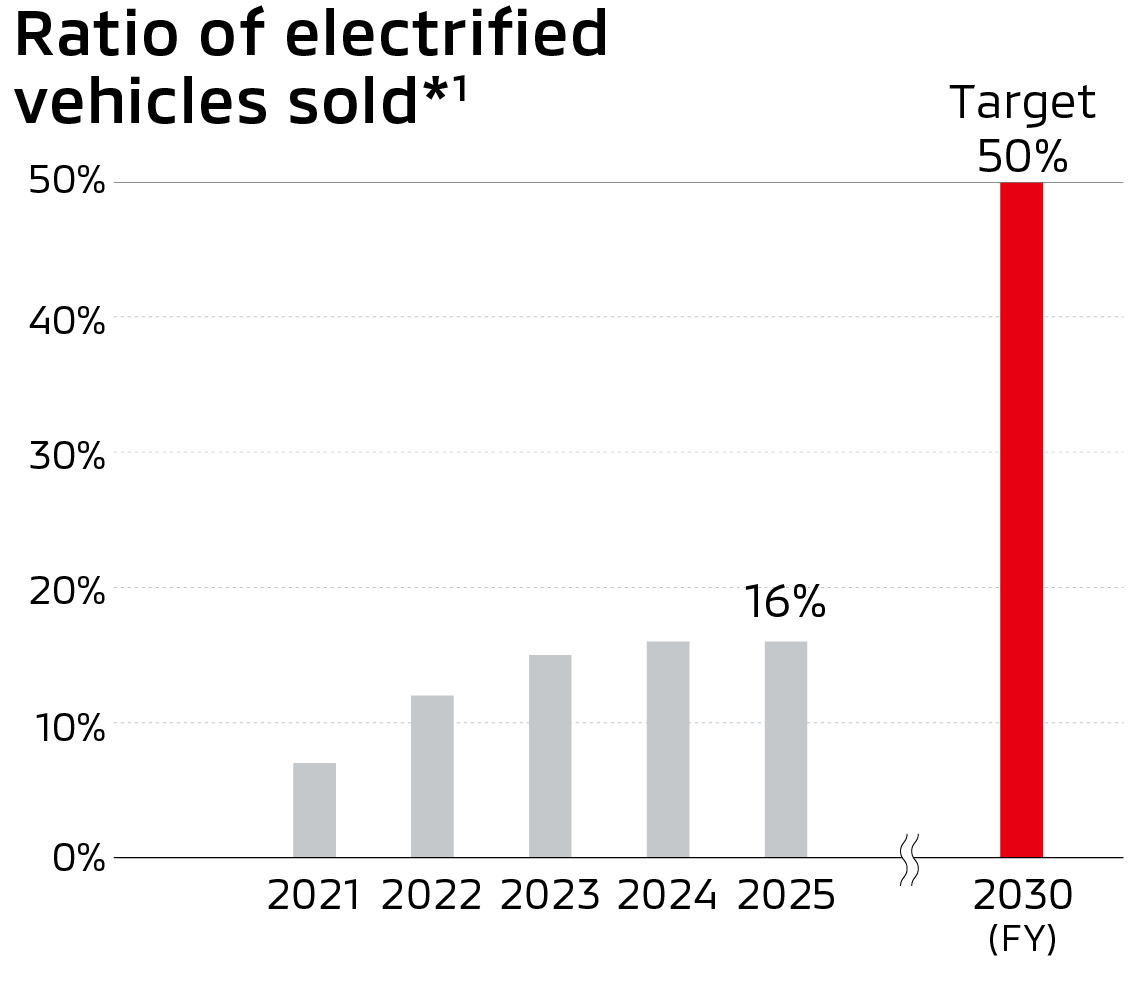
- Based on number of wholesale units sold.
-
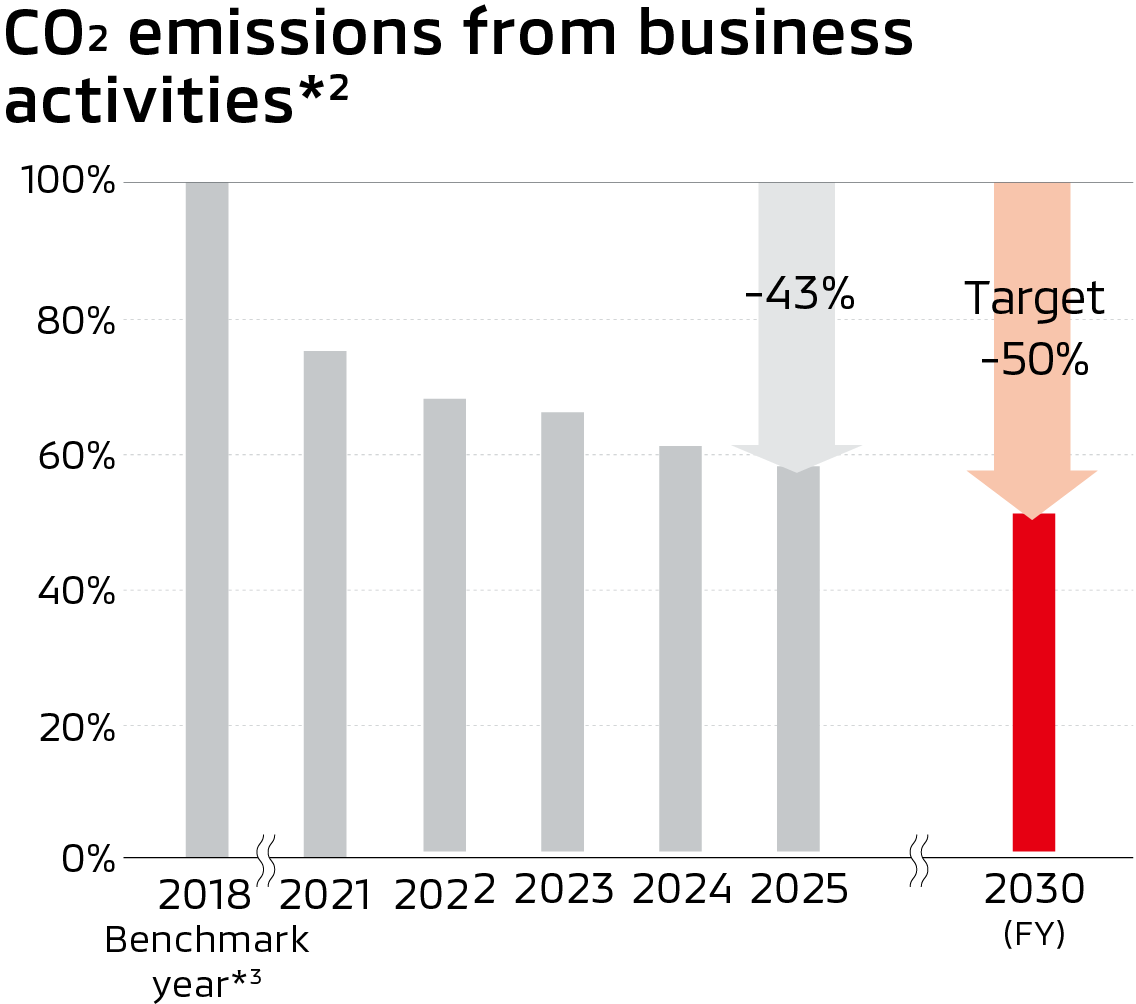
- Scope 1 and Scope 2
- The officially reported emission volume of FY2018 (the benchmark year), was 588 thousand t-CO2. This volume includes 43 thousand t-CO2 emissions from some equity-method associates.
For the purposes of target setting, we have revised our base figure to 545 thousand t-CO2, as our current method of selecting environmental management target companies excludes these equity-method associates.
Structure for Consideration in Formulation
To clarify MITSUBISHI MOTORS’ policies and plans in the environmental area and strengthen a series of initiatives, in 2018 we established a cross-company environmental working group to develop an environmental planning package.
After certain directions had been determined, a small circle chaired by the then-CEO moved forward to specifics. These were approved by the Board of Directors.
〈Structure for Consideration from July 2018 to December 2019〉

〈January–October 2020〉

- Positions as of March 2020
Steps to Formulation
The Environmental Working Group we set up in FY2018 gathered data related to global social changes, such as economic growth and population increase, as well as environmental issues. In particular, the group looked for information on regions of importance to our business, ascertaining the status of local communities and government environmental policies. We also looked at unit sales and the number of vehicles owned in each country, arranging this data to match our business characteristics by looking at our business data and results of environmental initiatives. The group also summarized our efforts to date.
Using this data, we then verified each of the environmental issues and our relationship to them. We identified three environmental issues to face head-on: action to climate change, resource circulation and pollution prevention. We considered the long-term outlook for these environmental issues by studying external scenarios from the IEA and IPCC, as well as by running our own simulations. We then arranged the issues to be addressed by thinking about how to contribute in a manner tailored to local communities while maximizing our strengths, looking at each market from a regional perspective and considering plug-in hybrid electric vehicles (PHEV) and other business characteristics.
Based on this analysis, we clearly spelled out the directions for initiatives indicated in the Environmental Policy and Environmental Vision 2050 and set numerical targets for the items in the Environmental Targets 2030. In this way, we formulated the New Environmental Plan Package, which provides an overall summary of our environmental strategies.
In the final process of formulation, we incorporate the perspectives of our stakeholders by conducting reviews by external experts.
Going forward, we will continue to accumulate and analyze information on social trends and confirm the appropriateness of our Environmental Plan Package.
| Gathering of Information |
|
|---|---|
| Analysis |
|
| Formulation |
|
| Review |
|