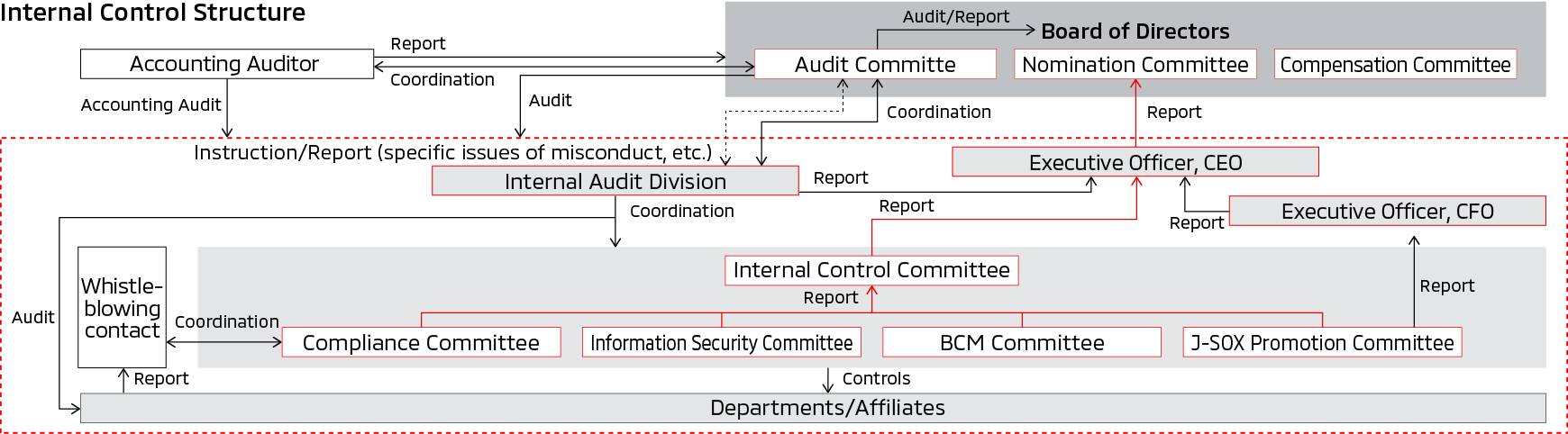
Based on the “Basic Policy on the Establishment of Internal Control Systems”* approved by the Board of Directors, MITSUBISHI MOTORS monitors its operational status and strives to improve and reinforce internal control systems.
We recognize the gravity of our improper conduct in fuel consumption testing, on top of past quality problems. As one of our priority measures aimed at regaining trust, in FY2017 we appointed a Global Risk Control Officer to manage compliance and operational hazard risks and report regularly to the Board of Directors on governance improvement measures (now the Executive Officer in charge of Internal Control). Furthermore, in order to reinforce, and improve the efficiency of, our handling of internal controls based on laws and regulations, we revised the internal control system. In the revised system, the J-SOX Promotion Committee, under the direct control of the Executive Officer, Executive Vice President (CFO), handles internal control related to financial reporting in accordance with the Financial Instruments and Exchange Act and the Internal Control Committee, chaired by Executive Officer, CEO and vice-chaired by Executive Officer in charge of Internal Control, will promote internal control in accordance with the Companies Act. The Internal Control Committee meets regularly twice a year with the participation of all Executive Officers. In accordance with the “Basic Policy on the Establishment of Internal Control Systems,” the Committee reviews and evaluates the status of company-wide risk management and matters reported and resolved by subcommittees responsible for individual areas of internal control, including compliance, information security, business continuity management (BCM), and J-SOX. These activities are also reported regularly to the Board of Directors to check their effectiveness.
To address new risks that have emerged in recent years, such as geopolitical risks, economic security risks, and business and human rights risks, in which multiple risk factors (strategic, financial, and operational hazard risks) are intricately intertwined in relation to a single event, the Internal Control Promotion Division, under the Executive Officer in charge of Internal Control, takes the lead in identifying and preventing potential risks, responding promptly when risks materialize, and enhancing the visibility of significant risks.
We will continue the “Internal Control KAIZEN Activities” launched in FY2024, through which each division identifies issues in its business processes and implements improvements, while working to firmly establish these activities.
In accordance with revisions to ministerial ordinances, including the Vehicle Type Designation Regulations, which took effect in April 2026, we have begun initiatives to strengthen and ensure the thorough implementation of internal controls related to certification operations. These include explicitly stating compliance with laws and regulations in our management policy, clarifying responsibility for certification operations, and evaluating and reporting on the implementation status of internal controls. We have designated personnel responsible for implementing these measures within the Company and established a framework for evaluating their implementation.
We have been working to establish a global internal control structure by gradually establishing and operating internal control committees from FY2018 at main affiliates in Japan and overseas. In addition, we have established a system in which a designated department is responsible for the overall management of each affiliated company, and related internal departments support such responsible department according to their roles, providing various support, checks and balances, and supervision to strengthen and further develop the management of affiliated companies. Additionally, internal rules have been established to ensure that important information at subsidiaries is reported to MITSUBISHI MOTORS in a timely and appropriate manner, and subsidiaries operate in accordance with these rules. To ensure the reliability of financial reporting, a specialized organization has been set up and is operated under the J-SOX Promotion Committee described above. This organization follows up on and compiles information related to the development of systems at MITSUBISHI MOTORS and its affiliates, the determination of evaluation scope, and the evaluation and improvement status of companies subject to assessment.
We have also positioned the Internal Audit Division as an organization independent of other business execution departments. The Internal Audit Division coordinates with other committees, including the Internal Control Committee, with the aim of achieving effective and efficient internal control system operation.
Going forward, we will continue with initiatives to further reinforce governance by ensuring compliance with laws and regulations and promoting proper and efficient business execution in line with changes in the internal and external environments.