Governance
Basic Approach
We understand that our Group’s activities affect many others,
given that we and our major overseas production facilities
have direct business relationships with approximately 800
companies, including suppliers of materials and parts, as well
as companies that provide services, advertising, and logistics,
and even more Tier 2 and other suppliers. We also recognize
that through collaboration throughout the supply chain and
local procurement, we can achieve carbon neutrality, improve
quality, and contribute to local community development.
Based on this understanding, we believe that for all
processes, from the procurement of raw materials to the
manufacture and delivery of parts and products, it is important
not only to comply with laws and regulations but also to
act responsibly, taking into account such factors as the
environment and human rights.
We have formulated “Supplier CSR Guidelines” and “Green
Procurement Guidelines” and work together with all our
business partners to achieve sustainable growth throughout the
supply chain. As compliance with both guidelines is a priority in
our Group’s procurement activities, our procurement division
executives take advantage of opportunities such as supplier
briefings to request that the entire supply chain thoroughly
comply with the guidelines
Supplier CSR Guidelines
The “Supplier CSR Guidelines,” which are based on our Human
Rights Policy, include provisions on respect for human rights,
including the elimination of discrimination and the prohibition
of child labor and forced labor. They require that suppliers
take human rights into consideration, that they undergo CSR
assessments by third-party organizations, and that they clearly
indicate measures taken in response to compliance violations. We
promote collaborative activities with all of our suppliers from the
same point of view. The scope of these activities includes labor
practices, environment management, and compliance.
In addition, to comply with domestic and international laws
and requirements related to environmental and human rights
risks throughout our value chain, we are considering revisions to
our guidelines with input from outside experts.
Green Procurement Guidelines
Our suppliers cooperate with us in various initiatives, such as those indicated below, including meeting the requirements of our “Green Procurement Guidelines.” In addition to Japan, we have introduced the guidelines in overseas production bases, adjusting the guidelines to account for actual conditions in each country and operational details at each location. These production bases are also applying the guidelines to their business partners.
Main Requirements of the “Green Procurement Guidelines”
- Acquire and renew external certifications of environment management systems
- Manage hazardous substances
- Promote the 3Rs (reduce, reuse, and recycle)
- Submit LCA*1 data to allow us to understand the lifecycle environmental impact
- Reduce environmental impact in business activities
- Reduce their environmental impact related to logistics
- LCA stands for Life Cycle Assessment, which is a technique for calculating and evaluating the environmental impact of a product from manufacturing to disposal.
Management Structure
For all material issues, including achieving a sustainable
supply chain, the Group confirms the risks and opportunities
identified from a long-term perspective by those responsible
for each materiality initiative. Our Sustainability Committee
deliberates and decides on initiative targets based on the
external environment and stakeholder needs and expectations
from a medium-term perspective, and uses the PDCA cycle by
checking progress.
We have a structure in which important matters such as reviewing material issues and the overall status of sustainability activities are deliberated and reported at Board of Directors meetings
Strategy
Risks, Opportunities and Impacts
| Risks |
|
|---|---|
| Opportunities |
|
| Impacts |
|
- Business continuity plan
Responsible Resource Procurement
“Conflict minerals” (tin, tantalum, tungsten, and gold) and
cobalt have become a source of funding for armed groups,
resulting in serious violations of human rights.
To ensure that we are not complicit in human rights abuses
through the procurement of these conflict minerals, the Group
promotes responsible procurement by clearly specifying in our
“Supplier CSR Guidelines” the prohibition of child labor, forced
labor, and the nonuse of conflict minerals as raw materials. To
achieve sustainable mineral sourcing, we are considering the
formulation of new policies, including environmental and human
rights due diligence, with input from outside experts. We ensure
the transparency of our raw material procurement along with
our suppliers and live up to our social responsibilities.
Risk Management
Business Continuity Plans in the Supply Chain
A large-scale natural disaster, major outbreak of infectious
disease, or production shortage of specific parts or materials
(such as semiconductors), could interrupt the flow of parts
from our suppliers. We might then run the risk of business
being suspended. To avoid or mitigate such risks, as part of our
business continuity plans (BCPs) in the supply chain, we are
taking measures to identify risks and impacts early on and to
find alternative suppliers and substitute components.
Specifically, we have established a Supply Chain Risk
Management System and ask suppliers to register Tier 2 to Tier
N suppliers, including their factories and overseas suppliers, so
that target suppliers can be rapidly narrowed down. In addition,
we have a system in place that allows us and our business
partners to share information about the status of damage
caused by disasters, the impact of production shortages for
specific parts and materials, and our response to production
plans so that we can take countermeasures.
Confirmation Based on Suppliers’ Commitments to Guidelines
The Company conducts transactions in an appropriate manner,
which includes not violating human rights. We determine
transaction prices and delivery dates following thorough
consultation with individual suppliers.
To ensure that suppliers thoroughly comply with our
“Supplier CSR Guidelines” and “Green Procurement Guidelines,”
we have them submit “Supplier Commitments” and “Declarations
of Conformity to Regulations on Substances of Concern.” We
ensure the effectiveness of our business partnerships by
having new business partners submit these documents before
commencing transactions, and by continuously confirming the
status of the agreement afterwards.
We have expanded these efforts to include our major
overseas bases-Mitsubishi Motors (Thailand) Co., Ltd. (MMTh),
PT Mitsubishi Motors Krama Yudha Indonesia (MMKI), Mitsubishi
Motors Philippines Corp. (MMPC)-and received Supplier
Commitment agreements from suppliers at our major overseas
production bases.
Establishing a Business Partner Helpline
As part of MITSUBISHI MOTORS’ efforts to adhere to the METI guidelines, we have established a Business Partner Helpline for the suppliers of our procurement division. The helpline receives opinions and comments from business partners, quickly identifies compliance issues or concerns, such as legal or regulatory infractions, unfair practices or human rights violations in our procurement activities, and promptly rectifies them, striving to achieve even fairer business transactions.
Metrics and Targets
| Long-Term Targets (2030) |
Promoting CO2 emission reduction activities through collaborations with suppliers/transporters in the fields of procurement and logistics |
|---|---|
| Medium-Term Targets |
|
FY2024 Initiatives
Communicating with Suppliers
Providing suppliers with appropriate information and two-way
communication is essential for supply chain management.
At the end of every fiscal year, we hold a Suppliers Meeting
to explain our procurement policies for the next fiscal year,
attended by approximately 300 companies. Small-scale
meetings between the management teams of suppliers and
our management team are held every year to help foster closer
communication at the management level. These meetings, each
of which involves approximately 20 companies, are conducted
by the MITSUBISHI MOTORS Council, a voluntary organization
of around 180 supplier companies. A total of nine small-scale
meetings were held in FY2024.
Enhancing CSR in the Supply Chain through Third-Party Evaluations
The Company conducts third-party CSR evaluations in the four
areas of the environment, labor and human rights, ethics, and
sustainable procurement, with the aim of raising the level of
CSR activities at our suppliers.
In FY2024, many business partners underwent third-party
evaluations. MITSUBISHI MOTORS plans to continue expanding
the number of business partners who undergo evaluations in
FY2025, and we will focus on improving the scores of those
partners who have already been evaluated (approximately 90%
of all orders based on order value).
Support for Quality Improvements by Suppliers
The Group regularly conducts quality audits and assists with
quality self-checks by suppliers to improve quality along the
entire supply chain.
In FY2024, we conducted process audits for 92 suppliers at
104 plants, and indicated items were generally improved within
three months. Process audits are conducted every one to three
years, with the audit cycle set according to the results of the
previous audit. Quality self-checks are performed by 310 business
partners. Each company is working to improve the weak points
found in the self-check. In addition, we are actively working to
improve communication with suppliers and enhance quality by,
for example, promoting improvements by disseminating the
results of our self-check trend analysis to all suppliers.
We issue monthly Supplier Score Cards, which numerically
represent suppliers’ quality results. This approach has
clarified issues for each company, assisting in the fast and
accurate implementation of improvement measures. In
cases of particularly serious defects, we analyze the causes
and examine the appropriateness of countermeasures in
collaboration with business partners to prevent recurrence.
MITSUBISHI MOTORS cooperates on defect prevention activities
to keep defective parts from being delivered and ensure we
are able to provide customers new models with confidence.
Promotion of Localization
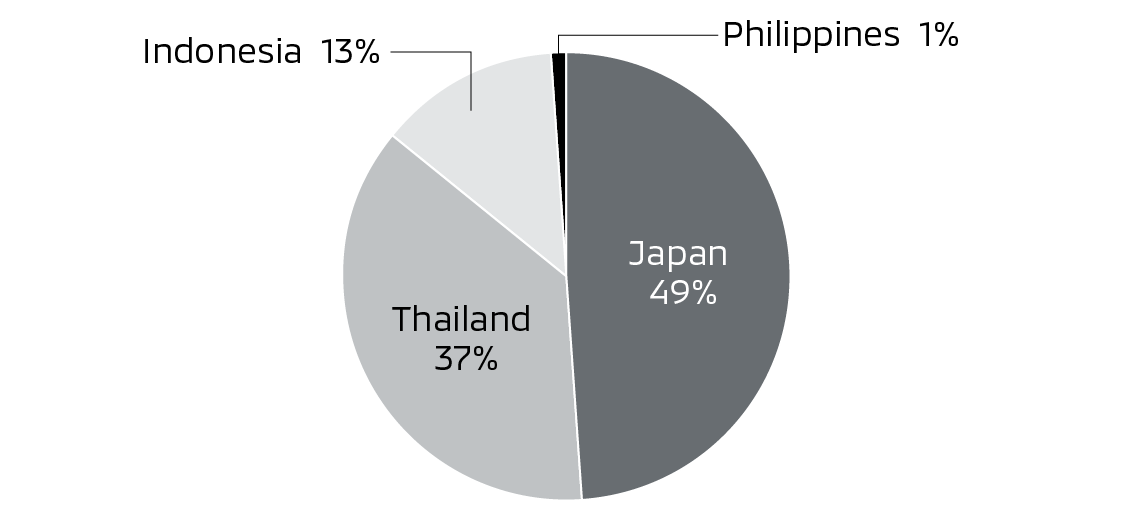
Country-Specific Parts Procurement Ratios by Production Base (FY2024)
To optimize costs at our overseas production bases, our basic
policy is to source from local suppliers where possible, as long as
such procurement is effective and the necessary technologies
are in place. For parts which are already locally procured, we also
promote the local procurement of the components used within
these parts, etc., to optimize costs further.
We conduct advanced audits of the systems and structures
of new business partners, evaluating items such as their
development capabilities, production capabilities, and quality
management capabilities, and issuing improvement instructions if
necessary. We also provide support to local business partners by
serving as a go-between with Japanese business partners, joint
ventures with local business partners, technical partnerships, and
the like. We work to contribute to local regions by creating local
jobs and improving local technical capabilities.
Employee Education and Training (Non-consolidated)
| Scope | Overview |
|---|---|
| All employees |
|
| Procurement divisions (Entry-level employees, mid-career hires, personnel transferred from other divisions) |
|
Participating in Outside Initiatives
- Japan Automobile Manufacturers Association, Inc.
- Partnership-building Declaration