
Message from Management
Strengthen Human Rights Initiatives
Takao Kato
Executive Officer & CEO
MITSUBISHI MOTORS CORPORATION
It is essential to address respect for human rights in order to expand our business globally and achieve sustainable growth, as well as to fulfill our corporate social responsibility.
We support and respect international norms and standards such as the “International Bill of Human Rights” and the “UN Guiding Principles on Business and Human Rights.” In addition, we have established our “Human Rights Policy,” which clearly states our commitment to prohibiting discrimination and eliminating unfair labor practices.
Through our human rights due diligence mechanism, we have conducted human rights assessments at our company and group companies. Moreover, the supply chain, since initiatives to respect human rights are a critical issue, we require suppliers to agree to our Supplier CSR Guidelines and endeavor to understand the situation through CSR assessments of our suppliers by third-party evaluation organizations.
In order to further strengthen our efforts to respect human rights, we established a new Human Rights Committee within the company in November 2024.
The automotive industry has a wide and complex range of suppliers. We will work to strengthen the prevention of human rights violations throughout the entire supply chain in order to ensure the elimination of all human rights risks, including human rights violations in the procurement of raw materials and parts production outside of our direct suppliers.
Governance
Basic Approach
Sustainable Corporate Activities Based on International Standards
Our Group believes that respect for human rights is fundamental to all business activities. Based on this belief, we support and respect international norms and standards such as “the International Bill of Human Rights”, “the UN Guiding Principles on Business and Human Rights”, “the ILO Declaration on Fundamental Principles and Rights at Work”, and “the OECD Guidelines for Multinational Enterprises”.
Formulation and Publication of Policies and Codes of Conduct
We established our “Human Rights Policy” after consultation with experts and approval by the Executive Committee, with the aim of conducting our business activities in a manner that respects the human rights of our stakeholders.
This policy outlines fundamental matters such as support and respect for international standards and norms regarding human rights, and matters for compliance. The policy also stipulates specific measures to prevent and reduce negative impacts on human rights, to provide remedial measures, and to provide education for officers and employees. This policy has been translated into English and made available on our website to all our stakeholders in Japan and overseas.
In article 8 of the MITSUBISHI MOTORS Group Global Code of Conduct, “Respect Human Rights and Diversity, Provide Equal Opportunity,” stipulates that discrimination, retaliation and harassment are not permitted in any form or to any extent, and that the diversity of suppliers, customers, executives, employees and local communities shall be respected in addition to respecting human rights.
In addition, taking into account domestic and international laws and requirements related to environmental and human rights risks, we are reviewing revisions to existing standards such as the “Human Rights Policy” and “Supplier CSR Guidelines,” and considering the establishment of due diligence policies related to the environment and human rights, with input from outside experts.
Human Rights Policy
The purpose of this human rights policy is to ensure that Mitsubishi Motors conducts business activities with respect for the human rights of our stakeholders.
- Mitsubishi Motors recognizes that the efforts to respect human rights are essential factors in the fulfillment of our social responsibilities. All of the executives and employees within Mitsubishi Motors comply with this human rights policy.
- Mitsubishi Motors respects basic human rights in our business activities on the basis of the Corporate Mission and the MITSUBISHI MOTORS Global Code of Conduct.
-
Mitsubishi Motors supports and respects the following international norms and standards.
- The International Bill of Human Rights and relevant treaties on human rights
- The ILO Declaration on Fundamental Principles and Rights at Work and relevant standards
- The UN Guiding Principles for Business and Human Rights
- The UN Global Compact
- Mitsubishi Motors promotes efforts to respect human rights through its relationship with stakeholders.
- Mitsubishi Motors complies with national laws and regulations in each market where we operate. Where we face conflicts between internationally recognized human rights and national laws, we will seek ways to honor the principles of international human rights.
Compliance items
- Prohibition of Discrimination
Mitsubishi Motors respects diversity and strives for equal opportunities. We do not tolerate unfair discrimination or harassment on bases such as race, color of skin, nationality, ethnicity, family origin, sex, sexual orientation, gender identity, age, disability, language, or religion.
- Elimination of Unjustifiable Labor Practices
Mitsubishi Motors does not accept any unjustifiable labor practices such as slavery labor, child labor, or forced labor, including human trafficking, and we strive to eliminate such labor practices.
- Freedom of Association, Labor and Management Dialogue
Mitsubishi Motors respects the right of an employee to associate. We also engage in sincere dialogue and consultations with our employees or representatives of employees.
- Ensuring Access to “Decent Work”
Mitsubishi Motors strives to ensure access to “Decent Work”, such as the provision of education for executives and employees, a living wage, safe and healthy workplace, and appropriate working hours.
- Community Involvement
Mitsubishi Motors understands the impact of our business activities on the people of the community and promotes multicultural coexistence.
Initiatives
<Human Rights Due Diligence>
Mitsubishi Motors will identify, prevent, or mitigate negative impacts on human rights which may be caused by our business activities through the application and support of human rights due diligence processes.
<Remediation>
Where Mitsubishi Motors identifies that it has caused or contributed to a negative impact on human rights, we will provide for or cooperate in legitimate internal and external processes to provide remediation.
<Ensuring Transparency and Accountability>
Mitsubishi Motors will provide appropriate education or training to all the executives and employees so that this policy is embedded in our business activities. We will ensure that our group companies comply with this policy. We will also request that our suppliers comply with the "Supplier CSR Guidelines" based on this policy. In order to ensure transparency and accountability, we will disclose our initiatives on respect for human rights through our website.
Complying with the Human Rights Policy
Coinciding with Human Rights Day on December 10, to raise awareness, each year MITSUBISHI MOTORS’ Executive Officer, President &CEO disseminates a message to all officers and employees regarding respect for human rights, emphasizing the importance of sincere words and actions, as well as enhancing awareness of our human rights policy and explaining the importance of our human rights initiatives. Our policies and activities for promoting and realizing respect for human rights are described below.
- Prohibiting Discrimination
We require executives and employees to respect diversity and to create equal opportunities with no allowance for unfair discrimination or harassment on bases such as race, skin color, nationality, ethnicity, family origin, sex, sexual orientation, gender identity, age, presence of disability, language or religion. Also, we emphasize the importance of diversity in our training programs, and we encourage our employees to work together with respect for diverse values.
- Eliminating Unjustifiable Labor Practices
We do not tolerate any unjustifiable labor practices such as slavery labor, child labor, forced labor, including human trafficking, and strives to eliminate such practices.
To ensure against such practices, we verify potential employees’ ages to ensure statutory requirements are met when entering into labor agreements. We do not charge applicants and hired employees any fees andcosts related to recruitment. Pay slips clearly state any legal deductions; we do not make unfair deductions, but regularly pay employees their full dues. We do not retain employees’ passports or other identifications or prevent them from movement. Employees are free to choose whether to enter or leave the dormitories. - Freedom of Association and Labor–Management Dialogue
We respect its employees’ right to associate, and we engage in sincere dialogue with employees to resolve various types of issues. Regarding collective agreements with labor unions, we recognize employees’ freedom to engage in legitimate union activity, including collective bargaining. We clearly state that employees who engage in such activities will not be subject to disadvantageous working conditions or other sanctions.
- Ensuring Access to Decent (Rewarding and Humane) Work
To ensure decent work, in addition to complying with individual countries’ laws and regulations, we conduct activities focused on respect for human rights, based on international norms (such as the International Bill of Human Rights and the ILO’s Declaration on Fundamental Principles and Rights at Work). We have designed our personnel system to ensure that employees are compensated at a level that allows for a stable livelihood, while also providing higher rewards for employees who perform well. This system aims to improve employee motivation and enhance their abilities.
When work beyond the prescribed working hours is required, we comply with the labor laws and regulations of each country and region, and implement overtime work based on labor–management agreements and work rules, with explanation to and consent from employees. In addition, when overtime work is carried out, we pay the legally mandated overtime premiums and ensure operations are conducted with consideration for employees’ health and work–life balance. - Community Involvement
In our efforts to maintain harmony with the local community, we contribute to society by utilizing each and every employee’s skills and know-how as well as our technologies and products.
- Consideration for Human Rights in Work and Investment
As we believe that positive relationships based on mutual understanding between employees and everyone in the community are essential to the sustainability of our business, when establishing business sites or related facilities, we give consideration to the cultural values of the country and region including customs and religions.
- Supply Chain Considerations
We conduct appropriate transactions, which includes not causing human rights violations against its business partners. We determine transaction prices and delivery dates following thorough consultation with individual suppliers.
In addition, we promote two-way communication with our business partners through management based on the Supplier CSR Guidelines
The guidelines include provisions on respect for human rights, including the elimination of discrimination and the prohibition of child labor and forced labor, and we request that suppliers take human rights into consideration. To enhance the guidelines’ effectiveness, we obtain Supplier Commitment agreements from our business partners.
In addition, based on their CSR evaluations by third-party organizations, we evaluate business partners on “labor and human rights,” and we ask them to make improvements as necessary. Furthermore, we will use AI analytical tools to analyze human rights risks in our supply chain, and if any such risks are identified, we will take measures to improve them and publish them on our website. - Initiatives at Dealers
At dealers, we carry out initiatives to provide a work environment with consideration for the health and safety of employees and we prohibit acts that infringe on human rights.
Initiatives for Formulating and Publishing Policies and Codes of Conduct
Based on domestic and international laws and requirements concerning environmental and human rights risks, we have commenced discussions—including external experts—on revising existing codes such as our Human Rights Policy and establishing a code of conduct for environmental and human rights due diligence.
Establishing Internal Framework
Our Group, led by top management and centered on the Sustainability Department, Human Resources Department, Procurement Department, and Administrative Department, is engaged in activities to respect human rights, also drawing on advice from external experts. Furthermore, we have positioned risks related to business and human rights as one of the priority risks with significant potential impact and high urgency. These risks are integrated into the company-wide risks managed by the Internal Control Committee and are appropriately managed.
Internal policy and International standards that Mitsubishi Motors supports and respects
Management Structure
In November 2024, the Company established the Human Rights Committee chaired by the Representative Executive Officer,President & CEO. The Committee is held approximately three times a year to discuss major human rights-related matters,and important matters are reported to and deliberated by the Board of Directors. Matters reported to and deliberated by the Board of Directors are shared by the Human Rights Committee members with relevant divisions and are used to improve efforts to respect human rights both internally and externally.
Shared Philosophy
<Employee Education and Training>
At our company, the executive officer in charge of human resources leads efforts, with regional HR departments working to enhance employees' awareness of human rights. To ensure all executives and employees respect human rights, we incorporate programs deepening understanding of human rights respect into various training initiatives, including tiered training and new employee orientation.
Employee Education and Training
In FY2024, we conducted a total of 730 hours of human rights training for 760 employees, including entry-level employees, mid-career employees and newly promoted managers (department general managers and section managers). Trainings for executives were also conducted. In addition, we launched an e-learning program on “Business and Human Rights.”
Education and Traning Record(FY2024 MITSUBISHI MOTORS)
| Target | Traning content | Number of Participants |
|---|---|---|
| Executives | Sharing of the latest on “Buisiness and Human Rights” by outside lecturers | 49 |
| Newly promoted general managers | Raising awareness of social human rights issues required for workplace management, sharing information on respect for human rights, prevention of harassment, and response in the event of occurrence, etc | 70 |
| Newly promoted managers | Recent topics related to human rights, harassment prevention, responding to incidents when they occur, and the role of manager | 174 |
| Mid-career employees (Newly promoted employees) |
Recent topics regarding human rights. The relation between our business and human rights,etc. | 307 |
| Entry-level employees | The significance of corporate initiatives regarding human rights. Fundamental knowledge regarding human rights, etc. |
208 |
| Those who wish to participate | Promote LGBTQ awareness | 485 |
| All employees | Promote LGBTQ awareness(e-Learning) | 9,259 |
| Business and human rights(e-Learning) | 8,665 | |
| Compliance Officer / Code Leader | Input of information related to business and human rights | 156 |
Communication and Dialogue with Suppliers and Others
As we advance our human rights initiatives, communicating and engaging with stakeholders in various ways is considered essential. We recognize that carefully and clearly explaining the significance of these efforts helps foster shared understanding and cooperation. Furthermore, dialogue provides an opportunity to reflect on our own initiatives and drive improvement.
FY2024 Engagement with Suppliers on Human Rights and Procurement Standards
Currently, MITSUBISHI MOTORS is engaging with key suppliers to promote understanding of our fundamental procurement principles, including our commitment to respect human rights, and to raise awareness of particularly relevant laws as well as regulations. Going forward, we plan to explain and engage in dialogue with a broader range of suppliers concerning matters requiring compliance and cooperation based on international standards on business and human rights.
(Details of Explanations and dialogues conducted to date to comply with particularly noteworthy laws and regulations described under each relevant section.)
<Communication through Various Media>
MITSUBISHI MOTORS articulates its fundamental principles on human rights through its Human Rights Policy and the international standards it supports and respects. These commitments are disclosed and communicated by publishing them in the Sustainability Report and on this website.
In addition, progress and challenges related to human rights initiatives are shared company-wide through reports to the Sustainability Committee and Human Rights Committee, chaired by the CEO.
Key deliberations and reports from this committee, along with specific human rights initiatives, are also disclosed externally through publication in our Sustainability Report and on this website to ensure transparency and accountability.
Sharing and communicating information on our principles and concrete actions, both internally and externally, we clarify our position and key human rights challenges.
<Continuing Human Rights Due Diligence Efforts>
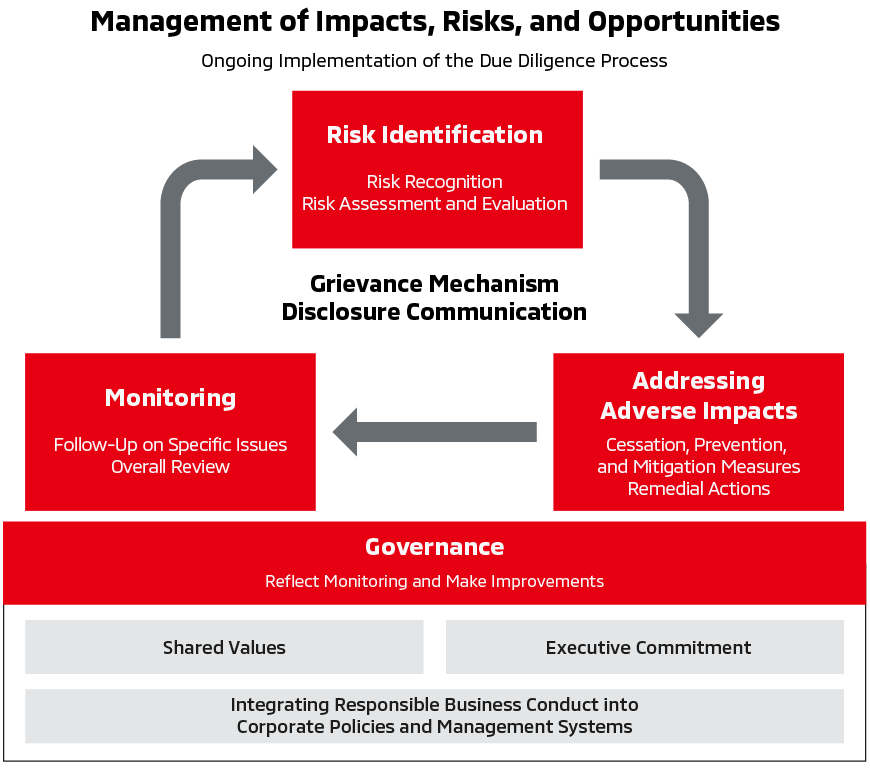
MITSUBISHI MOTORS is committed to identifying potential adverse human rights impacts associated with its business activities through a human rights due diligence framework and to preventing or mitigating such impacts.These efforts are based on the OECD Due Diligence Guidance for Responsible Business Conduct (hereinafter referred to as the OECD Guidance) issued by the Organization for Economic Co-operation and Development (OECD). By continuously implementing these measures, MITSUBISHI MOTORS strives to build a more sustainable supply chain by addressing the social and environmental risks associated with our business activities.
<Human Rights Impacts and Opportunity Management>
Identification and Assessment of Salient Human Rights Risks Across the Value Chain MITSUBISHI MOTORS works with external experts to identify and assess salient human rights risks across its value chain and consider prevention and mitigation measures. For identifying and assessing human rights risks, we created a risk map using guidelines published by the Global Compact Network Japan, evaluating and prioritizing each risk category by its severity and likelihood of occurrence.
(For further details, see: Human Rights Risk Assessment [Human Rights])
- Forced Labor: Risks of Labor being compelled to work by threat of punishment and of violating the right to work freely.
- Conflict Minerals (Tantalum, Tin, Tungsten, Gold) and Cobalt, Mica (Responsible Mineral Sourcing): Risks of child labor or forced labor associated with conflict minerals and responsible mineral sourcing.
- Occupational Health and Workplace Safety: Risk of injury and illness due to poor working conditions or hazardous tasks.
- Consumer Safety and Right to Know: Risk of providing products or services that harm consumers' physical or mental health, or involve misleading labeling.
- Right to Access Remedy: Risk of failing to ensure access to appropriate processes for obtaining effective remedy.
- Harassment: Risk of a deteriorating work environment due to power harassment or sexual harassment.
- Environmental and Climate Change Human Rights Issues: Risk of environmental destruction or infringement of local residents' rights due to business activities.
- Child Labor: Risk of labor by children below the legally mandated minimum working age.
- Rights of Indigenous Peoples and Local Communities: Risk of human rights violations against indigenous peoples and local communities due to business activities.
<Reporting High-Priority Human Rights Risks [Human Rights]>
In FY2024, MITSUBISHI MOTORS identified high-priority human rights risks based on a risk map incorporating opinions and verification from third-party experts and reported these risks to the Human Rights Committee. These risks were designated as key issues requiring our company's future attention. We will continue to regularly review and update our risk assessments to ensure timely and effective responses to emerging human rights concerns.
<Human Rights Risk Assessment [Human Rights]>
Based on the results of our human rights risk evaluation, MITSUBISHI MOTORS is currently prioritizing identified risks and considering appropriate corrective and preventive measures for each. This assessment is conducted in collaboration with external experts to ensure objectivity and alignment with international standards.
(For further details: Human Rights Impacts and Opportunity Management, Remediation Measures)
FY2024 Human Rights Risk Assessment Initiatives
Assessment at Major ASEAN Production Site [Human Rights]
In FY2024, MITSUBISHI MOTORS conducted a human rights assessment at Mitsubishi Motors Philippines Corporation (MMPC), a key production base in ASEAN. Ensuring meaningful participation and accurate impact evaluation, the assessment involved one-on-one interviews between the assessment agency and employees of diverse attributes. An independent external assessment agency carried out the assessment and ensured the objectivity of the assessment and its alignment with international standards.
(For details on Prevention, mitigation, and remedial actions are described in Related Matters: Prevention, Mitigation, and Remedial Actions [Human Rights])
Examples of assessment items: wage practices (pay records, overtime, unlawful deductions), child labor (employment under age 15), forced labor (freedom of movement and resignation), discrimination (harassment), health and safety (training, education, emergency preparedness), and access to remedy (consultation channels). These were evaluated in consultation with the external assessment agency, referencing ILO standards and industry initiatives.
Introduction of AI based Analytics tools [Supply Chain]
Starting in FY2024, MITSUBISHI MOTORS began leveraging AI-based tools to analyze and investigate potential connections with suppliers related to conflict minerals and other issues as well as to identify supply chain segments at risk of violating national human rights laws as part of its human rights due diligence across the supply chain.
By employing AI, we are able to conduct more comprehensive data-driven analyses and investigation of our global supply chain, enhancing the accuracy.
Given the complexity and global scale of our supply chain, encompassing a wide range of raw materials and regions, the scope of investigation is vast. Therefore, we prioritize investigations based on factors such as human rights risk level, export destination, vehicle model, part type, and the raw materials involved. These investigations are conducted in collaboration with suppliers.
In FY2024, we conducted AI analysis targeting transactions with approximately 800 our major suppliers. Based on the results, we requested written survey cooperation from 155 companies. Where responses indicated potential concerns, after reviewing the responses from suppliers, we determined that additional investigation was necessary for a certain number of suppliers. We conducted direct interviews and initiated ongoing monitoring for those requiring further investigation.We will continue conducting ongoing monitoring and expanding our human rights due diligence practices. This aims to strengthen our commitment to respecting human rights and reduce risks associated with human rights issues.
Addressing Adverse Human rights impact
Preventive, Mitigative, and Remedial Actions
<Supplier CSR Guidelines [Supply Chain]>
MITSUBISHI MOTORS has established the “Supplier CSR Guidelines” to address risks such as forced labor, conflict minerals, including cobalt and mica, and to achieve sustainable growth throughout the entire supply chain. We share these guidelines with all business partners and collaborate to advance CSR.
Compliance with these guidelines is a top priority in our procurement activities. Therefore, our executives request thorough adherence to these guidelines across the entire supply chain at venues such as supplier briefings.
These guidelines reflect our Human Rights Policy and include key principles such as the elimination of discrimination, child labor, and forced labor. We request our suppliers to commit to these principles and submit “Supplier Agreement Confirmation Form.” For new suppliers, business transactions begin upon submission of these documents. MITSUBISHI MOTORS continuously monitors and verifies compliance to ensure the effectiveness of these agreements.
These practices are consistently implemented at our major overseas production sites, including Mitsubishi Motors (Thailand) Co., Ltd. (MMTh), Mitsubishi Motors Krama Yudha Indonesia (MMKI), and Mitsubishi Motors Philippines Corporation (MMPC).
Effective supply chain management requires clear communication and mutual understanding. Each year at the end of the fiscal year, we host procurement policy briefings for the upcoming fiscal year, attended by approximately 300 suppliers. Additionally, we hold small-group meetings (about 20 companies per session, 9 times in total) between our executives and members of the Mitsubishi Motors Suppliers Association, a voluntary organization of around 180 companies. These meetings foster close dialogue at the executive level.
Through the management framework based on the Supplier CSR Guidelines, we promote two-way communication with suppliers. The guidelines, grounded in our Human Rights Policy, call for proactive human rights practices and require suppliers to submit a signed agreement, reinforcing the credibility and effectiveness of our approach.
FY2024 Initiatives on Preventive, Mitigative, and Remedial Actions
Human Rights Assessment at a Key ASEAN Site [Human Rights]
As previously noted, MITSUBISHI MOTORS conducted a human rights assessment in FY2024 at a key ASEAN production site, Mitsubishi Motors Philippines Corporation (MMPC). The assessment found no serious violations impacting the rights of employees or business operations. However, to further reduce human rights risks, we have established a process regularly reviewing the situation. This involves summarizing the assessment results, identifying areas for improvement and assigning the responsible departments, monitoring implementation progress and reporting to the Sustainability Committee. Based on these findings, we continuously review and refine our internal systems.
We also plan to share these initiatives across the group to promote knowledge-sharing to prevent similar issues from arising in the future.
Going forward, we will expand the scope of human rights assessments to additional sites. This will include identifying key risks, developing prevention and mitigation strategies, and enhancing the monitoring of these measures and the disclosure of relevant information.
(For details on this assessment, please see “Human Rights Risk Assessment “[Human Rights])
Enhancing CSR in the Supply Chain Through Third-Party Evaluation [Supply Chain]
To strengthen CSR practices among our suppliers, MITSUBISHI MOTORS conducts third-party assessments across four key areas:” Environment,” “Labor and Human Rights,” “Ethics,” and “Sustainable Sourcing”. We continue to expand the number of suppliers undergoing assessment, while focusing on improving the scores of those which have already been evaluated (which together represent approximately 90% of total procurement value).
Strengthening Guidelines, Audits, and On-Site Inspections [Supply Chain]
MITSUBISHI MOTORS is currently reviewing and planning to issue a revised version of the Supplier CSR Guidelines after confirming required items and expanding stipulated provisions.
In addition, we plan to strengthen measures to prevent and remedy human rights risks in the supply chain of raw materials for EV batteries.
Recognizing the importance of audits and on-site inspections for suppliers identified as high-risk, we are exploring appropriate engagement strategies for Tier N suppliers, at the raw material and refinery levels.
Remedial Measures
According to the OECD Due Diligence Guidance, remedial measures refer to substantive outcomes that provide redress for adverse human rights impacts or mitigate and restore such impacts. Going forward, as MITSUBISHI MOTORS commenced full-scale human rights due diligence in FY2024, we are currently developing specific remediation processes. Once implemented, these measures will be disclosed through our Sustainability Report and corporate website, just as we do with other disclosure items.
Review (Follow-Up on Individual Issues/Overall Reflection)
Human rights initiatives require ongoing and iterative efforts. Therefore, the OECD Guidance emphasizes the importance of follow-up on the content and outcomes of actions addressing individual human rights issues, as well as reflecting on the adequacy of the management framework system. These reviews will incorporate stakeholder feedback, changes in domestic and international regulations, and updates to global standards and guidelines.
As part of our due diligence framework launched in FY2024, we are also considering how best to disclose and communicate the outcomes of these reviews. Any future reviews will be published via our Sustainability Report and website.
Disclosure and Communication
MITSUBISHI MOTORS plans to enhance its information disclosure, including the disclosure of prevention and mitigation measures to meet international sustainability standards and due diligence reporting obligations across countries and regions. In addition to annual reporting through our Sustainability Report, we will ensure transparency through timely disclosure on our website as necessary.
Monitoring
When MITSUBISHI MOTORS is found to have caused, contributed to, or is directly linked to adverse human rights impacts through transactional relationships, we take appropriate remedial action through internal and external procedures.
Grievance Mechanisms
When MITSUBISHI MOTORS is found to have caused, contributed to, or is directly linked to adverse human rights impacts through transactional relationships, we take appropriate remedial action through internal and external procedures.
Dialogue and Remedy Platform
JaCER provides the “Dialogue and Remedy Platform,” a non-judicial grievance mechanism aligned with the UN Guiding Principles on Business and Human Rights. The organization supports and promotes member companies' grievance handling from a professional standpoint. All stakeholders along the value chain can submit reports. With JaCER's support, MITSUBISHI MOTORS strives to ensure the legitimacy of complaint handling mechanisms while enhancing the effectiveness and efficiency of grievance resolution.
MITSUBISHI MOTORS Global Hotline/Internal Consultation Desk (Employee Consultation Office)/MMC Hotline
To respond swiftly to human rights concerns, MITSUBISHI MOTORS has established consultation desks both inside and outside the company, as well as a Global Whistleblowing Hotline that supports multiple languages. This system enables employees to report and consult on human rights issues. The Global Internal Reporting Hotline is operated by specialized companies, offering primary reception points in 14 countries and handling reports in 13 languages for employees of MITSUBISHI MOTORS and its major affiliated companies.
Customer Service Center
We have established a Customer Service Center for our customers nationwide. This center serves as a direct point of contact for addressing all customer feedback, inquiries, opinions, and requests regarding vehicle purchases and handling. We also handle opinions and concerns regarding human rights matters.
Business Partner Helpline
We operate the “Business Partner Consultation Desk” as a dedicated consultation desk for business partners to report human rights concerns and other compliance issues. It is part of our efforts to promote fair trade practices in accordance with the “Guidelines for Fair Trade Practices in the Automotive Industry” issued by the Ministry of Economy, Trade and Industry (METI). Through this desk, we receive feedback and reports on matters such as legal violations, misconduct, unfair practices, or human rights violations within our procurement activities. By identifying issues early and taking prompt corrective action, we strive to ensure compliance and strengthen fair trade practices across our supply chain.
All reporting channels guarantee confidentiality and anonymity for users, ensuring that those who report or seek advice will not face any disadvantage or retaliation. When investigation needs to extend beyond our organization to a business partner, we collaborate with partner’s compliance officer to resolve the matter under a prior agreement that prohibits identifying the reporter or any retaliatory actions. Details of responses and remedial measures taken in cases of human rights violations or suspected violations will be disclosed on our website in a timely manner and included in our Sustainability Report.
| Channnel Name | Target | Key Features |
|---|---|---|
| Non-judicial, dialogue-based platform for grievance redress | All stakeholders across the value chain | Managed by JaCER (Japan Center for Engagement and Remedy on Business and Human Rights) |
| Customer Service Center | Customers | Operated by MITSUBISHI MOTORS Customer Contact Center |
| Business Partner Helpline | Suppliers in the procurement division | First point of contact handled by the Compliance Department |
| MITSUBISHI MOTORS Global Hotline | Employees of domestic and international group companies | Managed by specialized external firm; available in 14 countries and 13 languages |
| Internal Consultation Desk (Employee Consultation Office) | Employees and retirees of MITSUBISHI MOTORS and domestic affiliates | Handled by the Compliance Department |
| MMC Hotline | Employees and retirees of MITSUBISHI MOTORS and domestic affiliates | Managed by external legal counsel |
FY2024 Initiatives on Grievance Mechanisms
Membership in the Japan Association for Corporate Engagement and Remediation [Human Rights] [Supply Chain]
MITSUBISHI MOTORS joined the Japan Association for Corporate Engagement and Remediation (JaCER) to establish a grievance mechanism accessible to all stakeholders in the value chain (including external stakeholders).
Participation in External Initiatives MITSUBISHI MOTORS actively participates in the Industrial Federation for Human Rights, Tokyo and the Mitsubishi Group Human Rights Enlightenment Committee.
We incorporate the latest insights gained through these initiatives into our human rights awareness activities and internal training program.
The above outlines MITSUBISHI MOTORS' human rights initiatives. Through these initiatives, we will continue working toward sustainable growth as a responsible member of society.