- Basic Approach and Policies
- Management Structure
- Establishment of Internal and External Consultation Offices
- Education and Training (Japan)
- Anti-Corruption
- Political Involvement (Political Contributions)
- Information Security
- Protection of Personal Information
- Security Export Control
- Approach to Taxation
Basic Approach and Policies
Corporate activities are closely interlinked with various laws and public systems such as those related to the environment, labor, and consumer protection. Corporate activities must be carried out in compliance with these laws and systems.
MITSUBISHI MOTORS Group recognizes that the failure to appropriately comply with these laws, regulations, and systems would not only impede its business continuity, but would also place significant burdens on society and the environment.
In order to fulfill its social responsibilities as a company by not only complying with laws, international rules, and internal regulations but also by respecting changing social norms to the greatest degree possible, we have issued a “Global Code of Conduct” to serve as a standard of conduct for all executives and employees. We are also redoubling our efforts to enhance our compliance framework and employee training, including those at our major affiliates in Japan and overseas.
We review the Global Code of Conduct as necessary. Most recently, following the revision of the Road Transport Vehicle Act (effective April 2026), we revised the Code on April 1, 2026. Specifically, we added a statement, “ . We shall prioritize compliance with laws and regulations over Company convenience (such as cost or schedule) to ensure we provide our customers with safe and reliable products and services.”
Management Structure
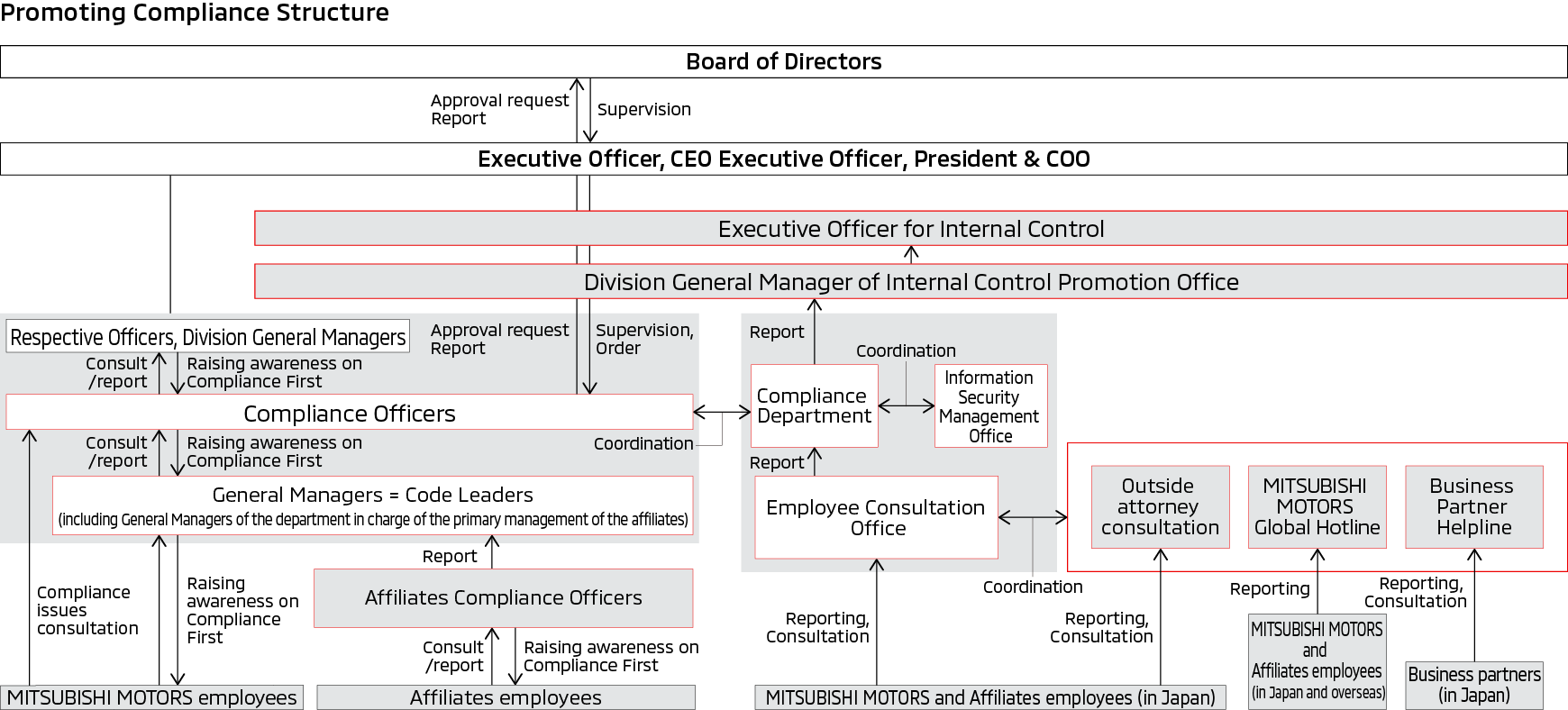
At MITSUBISHI MOTORS Group, we have established a compliance framework with the Executive Officer for Internal Control as the person responsible, overseeing, directing, and supervising all compliance activities. This officer also reports regularly to the Board of Directors on the status of compliance activities. In addition, each division appoints a compliance officer, and department heads serving as code leaders, to ensure a structured compliance system across the Company.
Compliance officers work closely with the code leaders to prevent compliance violations and information security incidents, including those involving personal data. When a compliance violation occurs, compliance officers take corrective actions, establish measures to prevent recurrence and verify their effectiveness, and roll out the measures across relevant divisions, then report to the Executive Officer in charge of Internal Control.
Major affiliates in Japan and overseas also appoint compliance officers. To help prevent compliance violations, we have established and operated the MITSUBISHI MOTORS Global Hotline since FY2018.
In the event of a serious incident, an emergency response organization is set up in accordance with the emergency response manual, and a system is in place to ensure that appropriate measures are taken.
As for internal controls related to financial reporting, we verify compliance structures and financial closing procedures. If inadequate controls are found at those companies under evaluation, we request reporting on the nature of the problem and improvements being made. In FY2025, we checked the status of 17 Group companies (MITSUBISHI MOTORS, 5 domestic affiliates, and 11 overseas affiliates).
In FY2025, we experienced no serious compliance violations that might damage our credibility with customers, investors, or other parties.
Establishment of Internal and External Consultation Offices
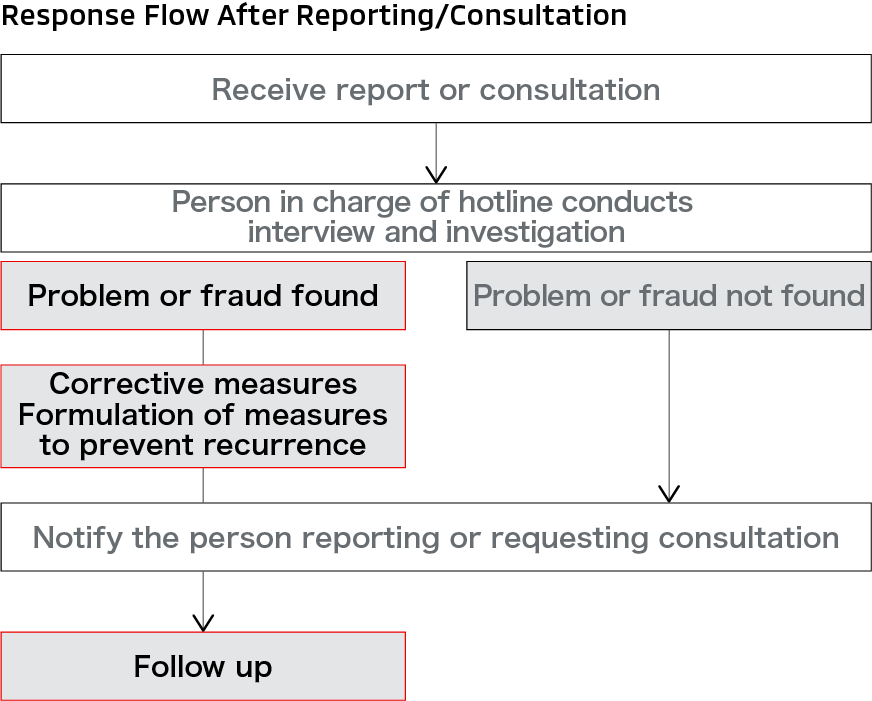
To prevent and promptly detect improper conduct, MITSUBISHI MOTORS has established several consultation offices allowing our employees or its affiliates in Japan and overseas to report or consult about such conduct.
Of the 121 reports and consultations received in FY2025, the results of the investigation revealed 10 cases of compliance issues, including violations of laws and regulations and harassment. We instructed the relevant departments to promptly take corrective actions and confirmed that the corrective actions had been implemented and were effective.
Employee Whistleblowing and Consultation Offices (Global)
| Name | Contact point | Target participants | Key features |
|---|---|---|---|
| MITSUBISHI MOTORS Global Hotline | Outside | Group employees in Japan and overseas |
|
| Internal consultation Desk (Employee Consultation Office) | Internal | Employees of the Company and affiliates in Japan (including retirees) |
|
| MMC Hotline | Outside (Attorneys) |
|
Number of Reports/Consultations Fielded by Consultation Offices by Category (FY2025)
| Item | No. of cases |
|---|---|
| Corporate/business proposals | 7 |
| Workplace environment | 23 |
| Labor relations | 14 |
| Human relations/harassment | 32 |
| Compliance, violations of operational rules, fraud | 36 |
| Other | 9 |
| Total | 121 |
Education and Training (Japan)
Every fiscal year we formulate compliance-related education and training programs and provide them by employee level. Each division also draws up and conducts its own measures under the direction of the compliance officer. On and around Safety Pledge Days,*1 each individual division voluntarily holds events to reaffirm the dayʼs significance. Workplace discussions are also held at the same time to talk about compliance issues and workplace culture.
In addition, we regularly provide easy-to-understand compliance-related information by posting a Compliance Newsletter on our intranet.
- To prevent past incidents, such as the regrettable recall coverup, from being forgotten over time, we designated January 10 and October 19 as “Safety Pledge Days” in October 2004. These days were chosen because two fatal accidents involving large trucks manufactured by Mitsubishi Fuso, a former MITSUBISHI MOTORS division, occurred on these days.
Education and Training Record (FY2025)
| Target participants | Training content |
|---|---|
| Entry-level employees | MITSUBISHI MOTORS’ history of compliance issues and lessons learned |
| Mid-career employees | |
| Newly promoted employees | |
| Employees of certain domestic affiliates | |
| Executives | Latest Status of Compliance and Cybersecurity |
| General Manager level and above | Lessons from the past improper conduct |
| All Employees (including part-time and contract employees) |
e-Learning
|
Anti-Corruption
Policies and Approach
The “Global Code of Conduct” clearly stipulates that MITSUBISHI MOTORS executives and employees shall comply with laws and regulations and shall maintain fair and equitable relationships with public officials and business partners.
Additionally, we have formulated the “MITSUBISHI MOTORS GLOBAL ANTI-BRIBERY POLICY” as a global guideline for the prevention of bribery and corrupt practices. This policy clearly states that we tolerate absolutely no bribery or corrupt practices. Furthermore, this policy is also enforced at both domestic and overseas affiliates.
Main Initiatives
Anti-Bribery Initiatives
We have established management regulations and operational standards regarding the provision and receipt of gifts or business entertainment involving public officials. In particular these management regulations and operational standards prohibit all executives and employees from improperly providing gifts or business entertainment to, or receiving them from, public officials in connection with their duties. We have put in place management and operational standards in addition to those for public officials. These standards expressly prohibit the provision of gifts or business entertainment that is illegal or goes beyond generally accepted bounds and the receipt of improper benefits.
We provide guidelines specifying the exceptional circumstances in which gifts and business entertainment may be permitted, provided they comply with applicable laws and are considered socially acceptable. Prior application is required to ensure transparency. When providing gifts or business entertainment to public officials, an application for prior approval must be made to the general manager of the Legal Department, and such gifts or entertainment may be provided only after approval is obtained.
In case these regulations or standards are violated, a system is in place for internal reporting and the formulation and implementation of measures to prevent recurrence.
Employee Training Initiatives
We conduct annual e-learning programs for all employees to promote awareness of the Global Code of Conduct. We also distribute booklets containing the Code and provide managers and above with access to the Code on their smartphones so that they can review it at any time.
We also communicate the code across the Group, distributing the pamphlets to affiliates in Japan, and sharing the data electronically with affiliates overseas.
Initiatives Towards Business Partners
Under the “MITSUBISHI MOTORS GLOBAL ANTI-BRIBERY POLICY,” we also ask our suppliers, contractors, procurement partners, dealers and outside agents to comply with applicable laws and regulations related to bribery and with their respective anti-bribery policies. We include specific provisions prohibiting bribery in our distributor agreements with overseas distributors.
Internal Audits of Sales Subsidiaries
Since many employees at sales locations directly handle money and other valuables in transactions with customers, there is a heightened risk of improper conduct such as embezzlement.
At our domestic sales subsidiaries we conduct regular education and training to instill thorough awareness of our compliance policies and prevent improper activity.
In addition, our Audit Division conducts operational audits of sales subsidiaries. The audit results are reported to our CEO, and the results are also shared with our Domestic Sales Division. We follow up on the implementation status of corrective measures.
Initiatives at Overseas Affiliates
Recognizing that overseas affiliates may be exposed to corruption risks, we provide executives and employees assigned from MMC to overseas affiliates with pre-assignment training on legal risks, including the prohibition and prevention of bribery, in order to strengthen anti-corruption efforts. Furthermore, when conducting audits of overseas affiliates, our Internal Audit Division also reviews efforts to prevent bribery and other corrupt practices.
Political Involvement (Political Contributions)
We respect the requirements set forth in the Global Code of Conduct to “comply with all laws and rules,” “be impartial and fair” and “be transparent and accountable,” and maintain an appropriate relationship with the political sphere.
Recognizing that reasonable expenditures are required to appropriately maintain a democratic government, we consider making political contributions to be one aspect of our social responsibility. When making such contributions, we do so in accordance with the Public Offices Election Act, the Political Funds Control Act, and other laws and regulations related to politics. We also ensure compliance with our internal approval rules.
Information Security
Policies and Approach
MITSUBISHI MOTORS recognizes its social responsibility to adequately protect its important information assets (information and the IT systems, equipment, media, facilities, and products that handle this information) in the course of its business activities in order to gain the trust of all its stakeholders. In addition, with the recent advancement of digital technologies, we recognize that the use of new technologies, including generative AI, not only brings the benefits of improved productivity but also requires appropriate measures to address risks such as information leakage and improper use.
We have established an information security policy and disclosed it on the following page. Based on this policy, we are working to protect information assets and strengthen cybersecurity measures, while promoting continuous improvement. While promoting the use of new technologies, we are also taking measures to address improper use and other related issues, including the establishment of internal guidelines for the use of tools such as generative AI.
Promotion Framework
-
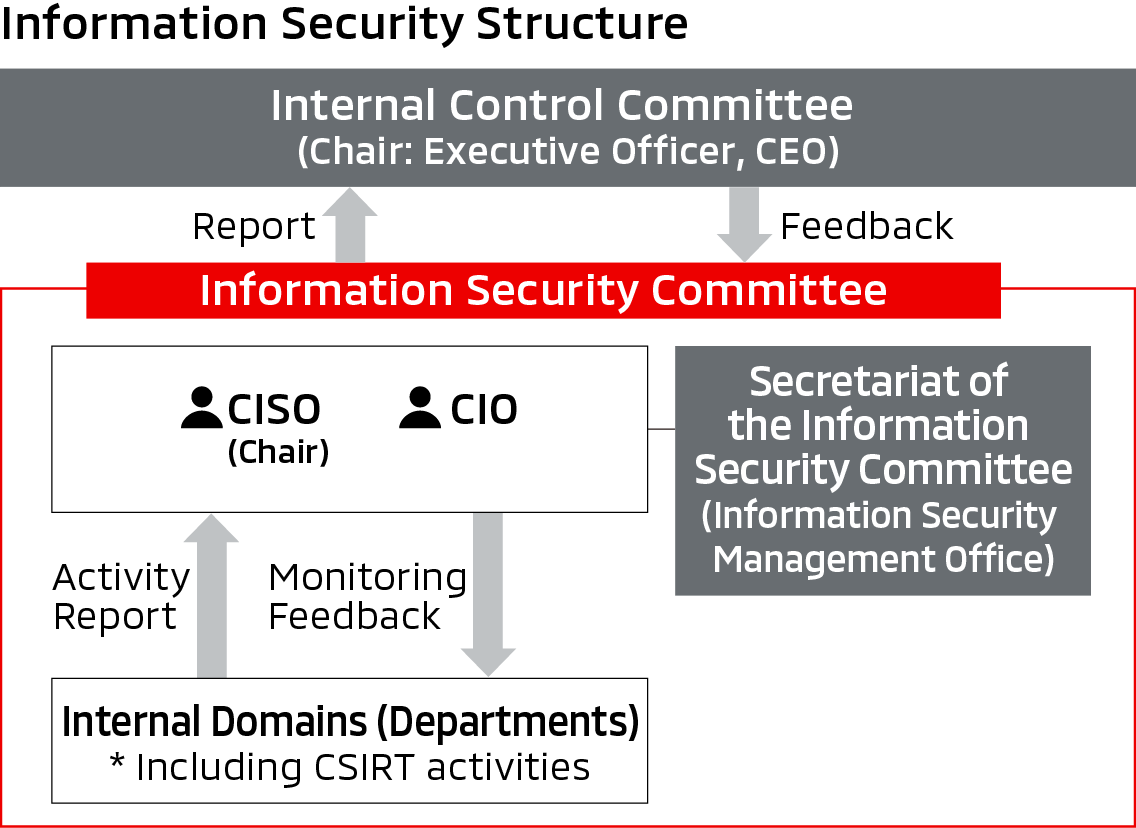
MITSUBISHI MOTORS has established the Information Security Committee, chaired by the Chief Information Security Officer (CISO), as a subordinate body under the Internal Control Committee. This committee determines key matters and policies related to information security management and monitors information security activities.
In addition, the Company has established a CSIRT(*2) to respond to security incidents and is working to build a robust information security framework.- CSIRT: Computer Security Incident Response Team
-
Main Initiatives
- Putting in place and reviewing internal regulations related to information security
- Strengthening management of information assets and measures against malware infections, including ransomware, and cyberattacks
- Regularly conducting CSIRT drills simulating information security incidents
- Providing employees with e-learning about information security, e-mail-based training, and alerts via our intranet
- Monitoring information security activities by the Information Security Committee
- Requesting suppliers to conduct the “JAMA/JAPIA Cybersecurity Guidelines Check Sheet” and calling for improvements from those whose measures are deemed insufficient
Product Cybersecurity
MITSUBISHI MOTORS Group recognizes that protecting vehicles and their peripheral systems against cybersecurity risks throughout the entire vehicle lifecycle is essential so that customers can use our products and services with confidence. We are committed to vehicle cybersecurity management.
As part of this commitment, we have established a management system compliant with UN Regulation No. 155 (UNR155), the United Nations regulation on automotive cybersecurity, and are promoting cybersecurity efforts under the Vehicle Cybersecurity Representative Meeting. In addition, to collect and analyze security-related information within the industry, we are members of Auto-ISAC organizations in Japan and the United States, striving to enhance our cybersecurity quality.
Furthermore, we regularly confirm that cybersecurity initiatives are being properly implemented in accordance with the management system.
Protection of Personal Information
The MITSUBISHI MOTORS Global Code of Conduct clearly states the importance of “compliance with laws and regulations,” which includes those related to the protection of personal information. Based on our Privacy Policy, we have established an organizational response framework, compliance requirements for handling personal information, and a reporting line for information leakage incidents. The Chief Information Security Officer (CISO) oversees all activities related to personal information protection. As the laws and regulations governing the protection of personal information continue to strengthen globally, we have established a framework to ensure compliance with applicable personal data protection requirements in each jurisdiction in collaboration with our local affiliates and offices.
When outsourcing the processing of personal information, the responsible manager selects and supervises service providers that maintain appropriate security measures, based on assessments conducted using our “Information Security Checklist.” We also provide continuous privacy and information security training for employees through e-learning and other educational programs.
Security Export Control
We fully recognize the importance of strict security export controls to prevent the proliferation of weapons of mass destruction and the excessive accumulation of conventional weapons in order to maintain international peace and security.
To conduct strict export controls, we have established “Security Export Control Regulations.” We ensure the legality of our export transactions by having the Executive Officer, CEO, hold ultimate responsibility for export control management and appointing an export control management supervisor under the CEO.
Approach to Taxation
We recognize that proper tax payment in all operating countries is one of the key elements of corporate social responsibility for multinational companies.
We have established a Global Tax Policy to promote tax compliance in business activities. In line with this policy, we have established a tax governance framework and strive to maintain proper tax payments in compliance with international rules and national regulations.