Basic Approach
Work-Life Balance
The Group recognizes the importance of realizing an
environment where individual finds purpose in their work, can
fully demonstrate their abilities, and maintains both physical and mental well-being is a critical priority.
With this understanding, we are creating a working
environment that enables individuals to maximize their capabilities and supports the realization of a work-life balance
that allows for both increased productivity and improved quality
of life, thereby linking the active participation of diverse human
resources to value creation. We promote flexible work styles
unconstrained by location or time by developing systems such
as flextime and remote work, as well as support measures for
balancing work and personal responsibilities, such as shortened
working hours and various leave and absence programs.
Diversity Promotion Policy
The Group aims to grow sustainably while responding to the
significant changes in the business and market environment
resulting from diversifying customer needs and technological
innovation. To this end, it is important for employees with
different values and ideas to work together to create
automobiles with new appeal and value. With respect for
employee diversity, including race, nationality, ethnicity, gender,
sexual orientation, gender identity, age, presence of disability,
or religion, we are making efforts to create an environment
where each person can work energetically without difficulty.
To promote and achieve diversity, we established the
Diversity Promotion Office based on the “Diversity Promotion
Policy” formulated in 2014, and are pursuing Di@MoND activities.
By embracing diversity, our aim is to leverage employees’ diverse
characteristics in a manner that will contribute to the mutual
growth of the Company and each individual employee. We are
working to create an environment in which all employees can
work comfortably and find their work rewarding.
Building a Better Place to Work
Promoting Location-Free Work Arrangements
At MITSUBISHI MOTORS, we have introduced a telecommuting
system to help each employee work more efficiently and
flexibly and achieve a better work–life balance.
While the system is used widely on an ongoing basis, we
operate it flexibly in a full-remote format for employees who
have unavoidable circumstances, such as childcare or nursing
care, that restrict them from commuting to the office in order
to help them avoid losing work opportunities and maintain
work-life balance. On the other hand, we recognize that coming
into the office fosters face-to-face communication within
teams, which can lead to generating new ideas and provide
opportunities to acquire knowledge and skills. For this reason,
we are working to realize a better work style by balancing in office
and remote work to support more effective and efficient
employee growth.
In addition, from the perspective of creating flexible work
styles that support both work and personal responsibilities, such
as childcare and nursing care, we are enhancing various support
systems to help employees balance work and life. In FY2018, we
established the “Work-life Balance Support Concierge” within
the Company, from which employees can seek advice on the
programs suitable for their individual childcare and nursing care
needs. Feedback collected through the concierge service is used
to improve programs and their operation, helping to create an
environment that enables more flexible working styles.
Supporting Employees to Balance Work and Childcare
The Company actively supports employees who seek to balance work and childcare. We have established on-site daycare centers at our facilities. Dia•Kids Okazaki was opened at the Okazaki site in April 2017, followed by Dia•Kids Tamachi at our head office building in February 2019. Since FY2023, we have also offered “childcare counseling” by staff from both centers to all employees, providing individual consultations about childcare for employees and their families online or by phone.
-
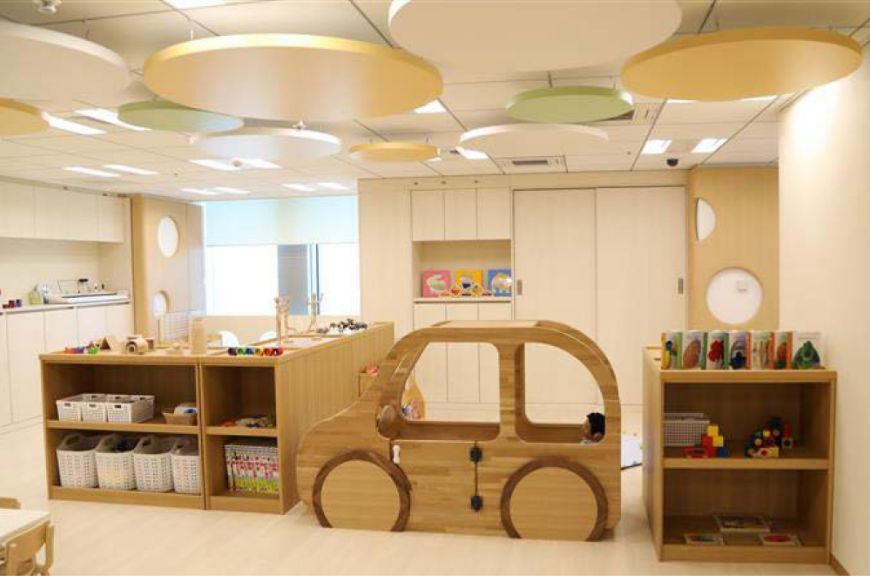
Dia・Kids Tamachi, a nursery school for employees (within the head office building)
-
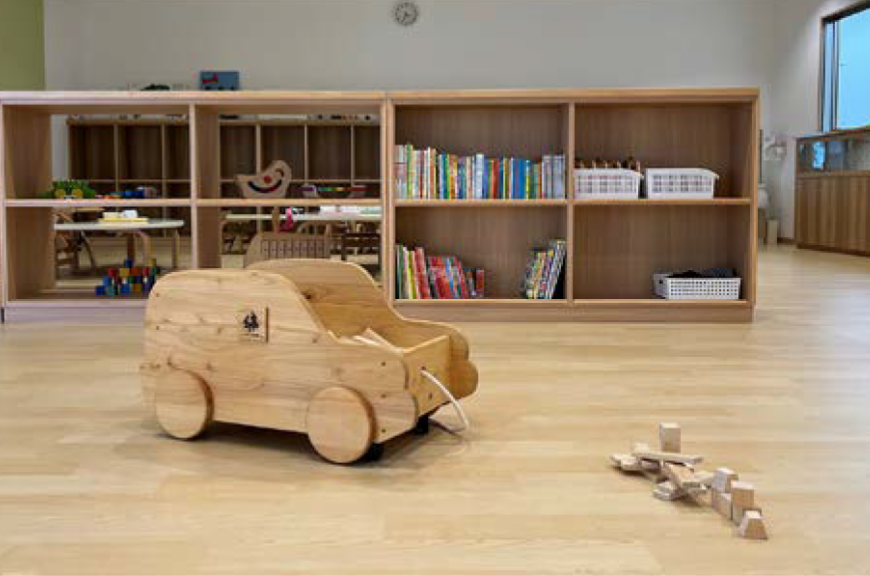
Dia・Kids Okazaki (within the Okazaki site)
On the working environment development front, to further encourage male employees to take childcare leave in accordance with the enforcement of the revised Childcare and Family Care Leave Act, we continue implementing training for managers, conducted seminars for expectant fathers and mothers, and offered e-learning programs. Furthermore, in FY2024, we rolled out video content for manager training, seminars for expectant fathers and mothers, and return-to-work seminars after childcare leave, establishing an environment that allows employees to view the content at their convenience. In addition, we are promoting initiatives aimed at bringing the rate of male employees taking childcare leave close to that of female employees.
Supporting Employees to Balance Work and Nursing Care
As society ages, we believe it is important to help employees
balance work and nursing care. We have established a contact
point that employees can use to contact nursing care specialists
by e-mail or telephone as needed, and we continue to offer
nursing care on-demand video seminars where employees can
learn basic knowledge about balancing work and nursing care
from outside lecturers.
In addition, we have rolled out “nursing care short videos”
that explain key points about nursing care and can be viewed at
a time convenient for each employee.
List of work-life balance assistance programs
| Programs | Overview | |
|---|---|---|
| Childcare | Pregnancy leave | Can be taken for the designated period of time applied for in advance, between becoming pregnant and the day prior to maternity leave (may be taken multiple times). |
| Maternity leave | Six weeks prior to birth and eight weeks after birth. | |
| Spousal maternity leave | When a spouse gives birth, the employee can take up to two days of leave between the day before and 14 days after the date of birth or expected date of birth. | |
| Childcare leave | Can be taken up to the end of April of the following fiscal year after the child’s third birthday. | |
| Leave to care for newborns | Up to four weeks of leave can be taken within eight weeks of the (expected) date of birth. Partial employment during the leave period is also possible. | |
| Child nursing leave | Can be taken until the end of the fiscal year of the child’s 12th birthday (one child: up to 5 days; two and over: up to 10 days; first five days are paid in both cases). | |
| Reduced working hours for childcare | Four-, five-, six-, or seven-hour work shifts can be chosen until the end of the fiscal year of the child’s 12th birthday (combined use with the flextime system is also available). | |
| Nursing care | Nursing care leave | Aggregate total of three years can be taken per person receiving nursing care. |
| Short-term nursing care leave | If one person receiving nursing care: up to 5 days; if two or more people receiving nursing care: up to 10 days (first five days are paid in both cases). | |
| Reduced working hours for nursing care | Available until the reason for the nursing care no longer exists. Employees can elect to work, four-, five-, six-, or seven-hours per day, and are also eligible for flextime work. | |
| Miscellaneous | Life plan leave | Employees can take up to 10 days leave per year for various predefined purposes such as receiving treatment for non-work-related injury/illness, caring for family, childcare, infertility treatment, participating in volunteer activities, and language studies. |
| Accumulation of unused paid leave | Employees can accumulate unused annual paid leave up to four days per year to a maximum of 40 days which can be used for predefined purposes. (E.g., receiving treatment for non-work-related injury/illness, caring for family, childcare, participating in volunteer activities, and infertility treatment). | |
| Flextime system | System that lets employees set their own working hours with no core time under predefined conditions on prescribed work days. | |
| Telecommuting system | System that allows employees to work from a location other than their own or family home, as long as certain conditions are met, and to pay an allowance. | |
| Reemployment system | Eligible for employees who resigned due to pregnancy, the birth of a child, childcare, nursing care, marriage, moving due to spouse work transfer, or other reasons recognized by the Company, with an applicable period within five years after resignation. | |
| Accompanying leave | Temporary leave system for employees to accompany spouses who have been transferred in Japan or overseas or are studying abroad, with an applicable period of from one month to five years. | |
Creating an Environment That Welcomes Non-Japanese Employees
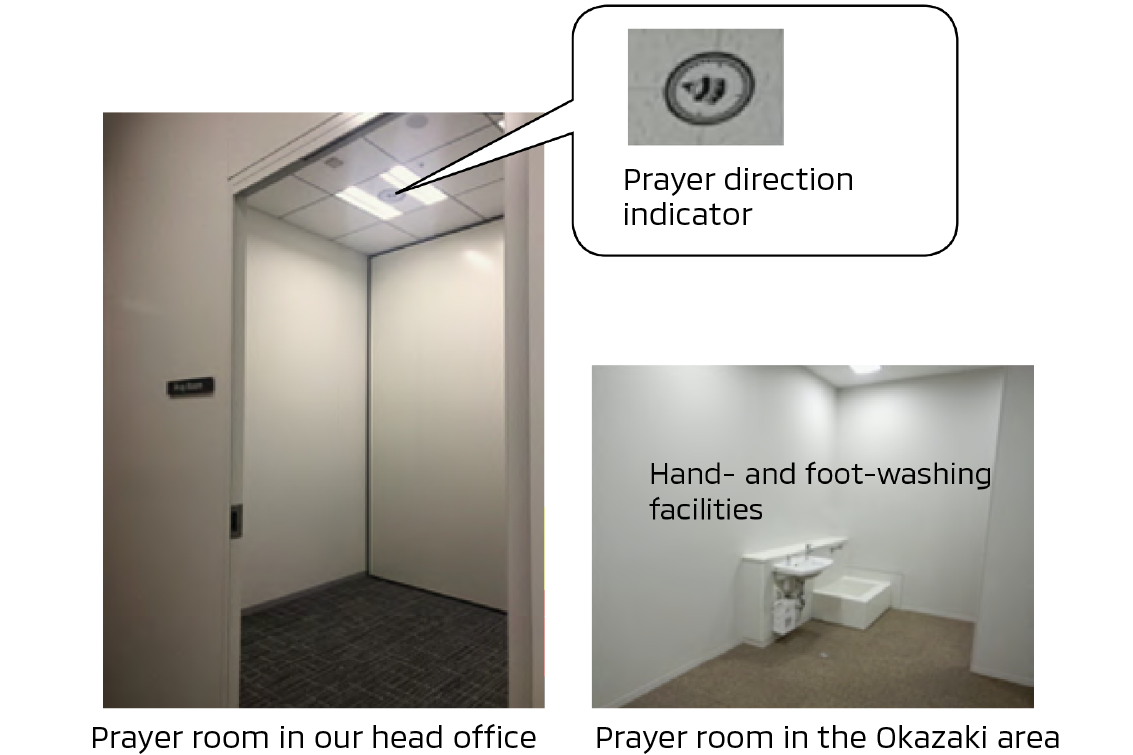
As part of the support offered to our workforce of non-Japanese employees, which is increasing year by year, we have established prayer rooms at our head office and Okazaki sites that are available to people of all religions and denominations. These rooms are open to customers, suppliers and other stakeholders who visit our sites. A facility for cleansing parts of the body before worship has also been set up in the prayer room at the Okazaki site.
Promote LGBTQ Awareness
The Company’s human rights policy defines “respect for human
rights of our stakeholders” and states that we will not tolerate
unfair discrimination or harassment based on such factors as
gender, sexual orientation or gender identity, and will respect
diversity. Furthermore, the MITSUBISHI MOTORS Global Code
of Conduct, which all employees and executives are bound
to comply with, clearly states: “Respect Human Rights and
Diversity, Provide Equal Opportunity.”
Based on these ideas and policies, we are striving to
improve the workplace environment and internal systems in
order to create a comfortable working environment where
LGBTQ people can play an active role in the Company. In our
employee system, the definition of marriage includes samesex
relationships, and employees in such relationships can
take marriage and childcare leave and use Company housing.
Additionally, we have held seminars and offered e-learning to help employees gain an accurate understanding of LGBTQ
issues and to increase supporters known as “Allies.” In FY2024,
approximately 485 employees participated in the seminar led
by external lecturers, which has been held since FY2018 to
promote understanding with some 9,259 employees taking
part in e-learning. Upon request, employees who have taken
the course can receive “ally stickers” to visibly show their
support as allies.
Participating in Initiatives Outside the Company
The Company has pledged our support to the Business for
Marriage Equality campaign, which invites companies to join us
in calling for equality in marriage.
Business for Marriage Equality is a campaign spearheaded
by three Japanese non-profit organizations in an effort to
visualize companies that support the legalization of same-sex
marriage. We actively strive to fulfill our social responsibility and
contribute to the achievement of the United Nations Sustainable
Development Goals (SDGs). By endorsing this campaign, we aim
to further contribute to SDGs goals 5 (Gender Equality) and 10
(Reduced Inequalities).
Securing/Cultivating a Diverse Workforce
Implementing a Flexible Total Rewards Strategy and Structure
To further enhance our corporate competitiveness through the
recruitment of diverse human resources and the realization
of the right person in the right position, the Company has
introduced a “Role Grade System” for management-level
employees. This system determines compensation based on
the role and its significance rather than on seniority or work
history, thereby establishing a flexible compensation structure
that sets appropriate remuneration according to the scope and
level of responsibility of each role. By revising our conventional
seniority-based compensation structure, this initiative makes
it easier to secure talent with diverse backgrounds from both
inside and outside the Company. In particular, responding
swiftly and accurately to rapid changes in technology, markets,
and the business environment requires the definition of roles
aligned with business strategies and organizational needs,
as well as offering fair and competitive compensation to
individuals with the required skills and experience.
Going forward, we will continue to evolve the operation of
the “Role Grade System,” striving for greater effectiveness as a
flexible compensation structure that can promptly respond to
changes in the external environment and business strategies.
Developing Workplaces Where Diverse Human Resources Can Proactively Leverage Their Skills and Potential to Contribute to Organizational Mission
To promote the creation of an environment in which diverse
human resources can play an active role, we are considering
and implementing new initiatives in addition to the
promotional activities carried out up to FY2023. In employing
people with disabilities, we are working to promote companywide
employment by not only encouraging hiring at specialpurpose
subsidiaries but also assigning personnel within
the headquarters’ Human Resources Division to implement
centralized hiring. We are also expanding employment
variations and holding employment promotion seminars
tailored to regional circumstances. Through collaboration
across departments, we are examining and implementing
measures to create a workplace where a more diverse group
of people with disabilities can thrive.
In addition, we will review the nature of employment and
working conditions, including the employment period, so that
senior human resources can be more active than ever before. In
the Production Division, we will work to create less-demanding
jobs for senior personnel, while upgrading facilities to provide a
comfortable working environment. In addition, we are planning
to update and introduce IT tools in office divisions.
Promoting Women’s Participation and Advancement in the Workplace
The Company has positioned the promotion of women’s
participation as one of its key priorities. Based on the Act on
the Promotion of Women’s Active Engagement in Professional
Life, in April 2024, we formulated an action plan to promote
women’s advancement. We are continuously working to close
the gaps in the female manager ratio and the ratio of women
to indirect employees by March 2029.
As part of this initiative, we have been selecting
management candidates and current female managers to
participate in the Working Women’s Empowerment Forum
organized by the Japan Institute for Women’s Empowerment
& Diversity Management to enhance motivation, improve
skills, and build external networks. In addition, we dispatch female management candidates from the Okazaki region to
Aichi Women’s Empowerment Promotion Project Executive
Committee seminars to provide opportunities for learning about
leadership styles and management skills.
Promoting Employment of People with Disabilities
Aiming to achieve a workplace where everyone can thrive,
we actively hire people with disabilities in a wide range of
occupations. In FY2024, the percentage of employees with
disabilities at the Company (Non-consolidated) was 2.55%,
which exceeds the statutory level. We will continue to promote
additional employment while improving the work environment.
On a non-consolidated basis, the Company employs
190 people with disabilities, including physical, mental, and
intellectual abilities. In addition, we are working to create an
inclusive workplace by installing multipurpose toilets that
accommodate ostomates and wheelchair users, and providing
communication support tools for employees with hearing
impairments. Starting in FY2024, we have assigned dedicated
personnel to the Human Resources Division at the head office to
promote initiatives that expand employment opportunities for
people with diverse disabilities, including the implementation of
department-concentrated hiring schemes.
We also promote the employment of people with disabilities
through MITSUBISHI MOTORS WING (In December 2023, this
subsidiary changed its name.), a special-purpose subsidiary
established as MMC WING in April 2007. This company employs
a total of 80 workers with physical, mental, and intellectual
disabilities at the Okazaki, Mizushima, and Kyoto plants. Now in
its 18th year since establishment, MITSUBISHI MOTORS WING has
received many inquiries and consultations regarding employment
from “Hello Work” Public Employment Security Offices, the
prefectural employment and support center for persons with
disabilities, and special needs schools, and its recognition in
the region continues to grow. To help support the employment
of people with disabilities, we proactively accept requests
from employment support organizations and special needs
schools to try on-site training, teaching people with disabilities
opportunities about group activities and work processes.
Going forward, we plan to develop company-wide initiatives
aimed at further promoting employment, such as sharing best
practices for the employment of persons with disabilities at
each workplace and holding seminars to foster a common
understanding throughout the Company.
Increasing Employment of Senior Workers
With the goal of handing down skills and technologies and securing a talented workforce with extensive knowledge and experience, we operate a program to continue employing senior workers after their retirement. As of March 2025, there were 814 reemployed workers, engaged in handing down techniques and training the next generation.