Governance
Basic Approach and Policy
MITSUBISHI MOTORS’ educational three pillars are the “Three
Principles,” a statement of the Mitsubishi Group’s management
principles; our Corporate Vision and Mission; and the “MMC
WAY,” guidelines for daily behavior. We also specified the
abilities and skills necessary to put these principles or behavior
into practice for each job classification.
Based on this, the Human Resources Division has developed
a companywide education system. In order to promote
systematic human resource development from entry-level
employees to general manager level, we conduct a variety
of training programs, including training curricula structured
according to job grade and years of experience, selective
training programs for next-generation leader development,
training for all employees utilizing e-learning, and selective
training programs in which employees can voluntarily choose
to take.
The status and results of the education system, which consists of companywide and departmental education programs, are reported to the Human Resources Development Council, which is attended by senior management.
In addition, each function and department implements
education programs based on specialized skills defined for each
division, aiming to develop personnel who can grow through
their work and become more active in the workplace.
We also provide opportunities for employees to discuss
their personal vision for the future during annual interviews
with their superiors. Doing so can help employees gain a better
understanding of their future career, leading to their next stage
of growth.

Strategy

Embedding Technical Expertise into HR Systems and Processes
In our FY2022 revisions to the HR system, we newly established
the category of “expertise” as a behavioral assessment item.
Our intent is to drive individual performance and achievement
by evaluating the degree to which employees have acquired
the specialized knowledge and skills required in their respective
organizations, as well as the degree to which they apply
them in practice. Evaluation based on “expertise” is linked to
a cycle of recognition and motivation, practice and feedback,
and skill development and growth, and is connected to salary
increases and promotions. By repeating this cycle through
annual evaluations, we aim to foster career development and
growth based on enhanced expertise, while also encouraging a
willingness to take on new challenges.
When the system was first introduced in FY2022,
evaluations were conducted based on provisional companywide
standards. However, we have put in place department-specific
evaluation standards throughout FY2023, and the system was
officially introduced in January 2024. In FY2025, we will further
refine the definition of “expertise” by developing job-specific
skill maps and a structured training program, thereby promoting
more effective skill development. Expertise is not something
that can be cultivated through training alone̶it is deepened
through accumulated practice and experience. To this end, we
will continue to prioritize the creation of growth opportunities
centered on on-the-job training (OJT) in each department, while
also combining this with off-the-job training (Off-JT) as needed to strengthen expertise through actual work.
We will continue to view expertise as a source of
competitive advantage and further evolve our systems and
environment to support its enhancement.
Career Development
Regarding career development, we have put in place a system
which enables employees to proactively set their own goals
based on their achievements, capabilities, and life plans, while
elevating their capacity to achieve these goals.
As a specific career development method, employees
participate in interviews with their superiors every year. The
interviews are held based on their Career Development Plans
(CDP) in which employees describe a future career course they
hope to take and their medium-to long-term career design by
reflecting on their past career. The aim of this interview is to
have employees build an objective picture of their challenges
and then proceed along a career path they have formed for
themselves with conviction and a high degree of motivation.
To further promote the use of this initiative, in FY2024 we
launched seminars for all employees to learn about the
importance of career development and specific approaches to
designing their careers.
We have created a “second assignment system,” in which
employees are rotated across departments three to five years
after their initial assignment. This approach aims to develop
new-graduate office workers into human resources with a broad
range of knowledge and insight as well as a broad network
of contacts within the Company and a perspective of overall
optimization through experience in multiple departments.
We are also working to develop human resources with
diverse experience and a high level of expertise through
intradepartmental rotations, job rotations to other departments
with which they have a business relationship, and by dispatching
people from the sales department to dealers.
Cultivating Next-Generation Leaders
(MITSUBISHI MOTORS)
To achieve sustainable corporate growth, we are systematically
developing the next generation of leaders who will support the
Company’s long-term development.
Starting in FY2024, we expanded the scope of the selective
training program “Leadership Development Program” to include
not only management-level employees but also Assistant
Managers. The program, which lasts approximately seven
months, defines the desired image of a leader for each position.
It supports step-by-step growth through the acquisition of
knowledge and training in thinking skills necessary for future
management responsibilities.
In addition, we hold an “advance review meeting for
personnel assignments to key positions” as part of our talent
management efforts, through which we aim to systematically
develop and assign management personnel. This meeting, which
is attended by the Representative Executive Officer, President &
CEO, Representative Executive Officer, Executive Vice President,
and executive officers, discusses succession plans for people in
“key positions,” which include executive officers, presidents of
affiliated companies, and general managers of internal divisions.
Succession plans, which form the basis for discussion, are
updated annually by the head of each division, and are prepared
jointly with the human resources department by listing
three tiers of personnel both within and outside the division
in question: candidates for succession in one to two years,
candidates for succession in three to five years, and people
with the potential to become candidates at some point in the
future. Each division prepares a general manager succession
plan every year, and holds a personnel meeting with the general
manager and the human resources department to discuss the
assignment and training of candidates for the next fiscal year.
In addition, beginning in FY2024, we have launched one-onone
meetings between executives and female leaders as part of
our initiative to develop future female executive candidates.
Risk Management
Launching Digital Reskilling Programs to Support DX
The automotive industry is undergoing a once-in-a-century
transformation, and the business environment is changing
dramatically on a daily basis due to advances in IT/digital
technology. To adapt to these changes and strengthen our
reach to a diverse global customer base, the promotion of
digital transformation (DX) is essential. In particular, to meet
the diverse needs of not only Generation Z, who are digital
natives, but also customers of all generations and markets, and
to deliver new value to more customers, it is vital to reinforce
innovative approaches that leverage digital technologies.
Against this backdrop, all Board members have discussed
our vision for the next 15 years in the IT/Digital area, and shared
the recognition that it is essential for all employees to be
literate in IT and digital technologies in order to make the most
of the power of technology and move forward into the future. In
“promotion of digitalization/expansion into new business areas,”
which is one of the core initiatives of the mid-term business
plan “Challenge 2025,” the development of digital talent is an
extremely important theme.
In FY2023, as the first step in developing digital human
resources, we conducted “IT/Digital literacy improvement
training” (six hours in total) for all executives and indirect
employees to foster a change-oriented mindset among all
Board members and employees. In FY2024, we began offering
seminars to help employees acquire fundamental knowledge
of generative AI, which is rapidly becoming more widespread,
and how to apply it in business. We are also developing an
environment in which employees can make effective use of
AI. In addition, we are promoting the use of no-code and lowcode
tools to further streamline operations and are rolling out
a phased educational program to support their use, thereby
helping to improve employee productivity.
Going forward, we will continue to clearly define the types
of IT and digital human resources required by the Group and
steadily advance initiatives to develop personnel equipped with
cutting-edge digital skills.
Metrics and Targets
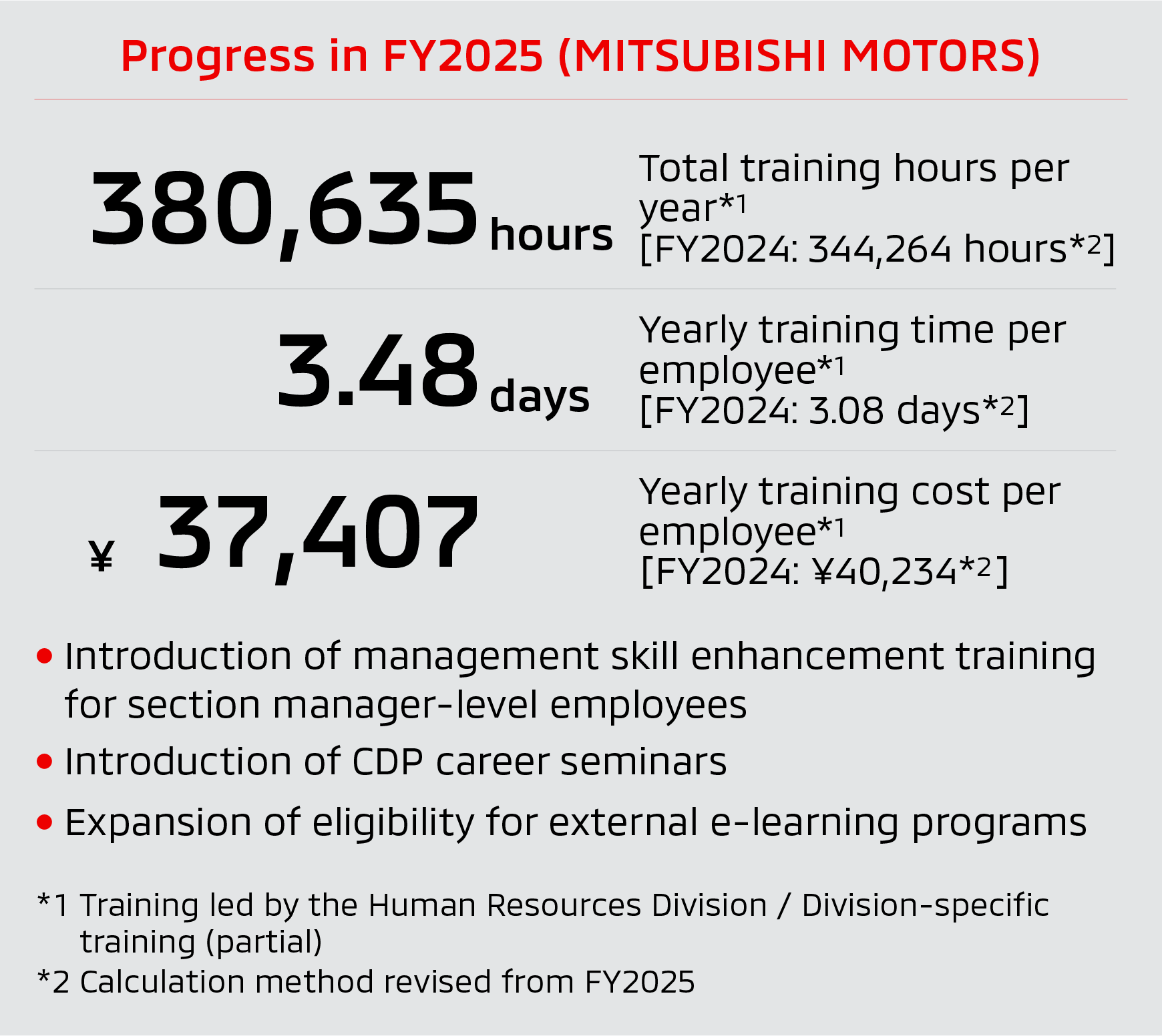
FY2025 Initiatives
Activities to Promote MMC WAY (MITSUBISHI MOTORS)
As part of our efforts to instill the MMC WAY among employees, we hold workplace workshops annually and publish interviews
with top management on the company intranet. Through these
articles, we communicate the intent behind the MMC WAY and
how to put it into practice, providing guidance for employees.
In FY2024, we interviewed employees who joined the
Company in 2017̶the year the MMC WAY was first introduced.
The MMC WAY was revised in 2022, and these employees, familiar
with both the original and updated versions, shared how they
currently perceive and implement it in their workplaces. By
sharing perspectives from employees who are closer in position
than top management, we aim to make the MMC WAY more
relatable and easier to integrate into daily work.