Basic Approach
Minimizing environmental impact is an essential element of the Groupʼs sustainable growth. To this end, we recognize the importance of environmental management. We also believe that the costs of promoting related initiatives are an important investment from a long-term perspective.
In order to promote environmental initiatives reliably and efficiently, we have constructed a framework for environmental management. We are promoting Group initiatives, including education and awareness activities for employees, and the acquisition of certifications for environment management systems among affiliated companies. We also communicate our initiatives through our website and our Sustainability Report in order to promote understanding of our efforts among various stakeholders.
Management Structure
Since 1993, we have been holding an Environmental Council, which is attended by the Representative Executive Officer, President & CEO and officers from each division. The Sustainability Committee, chaired by the Representative Executive Officer, President & CEO, has met since FY2017. This committee has specified environmental initiatives as key material issues for our Group, and it discusses our environmental policies and targets and confirms the progress and results from materiality initiatives such as the Environmental Targets 2030.
For the management target companies, we have established selection criteria as a framework for the scope of environmental targets and the collection and publication of environmental data, and we review these criteria on a regular basis.
Management Target Companies (20 Companies) (As of March 31, 2025)
| Country | Company Name |
|---|---|
| Japan | MITSUBISHI MOTORS CORPORATION |
Production Affiliates
| Country | Company Name |
|---|---|
| Japan | Suiryo Plastics Co., Ltd. |
| Thailand | Mitsubishi Motors (Thailand) Co., Ltd. (MMTh) MMTh Engine Co., Ltd. (MEC) |
| Philippines | Mitsubishi Motors Philippines Corporation (MMPC) Asian Transmission Corporation (ATC) |
| Indonesia | PT Mitsubishi Motors Krama Yudha Indonesia (MMKI) |
| Vietnam | Mitsubishi Motors Vietnam Co., Ltd. (MMV) |
| Malaysia | MMC Manufacturing Malaysia Sdn. Bhd, (MMCMM) |
Non-Production Affiliates
| Country | Company Name |
|---|---|
| Japan | Mitsubishi Automotive Engineering Co., Ltd. Mitsubishi Automotive Logistics Technology Co., Ltd. Higashi Nihon Mitsubishi Motor Sales Co., Ltd. Nishi Nihon Mitsubishi Motor Sales Co., Ltd. |
| United States | Mitsubishi Motors North America, Inc. (MMNA) |
| Netherlands | Mitsubishi Motors Europe B.V. (MME) |
| UAE | Mitsubishi Motors Middle East and Africa FZE (MMMEA) |
| Australia | Mitsubishi Motors Australia, Ltd. (MMAL) |
| New Zealand | Mitsubishi Motors New Zealand Ltd. (MMNZ) |
| Canada | Mitsubishi Motor Sales of Canada, Inc. (MMSCAN) |
| Mexico | Mitsubishi Motors de México S.A. de C.V. (MMDM) |
Environmental Management System
In FY2010, MITSUBISHI MOTORS acquired companywide integrated ISO 14001 certification. (Previously, sites in Japan had acquired this certification individually.) We are leveraging the ISO 14001 framework and engaging in ongoing initiatives to improve business activities. The ISO 14001 framework is proving helpful in the companywide promotion of the Environmental Plan Package we formulated in FY2020.
Affiliates in Japan and overseas are also being encouraged to acquire ISO 14001 and Eco-Action 21* certification, and they are engaging in environmental management.
- Eco-Action 21 is a certification and registration system based on the Environmental Management Systems guidelines formulated by the Japanese Ministry of the Environment for medium-sized companies.
Status of ISO 14001 Certification (As of March 31, 2025)
| Development Companies |
|---|
| Mitsubishi Automotive Engineering Co., Ltd. |
| Production Companies |
| Suiryo Plastics Co., Ltd. Mitsubishi Motors Philippines Corporation (MMPC) Asian Transmission Corporation (ATC) Mitsubishi Motors (Thailand) Co., Ltd. (MMTh) MMTh Engine Co., Ltd. (MEC) PT Mitsubishi Motors Krama Yudha Indonesia (MMKI) |
| Distribution and After-Sales Service Companies |
| Mitsubishi Automotive Logistics Technology Co., Ltd. (Mizushima New Vehicle Inspection Plant, New Vehicle Inspection and Delivery Coordination Business Division) |
Promoting Life Cycle Assessment (LCA)
We perform LCA to determine the environmental impact across a productʼs life cycle. We evaluate total emissions, mainly of CO2, from such processes as extracting the resources used in parts and materials, producing materials, manufacturing parts, assembling vehicles, producing fuel, driving and disposing of disused automobiles.
We use LCA to develop advanced parts, electrified vehicles and new-model vehicles that help address the issues related to climate change and energy. We compare life cycle CO2 emissions with those of previous parts and vehicles, and use this information in our activities to reduce CO2 emissions throughout the supply chain.
In light of growing interest in the environmental impact across the entire life cycle in individual countries and regions, we will continue to strengthen our systems and build the foundations to ensure we remain abreast of developments related to regulations and incentives.
Examples of LCA Implementation (FY2024)
| Model | Objective |
|---|---|
| The 2025 model year “OUTLANDER PHEV” |
|
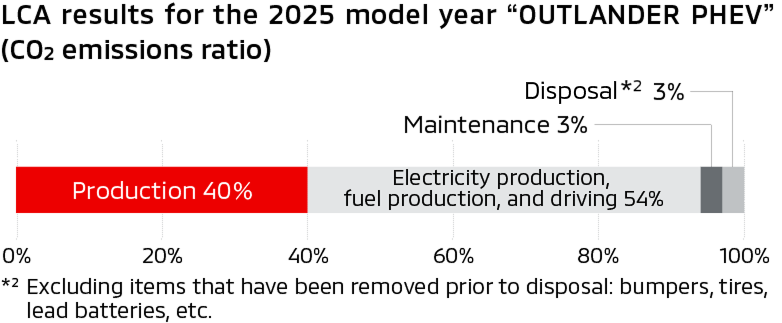
- Excluding items that have been removed prior to disposal: bumpers, tires, lead batteries, etc.
Promoting Employee Education and Awareness Activities
MITSUBISHI MOTORS conducts sustainability-related awareness activities throughout the year as part of its aims of deepening the understanding of sustainability among all executives and employees and contributing toward the realization of a sustainable society through routine business activities. Environmental education and awareness are one aspect of these activities.
In FY2024, we conducted rank-based training and distributed videos to all executives and employees. In these ways, we sought to promote an understanding of our social responsibility for realizing a sustainable society, the relationship between sustainability and the environment, the relationship between environmental issues and our business activities, and our initiatives aimed at achieving carbon neutrality.
Environmental Risk Management
Having learned from past cases of failing to comply with environmental regulations such as those aimed at preventing pollution, we make every effort to comply with relevant regulations. We sincerely respond to complaints from neighborhood residents after investigating the situation.
In the event that environmental laws and regulations are violated or an environmental accident occurs (such as if regulatory values are exceeded), or if we receive a complaint, the corresponding division must submit a Legal Non-Conformity Report to the Compliance Department and take necessary measures against the cause. The report clarifies the details of the case, measures and more, and appropriate countermeasures are taken. Furthermore, in order to prevent recurrence, initiatives are in place to improve work processes, enhance the supervision system, and increase employee awareness.
In FY2024, we were not subject to any fines or administrative orders stemming from violations of environmental laws and regulations*, nor any instances of exceeding statutory values. However, voluntary internal checks and monitoring activities uncovered 11 cases of legal non-compliance (including delays in issuing notifications and in conducting inspections). We responded to these incidents by swiftly taking corrective action, introducing measures to prevent recurrence and sharing information with other related divisions about the incidents and countermeasures to stop the occurrence of similar cases.
- Refers to 31 environment-related laws and regulations identified by us, including the Water Pollution Prevention Act and the Air Pollution Control Act.
Participation in External Associations and Initiatives
We are working with external organizations and initiatives to achieve carbon neutrality in 2050.