Basic Approach
The Group has been developing business in the ASEAN region since before the rise of motorization, and we have grown up alongside these countries while developing close ties with the region based on the idea that “regional development” contributes to the development of the Mitsubishi Motors Group.
In this region, where we have undertaken business activities for many years, we are working proactively to address local social issues. To promote joint growth, we will invigorate the region, cultivate the market, understand consumersʼ needs and reinforce our own brand. In these ways, we believe we can simultaneously achieve regional development and our own development. “Challenge 2025,” the midterm business plan, positions the ASEAN region as a core area of business and further expands spending on R&D and capex. In particular, it aims to grow our Group by increasing the percentage of spending on electrification, IT, and new business. One of our material issues is “contribution to local economies through business activities.” We are contributing to business development and local economies in the ASEAN region by creating employment, investment, technology transfer, and exports, as well as cultivating human resources to support the automotive industry (supporting the growth of human resources who are responsible for the regional economy).
In addition, we are responding to the societal needs of the ASEAN region, engaging in initiatives that leverage our Groupʼs technologies and services in the areas of the environment and social contribution.
Management Structure
Local subsidiaries take charge of planning and implementing activities in line with initiatives that target material issues in the ASEAN region, such as “contribution to local economy through business activities.” Our sales division, which maintains administrative and supervisory functions, is responsible for promoting these initiatives. In the four countries where our production bases are located, our sales divisions check with local subsidiaries twice a year on the rate of progress and results of initiatives, reporting to the management team via the Sustainability Committee.
Employment
Our mid-term business plan, “Challenge 2025” has positioned the ASEAN region as a core region for our business. Since FY2023, we have rolled out the new “XFORCE” SUV, an internal combustion engine vehicle, in Indonesia, Vietnam, and the Philippines. We have also launched the new “TRITON” pickup truck in various countries, including Thailand. The Group has also been working to reflect a series of policies announced in various countries to promote the realization of a carbonneutral society. In Thailand, we have started producing and selling the “XPANDER” series HEV model, and in Indonesia, we have begun production and sales of the “L100 EV (MINICAB EV)”, our first electric vehicle outside of Japan.
Through these business activities, in addition to generating business profits for companies, we plan to expand employment in the ASEAN region. We employed approximately 10,700 people in FY2024 in the four countries where we have production bases: Thailand, Indonesia, the Philippines and Vietnam. In FY2025, we will continue to create local employment in line with our business plans.
Human Resource Development
In the ASEAN region, which is working to become more industrially advanced, the Group provides experience in automobile manufacturing, sales and service, which aids in the development of specialized expertise and skills and the cultivation of people who are involved in manufacturing and the fostering of local economic growth.
Main Education and Training Programs (FY2024)
| Area | Eligible persons | Overview |
|---|---|---|
| Thailand | 26 students recruited from 11 industrial universities | Internship program to cultivate human resources who will become local economic leaders |
| Indonesia | 317 local employees | Training to acquire operational skills based on program participantsʼ business levels |
| Philippines | 8,786 local employees (total number of participants during the fiscal year) | Multiple training sessions aimed at enhancing participantsʼ operational skills, expertise, and productivity |
| Vietnam | 719 local employees | Training for strengthening the work skills and enhancing the expertise of local employees according to their position and field |
| Each country | Local employees | Training courses and OJT tailored to the conditions in each country |
Investment
We continue to make capital investments in plants, which support local economic growth. Our mid-term business plan, “Challenge 2025,” positions the ASEAN region as our core business region. There, we plan to promote the continuous launch of new products and the production and introduction of electric vehicles suitable for each market. To this end, we plan to continue investing in R&D and making capital expenditures in the ASEAN region at a stable and higher level than in the past.
Key Investment Projects
| FY2024 Results | Thailand: Capital investment for the start-up of HEV production (XFORCE in FY2024) |
|---|---|
| Philippines: Relocation and expansion of assembly and inspection lines | |
| Future Plans | Indonesia: Expansion of facilities to increase production capacity (Increased production capacity from 220,000 vehicles in FY2024 to 255,000 units in FY2025) |
| Vietnam: Deliberation regarding construction of new plant |
Technology Transfer
We continue to support the enhancement of manufacturing capabilities and strengthening of competitiveness through local production in various countries, with a focus on the ASEAN, our driver of growth. In FY2024, we transferred manufacturing technologies, including technologies for electrified vehicles developed in Japan, to overseas sites through the process of preparating for the production of new models such as the new 3-row SUV and the “XPANDER HEV.”
To enhance the manufacturing competitiveness of local subsidiaries (manufacturing sites), we have ensured that the Buddy system gained traction. Under this system, plants in Japan become “buddies” of overseas plants, so that they can grow together, and they actively provide their buddy plants with support, including employee development. We are enhancing competitiveness and transferring expertise in such areas as quality control and logistics improvements in everything from the start-up of new model vehicle production lines to mass production.
Furthermore, to better motivate employees, we are carrying out the global initiatives of Global Skill, Karakuri Kaizen®, and QC Circle Activity competitions. Many employees from plants in ASEAN countries have participated in these competitions.
Master trainers with manufacturing skills and site management knowledge have been placed in ASEAN sites to transfer those skills and knowledge. These trainers are trained and certified by our own global master trainers. Through this initiative, we are working to deepen the knowledge and expertise and improve the technical capabilities of Group employees.
Furthermore, to help local people acquire technological expertise, we provided scholarships and training vehicles to technical universities and vocational training schools in Thailand, Indonesia, the Philippines, and Vietnam. In addition, we have organized online seminars for teachers to help vocational school students working in the automotive industry understand the latest technologies and industry needs.
Through these efforts, we strive to promote local technology transfer by providing multifaceted support matched to local needs.
Export
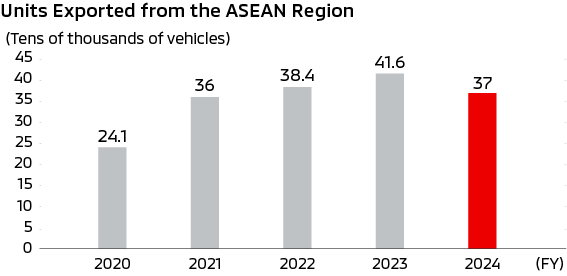
Exports generate foreign currency, which supports the continuous growth of the local economy. The Groupʼs overseas production bases, Mitsubishi Motors (Thailand) Co., Ltd. (MMTh) and P.T. Mitsubishi Motors Krama Yudha Indonesia (MMKI), are leveraging their strategic locations to export our mainstay models, such as pickup trucks and SUVs, both in the ASEAN region and globally.
Environmental and Social Contribution
As the importance of complying with environmental regulations in the ASEAN region grows, The Group is leveraging our electric vehicle technology and expertise, as well as working with our partners in each region, to realize sustainable business in the region and to promote efforts to realize a carbon-neutral society. We are also engaging in environmental and social contribution activities rooted in local communities, not just businesses. These activities include donating to disaster-struck areas in different countries, supplying vehicles and parts to educational institutions, conducting education and training at vocational schools, and participating in tree planting and waste recycling activities.