The First-Generation Pajero-- From a 4WD with "Go-Anywhere" Capability to One You Can Control
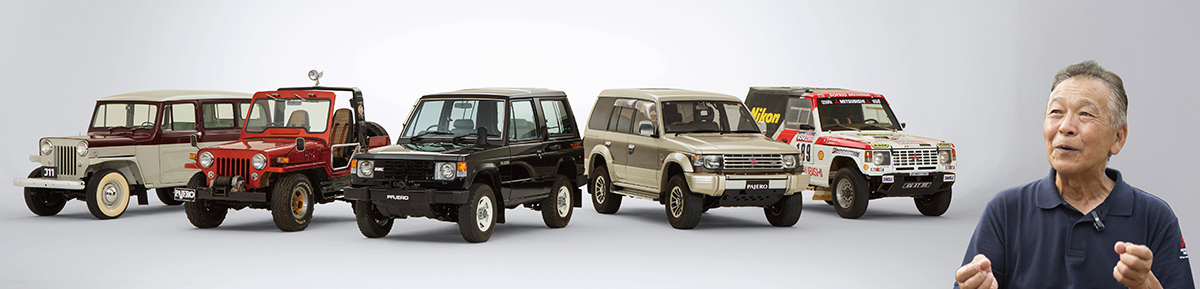
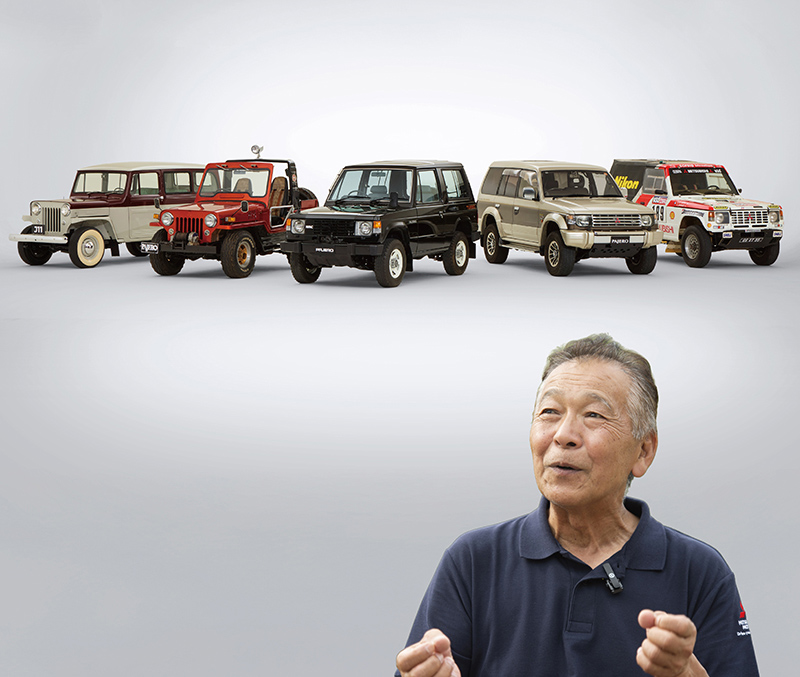
In a competition widely known as one of the world’s toughest rallies - the Dakar Rally - the Mitsubishi Pajero has claimed a total of 12 overall victories. Yet from the very beginning, the concept behind the Pajero was never about turning its strength into something exclusive. Technologies forged under extreme rally conditions were not intended only for professional drivers. They were meant to return to everyday driving for everyone. At a time when the very definition of four-wheel-drive (4WD) was beginning to shift, the Pajero quietly but steadily began to redefine what 4WD vehicles could be.
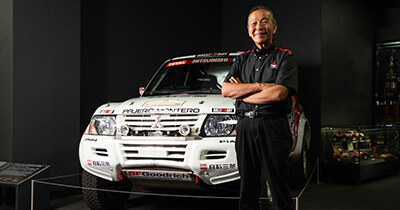
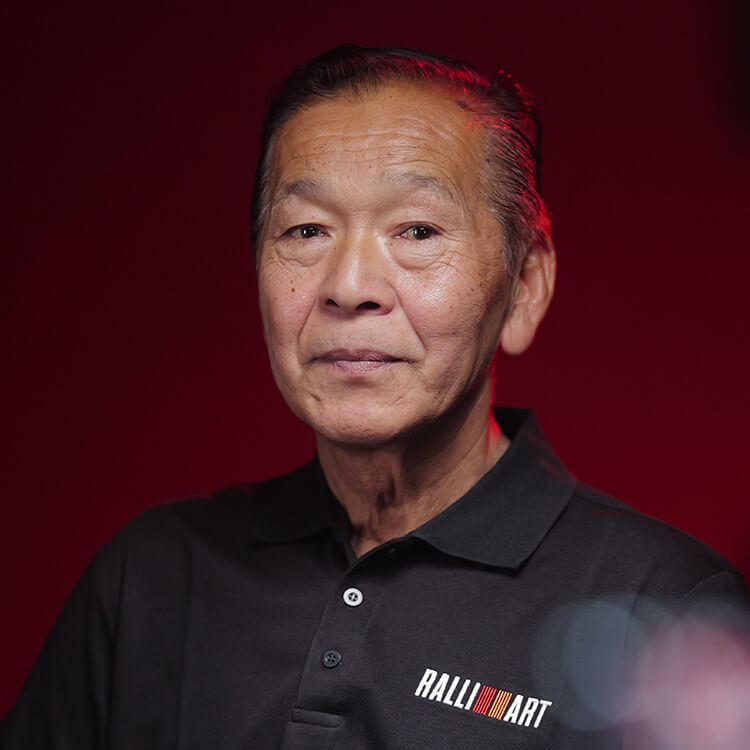
Standing at the forefront of that journey was Hiroshi Masuoka, the first Japanese driver to win the Dakar Rally overall twice in a row. Even today, he remembers with clarity the moment he first drove the first-generation Pajero. What surprised him most was not simply its speed.
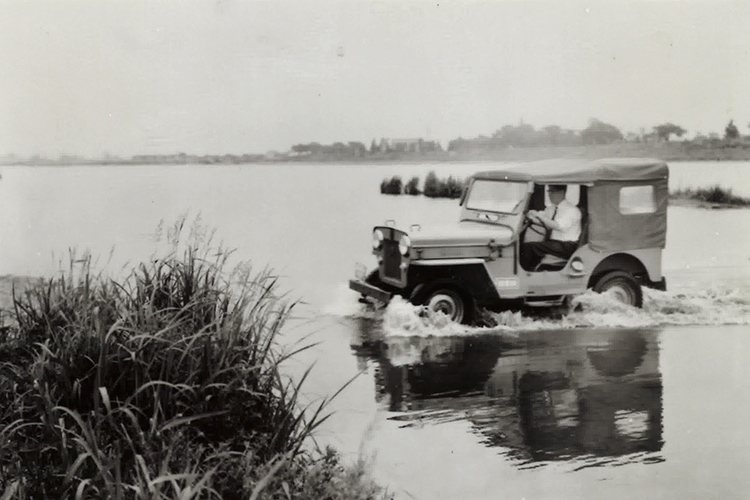
The Mitsubishi Jeep, engineered for professional use and known for its exceptional off-road capability.
1982 at Fuji Speedway: First Encounter with the Pajero
Masuoka’s first drive of the pre–production, first-generation Pajero took place in 1982, on an off-road course adjacent to Fuji Speedway. At the time, he was competing at the highest level of off-road racing in the Mitsubishi Jeep J58. Driving both vehicles on the same course, on the same day, under identical conditions, the difference was apparent.
"The Pajero easily beat the time of the Mitsubishi Jeep. It was clearly faster," Masuoka recalls. "But what stayed with me wasn’t its speed. Even on rough terrain, it did exactly what I asked it to do. When I turned the wheel, it responded properly. There was no fear. What impressed me most was how easy it was to handle."
In the early 1980s, 4WD vehicles were still largely viewed as heavy-duty machines designed for work and professional use. Their off-road capability was unquestionable, but on highways, their weight and cumbersome handling were unavoidable drawbacks. They were vehicles with clearly defined roles, and clear limitations.
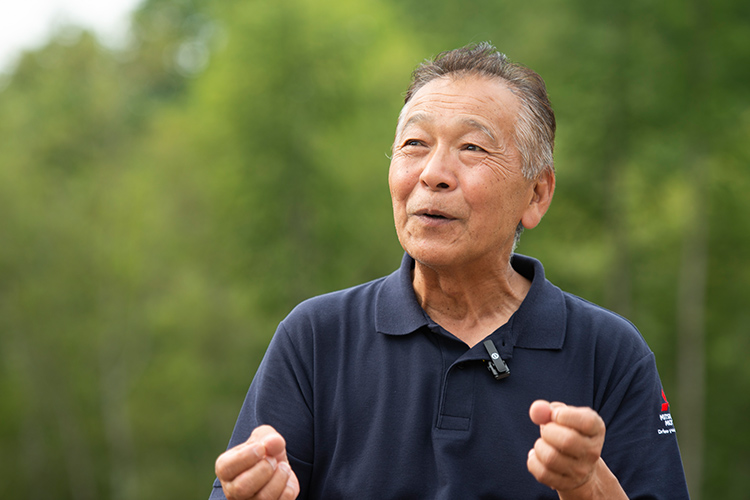
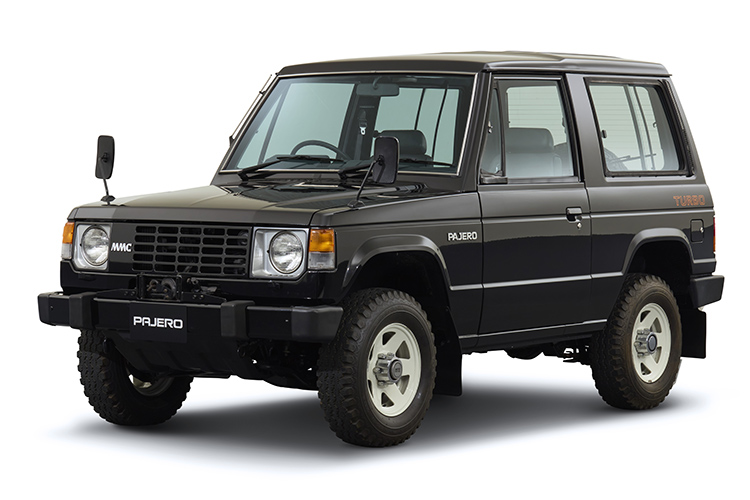
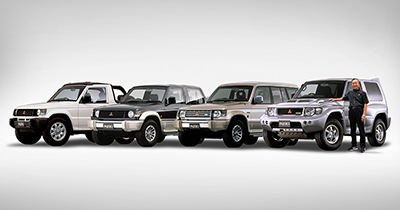
The First-Generation Pajero and Hiroshi Masuoka
At the same time, Japan’s expressway network was rapidly expanding in the 1980s. Expectations for 4WD vehicles began to shift, with growing emphasis placed on on-road comfort and ease of use. With the Pajero, Mitsubishi Motors set out to meet those demands. While retaining the robust ladder-frame structure common to serious off-road capability and pursuing durability, the Pajero adopted a double-wishbone independent front suspension to improve stability and control on paved roads. Comfort was also enhanced with features including suspension seats.
At a time when most competitors featured large-displacement engines - often exceeding 4.0 liters - in heavier bodies, the Pajero offered a more balanced approach. Its lineup included a 2.3 liter diesel engine and a 2.0 liter gasoline engine, responding to the era’s growing expectations for fuel economy.
"Back then, there was an understanding that 4WDs demanded a certain level of endurance - compromises you simply had to accept," Masuoka says. "But the Pajero was different. Anyone could take the wheel and handle it with ease. This was something new."
Technology forged in the extreme arena of rallying was being distilled into a vehicle - not for specific drivers, but for families to use in everyday life. Masuoka sensed the first tangible proof of that idea on the Fuji Speedway course.
Domestic Off-Road Racing as a Testing Ground
The product planning team at Mitsubishi Motors had already envisioned entering the Dakar Rally when the Pajero went on sale. Ahead of that, Masuoka and his colleagues began entering the Pajero in domestic off-road races from 1982. Data gathered from these competitions were quickly fed back into production. Harsh landings from large jumps would damage the front structure and oversized off-road tires placed excessive stress on suspension components. Challenges surfaced one after another - but they were addressed and reflected in production vehicles - often within little more than a month.
"When you race, weaknesses become very clear," Masuoka explains. "If something breaks, you find out why. Then you apply the fix straight to the production car. The speed of improvement was remarkable."
This rapid cycle was possible only because engineering teams and motorsports operations worked in close proximity. Before it was ever a promotional platform, rally participation functioned as a testing ground for vehicle development.
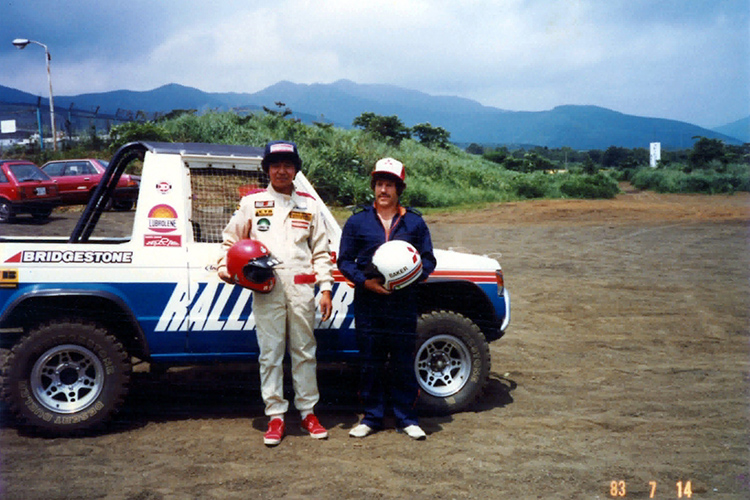
Masuoka with the Pajero at an off-road race event in Japan
Global Recognition Through the Dakar Rally
When it was first introduced, the Pajero was not immediately recognized as a full-fledged cross-country vehicle. Compared to heavy-duty professional vehicles equipped with front and rear rigid axles, the Pajero’s comfort and everyday ease led some to view it as less serious - perhaps a little "soft." But the Dakar Rally would prove otherwise.
In 1983, Pajero claimed victory in the unmodified production class. The following year, it won the modified class. By 1985 - only a few years after its launch - it secured its first overall victory at the Dakar Rally.
"The impact of an Asian manufacturer winning the Dakar Rally was enormous," Masuoka reflects. "But for us, it felt more like we had finally proven what we knew the Pajero was capable of."
Word spread quickly. If you drive a Pajero, you can win. Private teams began entering in large numbers. By the late 1980s, around 300 vehicles were competing in the Dakar Rally, with Mitsubishi models accounting for roughly 50 of them, including private teams.
The impact extended beyond competition. As skiing, camping, and outdoor travel became common weekend activities, the Pajero grew popular as a vehicle people could rely on for snowy roads and unpaved terrain – resonating with families and a wider range of drivers, including women. 4WDs were no longer the domain of a small circle of enthusiasts. At the center of that shift stood the Pajero, transforming rally-proven strength into everyday reassurance.
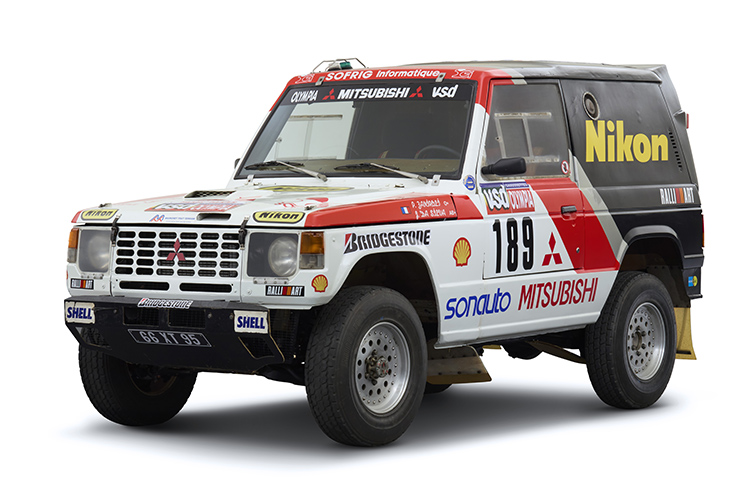
The Pajero that claimed overall victory at the 1985 Dakar Rally
-
-
Hiroshi Masuoka
Team Director, Team Mitsubishi RalliartAs a works driver for Mitsubishi Motors, Hiroshi Masuoka competed in the world’s most demanding rally - the Dakar Rally – with the Pajero. In 2002 and 2003, he claimed overall victory in consecutive years, becoming the first Japanese driver to achieve a back-to-back overall win. Today, he applies his hard-earned experience to new vehicle development and comprehensive evaluation, while also focusing on training test drivers. As team director of Team Mitsubishi Ralliart, he has also led the team to overall victories at the Asia Cross Country Rally - considered the toughest in the ASEAN region - in 2022 and 2025.
Related Content
Looking Back on the History of the Pajero with Hiroshi Masuoka
May 2026

