Rally driver
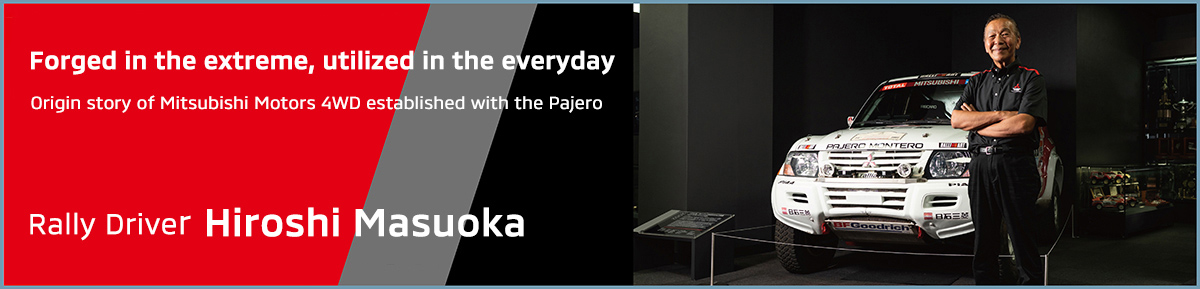
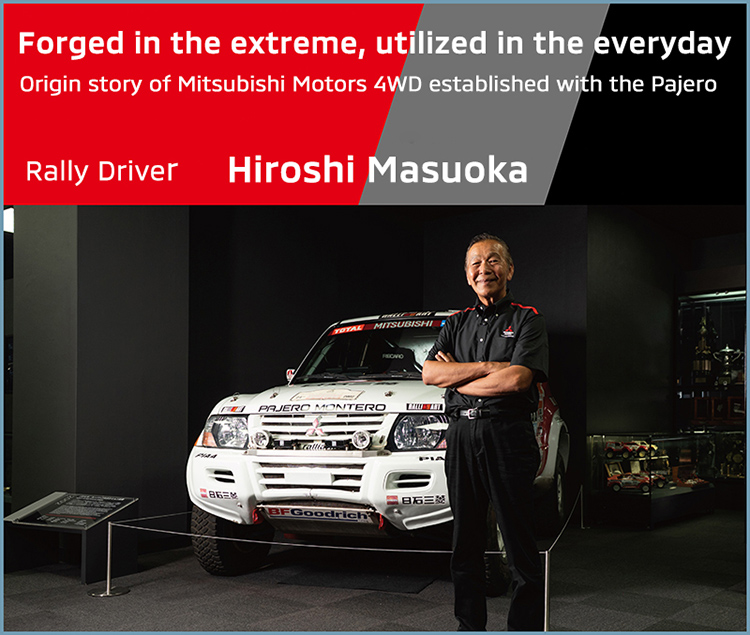
Hiroshi Masuoka
The Mitsubishi Motors Pajero has captured a long list of honors in the world’s most grueling rally event, the Dakar Rally. Mitsubishi Motors four-wheel drive technology that was forged in those brutal natural environments and proving grounds has now evolved into Super Select 4WD-II. Through insights gained and lessons learned from rally races, it has evolved into a reassuring, comfortable ride that anyone can now enjoy.
The Pajero, powering through extreme conditions to take the title of world’s best
The Dakar Rally spans a diverse range of harsh natural environments, from desert settings with sharp differences in temperature to wastelands covered in sharp rock formations, endless sand dunes, and dried up river beds. Each day features a grueling itinerary covering several hundred kilometers, testing not only the durability of the vehicle but also the physical strength, concentration, and decision-making skills of the driver and navigator. Carving out its own route while navigating through constantly changing terrain and weather—with hardly any paved or maintained roads in sight—the Mitsubishi Motors Pajero racked up victory after victory while overcoming these brutal tests. It ultimately accumulated 12 overall victories, including seven consecutively.
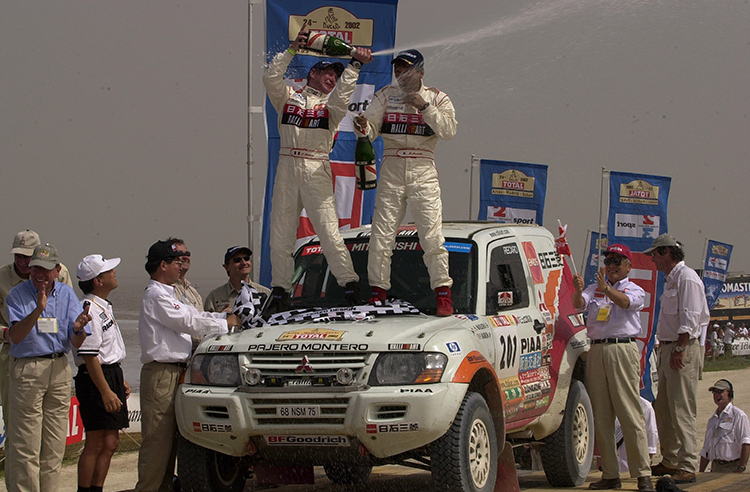
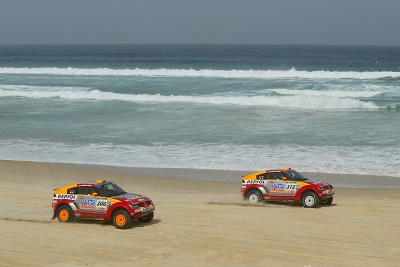
Winning the Dakar Rally for the first time in 2002 and the first back-to-back victories by a Japanese driver in 2003
At the center of it all was Masuoka. His experience and skills knowing the Pajero inside and out, and above all his obsession with “conversation between driver and car,” became the building blocks for victory. Masuoka emphasizes that grip strength is key.
“On rough roads, driving force is important. Only so much horsepower can be supplied to each wheel. Typically, the upper limit is around 100 horsepower. Accordingly, 200 horsepower is the maximum for two-wheel drive, but with four-wheel drive you can efficiently transmit 400 horsepower to the road, which greatly improves driving performance.”
Mitsubishi Motors obsessively pursues control that raises the threshold of capability to firmly grip the road on any type of curve, while simultaneously making it possible to recover even if you should happen to slip.
“In a world where there is no correct answer, we established countless parameters and improved the Pajero’s maximum performance by feeling our way forward. The higher the aims, the more satisfying it is for the engineers, so being ambitious really motivates them. For one auto manufacturer in Asia to take on competing manufacturers from around the world, it really is essential to have that level of technological capability.”
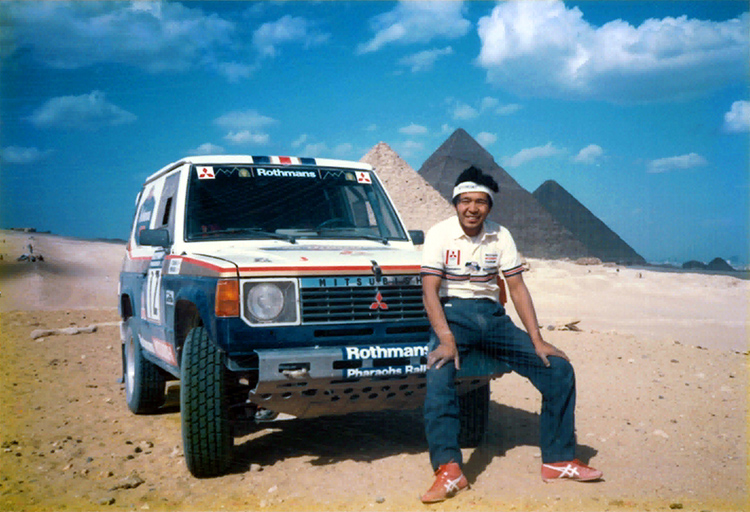
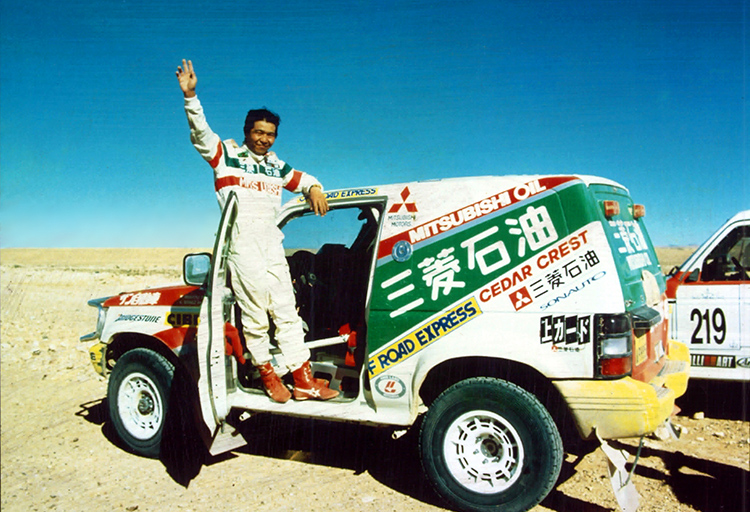
The first-generation Pajero competed in many rally races domestically and internationally
Left: Pharaohs Rally (1985), Right: Overall Victory at Silk Road Rally (1988)
With is outstanding maneuverability, the Pajero won spectators over with its sleek movements like gliding over the surface of water, even on narrow racecourses with rough roads or on vast swaths of desert.
Its robust build with an emphasis on safety and its seating comfort as a passenger vehicle are also major selling points for the Pajero.
“4x4 cross country vehicles at the time had large engines, bulky frames like trucks, and their bodies were also heavy. On the other hand, the Pajero was lightweight yet robust. I think the most appealing thing about it was that its ride was just as comfortable as a passenger vehicle, whether driving on rough road surfaces, expressways, or winding roads. In the Dakar Rally, there are many places where you jump in gaps and drive at high speeds on undulating roads. Since the Pajero is lightweight, it could complete maneuvers nimbly and it was also comfortable to drive, which reduced fatigue.”
Battling a day of extremes in the Pajero during the brutal year of 1994
Among the many trials and tribulations Masuoka has endured, he remembers 1994 as an especially brutal year for the Dakar Rally.
“There was one particular day that was more brutal than anything I had experienced before. On a route located somewhere isolated from people, there was sand that was extremely soft. Cars would start sinking into it right away. The car would get stuck every time I went 20 meters. I would raise it with a jack, put a plank underneath, and eventually get free. I had to repeat that process over and over.”
Masuoka stayed up all night plugging away on that merciless journey, finally reaching the service point in the early morning.
“The next starting time was already approaching, so all I did was refuel, then started driving again without taking a break. I still remember it to this day. It was the toughest moment I ever experienced in the Dakar Rally.”
After finishing that stage, Masuoka went on to finish fourth overall in the modified production car class Pajero, which was his highest ever finish at that point. The realizations that Masuoka gained from those extreme conditions also shaped his perspective toward four-wheel drive.
“‘Conversation’ between the vehicle and the driver is extremely important in a long-distance competition like the Dakar Rally. I consider a car to be a living thing. While I’m driving, I’m also sensing what state it’s in, taking in the sounds and smells of the engine, the vibrations, and the sensations being fed back through my hands and feet.”
1994 was not only a year when Masuoka achieved a successful result in the Dakar Rally; it was also the year when he became living proof of how dependable of a partner the Pajero was.
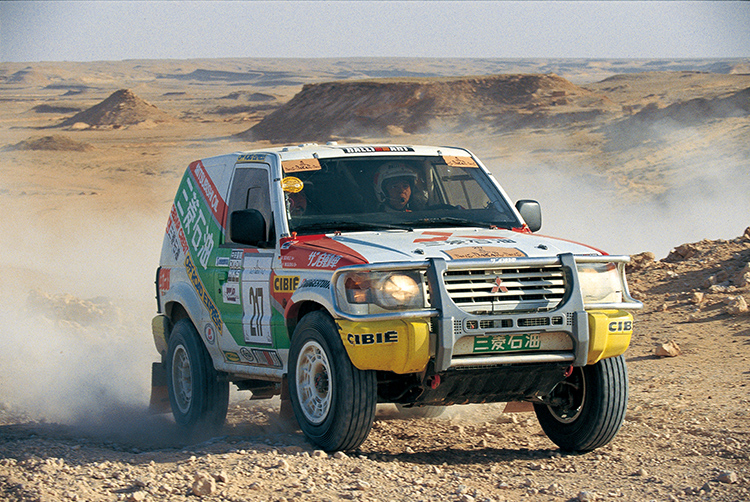
Won the modified production car class and took 4th overall in the 1994 Dakar Rally
Evolution into Super Select 4WD-II and obsession with comfort
The four-wheel drive technology forged in the grueling competition of the Dakar Rally evolved into the Super Select 4WD-II (SS4-II) system in the third-generation Pajero in 1999. The first Super Select 4WD which went into the second-generation Pajero was a revolutionary system that could freely switch between multiple drive modes: two-wheel drive, full-time 4x4, center differential lock, and low range. Employing a new planetary gear center differential made it possible to bring driving force distribution to the rear wheels, which in turn freed up more grip capacity for the front wheels. This resulted in dramatic improvements not only in off-road performance, but also in terms of handling and safety in everyday driving. The change to a format using an electric actuator for the transfer switch also made it possible to smoothly select between 2H, 4H, 4HLc, and 4LLc modes even while in motion, which greatly improved operability.
“Lots of people wanted to ride the Pajero to turn over a new leaf and venture out to someplace they were curious to go. Being able to return with certainty, no matter which roads you take—that is one of the most important elements desired in four-wheel drive cars. For example, if you get stuck on a muddy road and cannot get free under your own power, you might be able to deal with it if you’re a pro. However, normal people would struggle. I wanted to empower them in that situation. For that purpose, we adopted electronic control technology.”
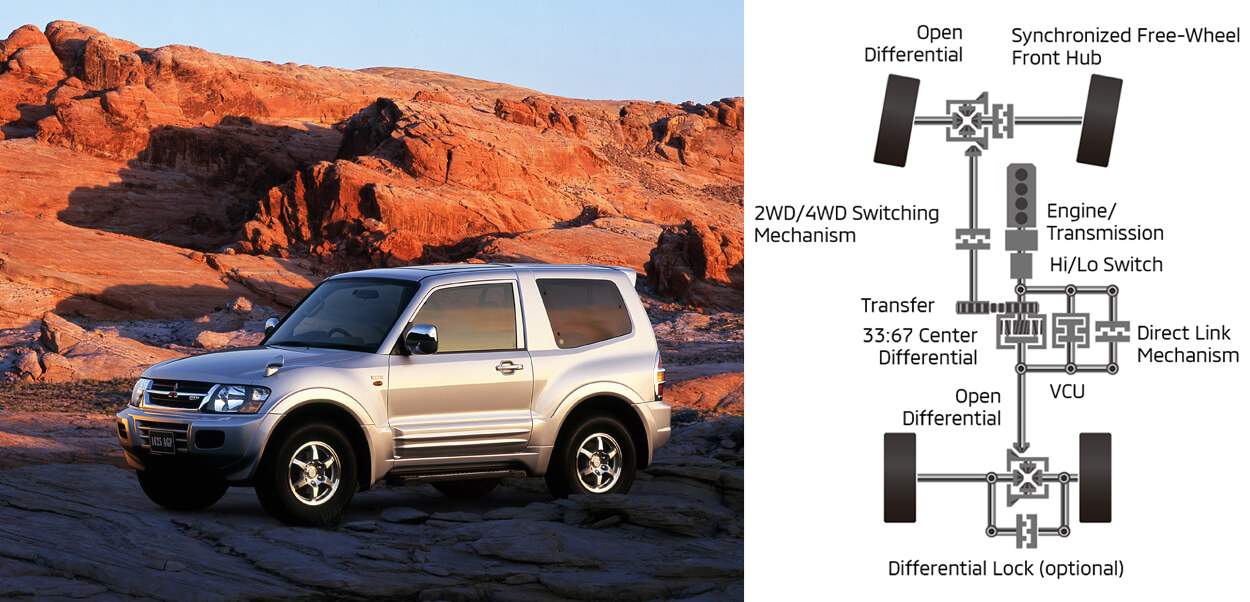
The third-generation Pajero with the SS4-II which employed a planetary gear center differential and brought distribution of torque to the rear wheels
In the fourth-generation Pajero launched in 2006, an evolved Action Stability and Traction Control system made it possible to prevent tire spinout more thoroughly, helping drivers to harness stable driving force even on slippery roads. Even when stuck in the mud on one side, the tires that are still operable can grip the road firmly and move the vehicle forward.
The Pajero equipped with SS4-II is a cross-country vehicle for professional use, but it simultaneously evolved into an SUV with high levels of safety and comfort in which anyone can feel reassured behind the wheel. It became a true all-rounder that maintained the same level of reliability on rough or unpaved roads, but with a refined on-road ride that seamlessly handles everything from city driving to adventures.
Mitsubishi Motors has always been obsessed not only with driving but also with the experience of the ride itself. In other words, the pursuit of ride comfort.
“Personally, I bought each successive generation of the Pajero. It drives reassuringly not only on rough and unpaved roads but also on expressways and winding roads as well. More than anything, it really cuts down on the driver’s workload. Competitions such as the Dakar Rally that require driving force; and those such as the World Rally Championship (WRC) which test cornering performance—Mitsubishi Motors has a tremendous strength in having challenged itself to meet the requirements of both extremes at the same time. We refined our four-wheel drive technology by integrating the strong points of both.”
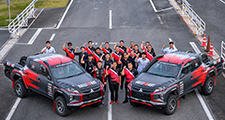
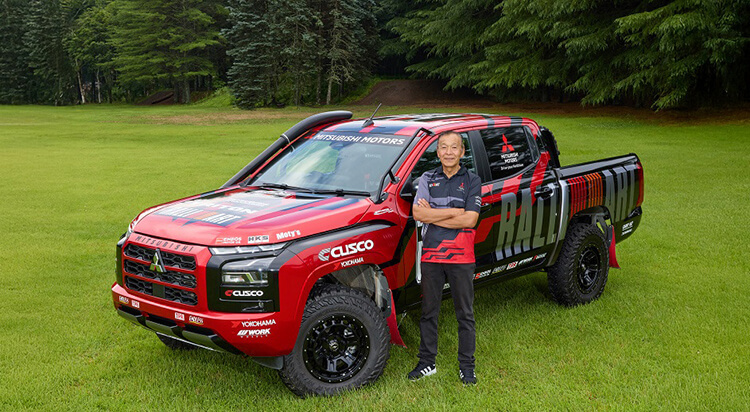
Having traced its evolution through these refinements, Mitsubishi Motors four-wheel drive technology has now been passed down to the Triton that competes in the Asia Cross Country Rally (AXCR).
-
-
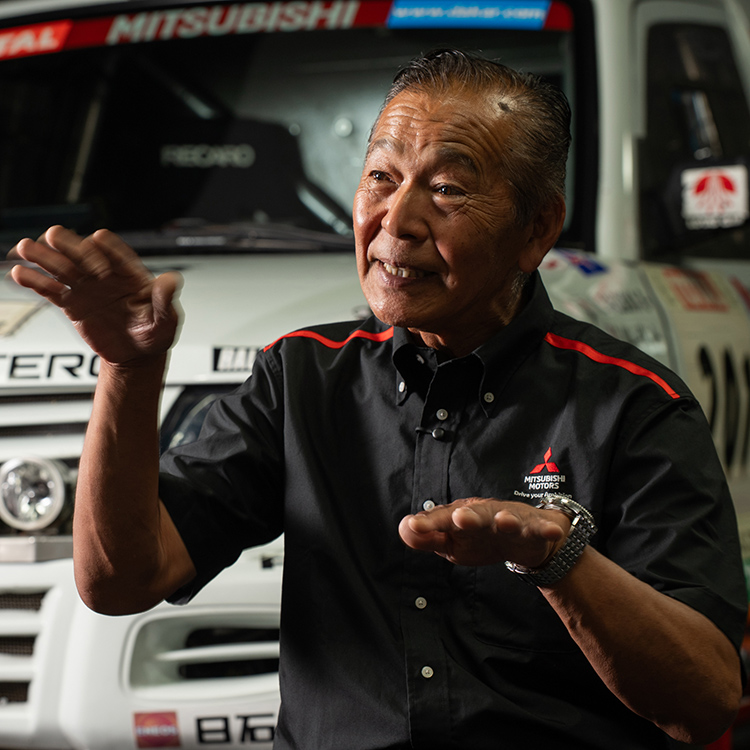
Hiroshi Masuoka
Rally driver Masuoka was the overall champion in 2002 and 2003 at the Paris–Dakar Rally, the world’s most grueling motorsport event. He has also competed in the Pikes Peak International Hill Climb in Colorado, USA with an electric race car, placing second in the Electric category in 2012 and 2013. During the Pikes Peak International Hill Climb held in June 2014, he achieved the outstanding result of second in the Electric Modified category (third overall) and contributed to the Mitsubishi Motors team’s 1–2 finish. Masuoka currently serves as Team Director for Team Mitsubishi Ralliart, which competes in the Asia Cross Country Rally. He led the teams that won the overall championship in 2022 and 2025.
Related Content
January 2026

