
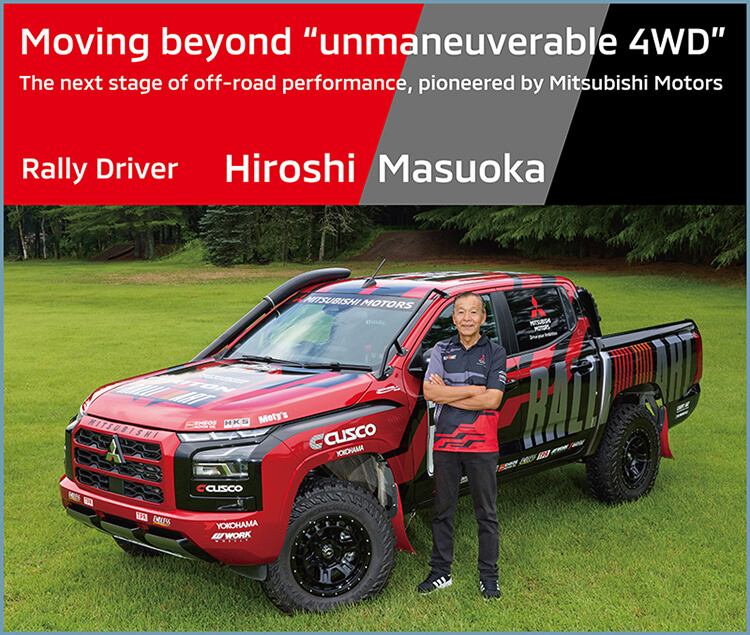
Rally driver
HiroshiMasuoka
“When I started driving as a rally driver, the main Mitsubishi Motors car of interest was the Mitsubishi Jeep, but four-wheel-drive (4WD) cars at the time won't turn. ” Those are the words of Hiroshi Masuoka, the first Japanese driver to win the Dakar Rally two years in a row. Conventional wisdom held that four-wheel-drive cars were for professional use and unsuited for regular drivers for city driving. Mitsubishi Motors is committed to four-wheel drive and has achieved numerous successes at the Dakar Rally and the World Rally Championship (WRC). In the extreme off-road environments of cross-country rally, how has Mitsubishi Motors evolved its four-wheel-drive vehicles into cars that can take corners well? Let’s take a look at Mitsubishi Motors history with 4WD.
It all began with the Mitsubishi Jeep, a four-wheel-drive car for handling rough roads
Masuoka, who works as a chief expert in Mitsubishi Motors Public Relations Dept. these days, says that for him, it all began with the Mitsubishi Jeep. He grew up in a family that ran a forestry business, and he was amazed by the power of the Mitsubishi Jeep, which could haul logs up muddy mountain slopes with ease. The very first car he ever bought was a Mitsubishi Jeep. He made his own modifications and used it in off-road race events, starting with the Fuji Speedway in 1979.
The Mitsubishi Jeep of that era performed well on rough roads, but it couldn’t handle turning at all. Masuoka recalls that he would deliberately drive up onto a rock, driving it on three wheels so he could force it to turn. It was originally designed with off-road capabilities as a priority, and it was highly valued in fields like forestry, construction, and firefighting.
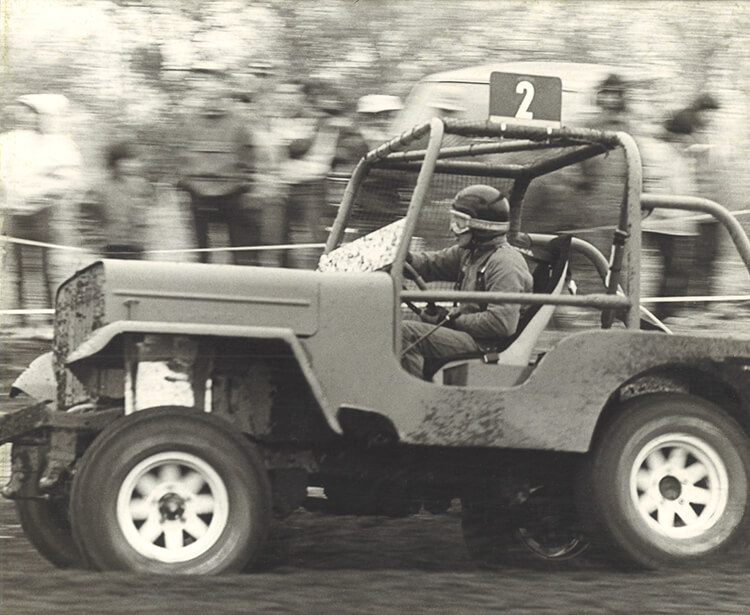
Masuoka driving the Mitsubishi Jeep in an off-road race at the Fuji Speedway (1982)
The problem with turning – The conflict between rotational speed differences and inner wheel travel differences
The reason four-wheel-drive cars have difficulty turning, Masuoka observed, was the inner wheel travel difference. When a car goes around a curve, the inner and outer wheels travel different distances, creating a difference in their rotational speed. The axles have differential gears in order to compensate for this difference. Rotational differences between the front and rear wheels also occur, and when the vehicle makes a sharp turn on paved roads in particular, the wheels cannot absorb this rotational difference, causing the vehicle to stop moving as if the brakes had been applied. How to absorb the difference between the front and rear wheels has been a major challenge for four-wheel-drive vehicles.
Mitsubishi Motors has addressed that challenge head-on with the aim of evolving four-wheel-drive cars into cars that are easy for anyone to handle.
The arrival of the Pajero – The fusion of drivability and comfort
We wanted to transform four-wheel-drive vehicles that can navigate rough terrain into vehicles that offer both comfort and safety. That desire was the driving force behind Mitsubishi’s involvement in rally racing. The Pajero II was announced at the Tokyo Motor Show in 1979, and a full-fledged 4WD Pajero was introduced in 1982. In marketing copy, it was described as “an SUV with exhilarating performance.” The front suspension employed an independent suspension system to ensure stability during high-speed driving. The later-model wagon versions of the Pajero featured a three-link suspension in the rear to improve riding comfort. For the drive system, it adopted the part-time 4WD system that had previously been used in the Forte pickup truck. This drive system is fundamentally rear-wheel drive, but it transmits power to the front wheels via a transfer case and also features a sub-transmission. It was in 1982 that Masuoka was invited to join RALLIART, the motorsports division at Mitsubishi Motors.
“The first time I drove the Pajero, I was surprised at how easy it was to drive. What’s more, my lap time was also fast. Masuoka had enjoyed success driving the modified Mitsubishi Jeep competition, but the Pajero easily beat its lap time during testing. It was very comfortable to ride in as well, and I promptly bought a canvas-top model for personal use. It was perfect for my recreational activities back then-skiing in winter and camping in summer.”
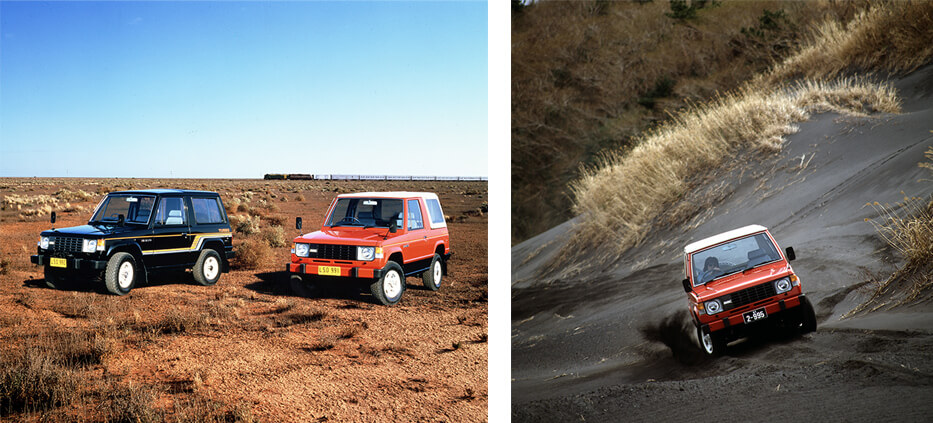
The Pajero, combining superior off-road capabilities with comfort, goes on sale (1982).
The Pajero demonstrated its true value in rally racing. In 1983, it made its first appearance in the Dakar Rally and won in the unmodified stock vehicle category. In 1985, it became the first Japanese car to win the overall championship. Masuoka also began competing in the Dakar Rally in 1987.
“The grueling Dakar Rally is the pinnacle of the world’s off-road races. I was determined to take on that challenge, driven by a strong desire to test both my own abilities and the performance of the vehicle in that arena. The first time I entered, my only thought was to win the overall championship. However, the pace was simply too fast, which caused a variety of problems. Ultimately, I was given a 10-hour penalty due to an electrical system malfunction. We recorded the race’s fastest time in some segments, which left us feeling frustrated at what we could have accomplished were it not for those problems. Covering about 14,000 kilometers over the course of three weeks—an average of 700 kilometers per day—the Dakar Rally was more grueling than I could have imagined. I still vividly remember how, back when I first competed, the finish rate was barely 30 percent. I sincerely felt like never competing again.”
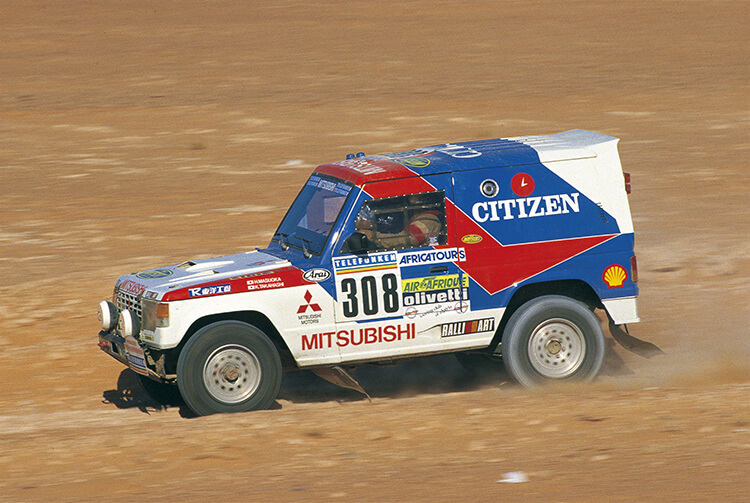
Masuoka’s first time competing with the Pajero at the Dakar Rally (1987)
Revolutionary Super Select 4WD — Performance honed through rally racing to improve the safety of production vehicles
1991: The second-generation Pajero hits the market. The Pajero gained attention as the world’s first vehicle to adopt Super Select 4WD, a system that combines the advantages of both full-time 4WD and part-time 4WD. In addition to 2WD mode and so-called direct 4WD mode without a center differential, the new VCU (viscous coupling unit) equipped 4WD mode allowed the vehicle to absorb the rotational differences between the front and rear wheels. This development achieved both smooth cornering on paved roads and advanced off-road capabilities.
“The adoption of a center differential made it possible to corner smoothly even on paved roads. During rally racing, this allowed for fast and comfortable driving that put less stress on the drive train during liaison sections, while for special stages, the center differential could be locked to maximize off-road capabilities.Thus, the car could be driven differently according to the circumstances.”
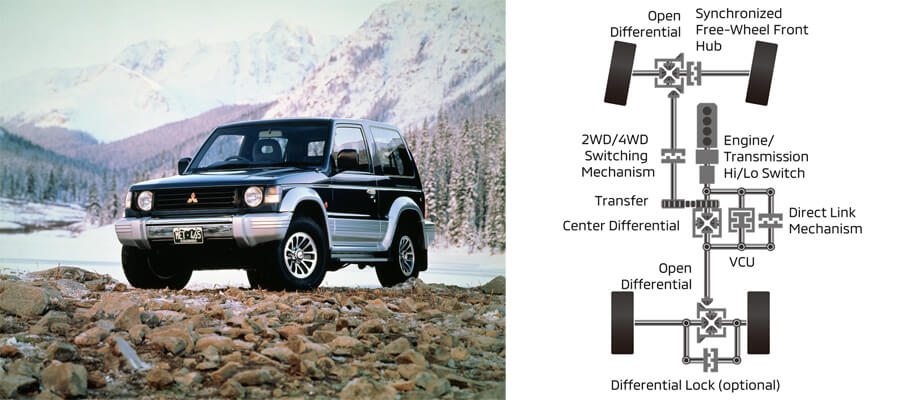
The second-generation Pajero, featuring Super Select 4WD with VCU-equipped center differential 4WD mode
The second-generation Pajero earned the marketing copy “grip the ground.” It embodied the concept of firmly gripping the ground for safe, enjoyable driving.
“What matters to drivers is how far they can push the car before reaching its grip limits. Rally racing provided the ideal test for improving that aspect of performance. It is precisely because of the performance that has been honed by professional drivers that we have achieved a car that regular people can drive with confidence. Back then, when skiing was all the rage, you’d often see Pajeros and Delicas at ski resorts.
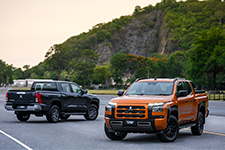
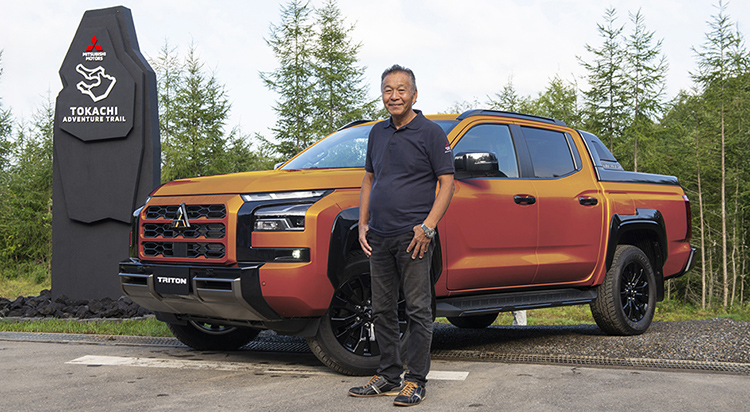
With Super Select 4WD, Mitsubishi’s four-wheel-drive system for traversing rough terrain was approaching its final form. However, Mitsubishi didn’t stop there. The company continued to refine the system, developing Super Select 4WD-II. The four-wheel control technology continuously refined by Mitsubishi is now featured in the Triton.
-
-
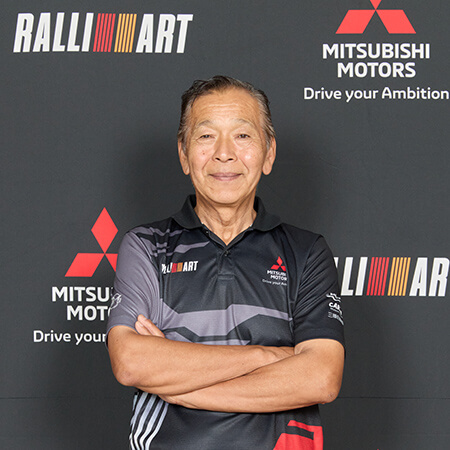
Hiroshi Masuoka
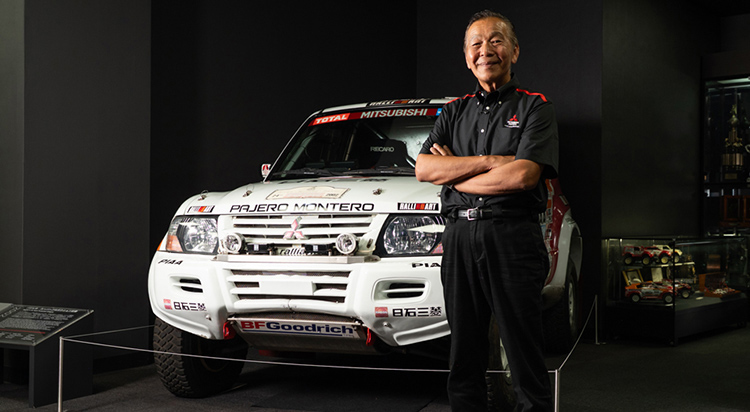
Rally driver Masuoka was the overall champion in 2002 and 2003 at the Paris–Dakar Rally, the world’s most grueling motorsport event. He has also competed in the Pikes Peak International Hill Climb in Colorado, USA with an electric race car, placing second in the Electric category in 2012 and 2013. During the Pikes Peak International Hill Climb held in June 2014, he achieved the outstanding result of second in the Electric Modified category (third overall) and contributed to the Mitsubishi Motors team’s 1–2 finish. Masuoka currently serves as Team Director for Team Mitsubishi Ralliart, which competes in the Asia Cross Country Rally. He led the teams that won the overall championship in 2022 and 2025.
Related Content
December 2025

