Pajero Story: Development Edition, Part 1
Four-wheel-drive vehicles were once machines built for specialists. The Pajero changed that. Born out of the bold ambition to create a vehicle that anyone could drive with confidence, it evolved dramatically over the decades while remaining true to a core principle that its engineers never abandoned: a genuine off-roader must not only conquer challenging terrain, but do so safely, comfortably, and with the assurance that wherever it goes, it can always bring its occupants home.
Looking back at the words of the engineers who helped develop the Pajero from the first through fourth generations reveals a philosophy that transcended eras and technological change, defining the vehicle from the very beginning.
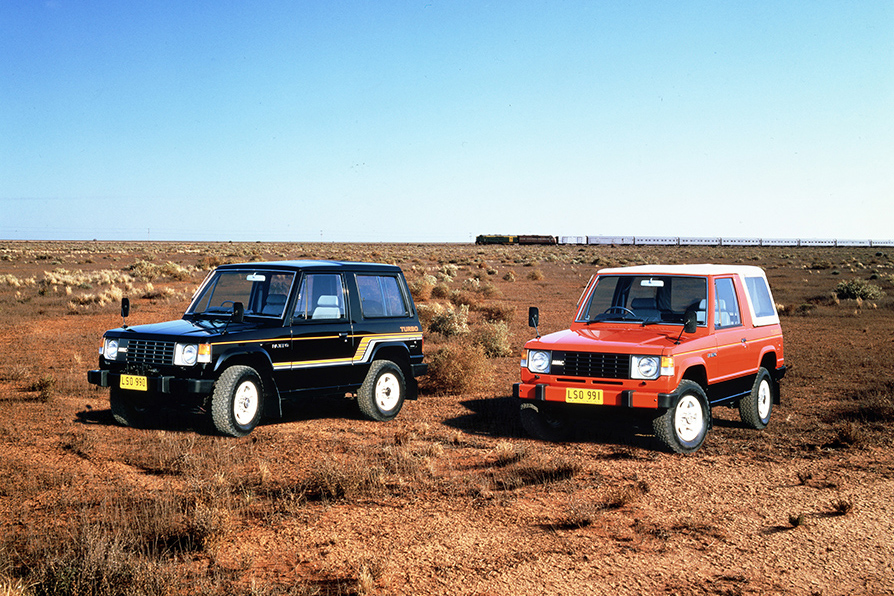
From “A 4x4 That Can Go Anywhere” to “A 4x4 That Anyone Can Drive”
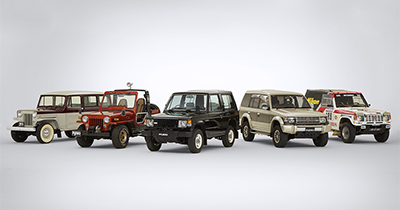
There was a time when four-wheel-drive vehicles were designed for a limited group of users. The story of the Pajero begins with the Jeep.
Under a licensing agreement with Willys-Overland, Mitsubishi Motors produced Mitsubishi-branded Jeep vehicles for the Japanese market. Their primary users included organizations such as the Self-Defense Forces, electric utility companies, and river management authorities, all of whom operated in demanding environments. These vehicles traversed rough terrain, transported heavy loads, and sometimes played a role in lifesaving missions. They offered exceptional durability and off-road capability, but this came at the cost of a stiff ride on regular paved roads, making them difficult to handle for the average driver.
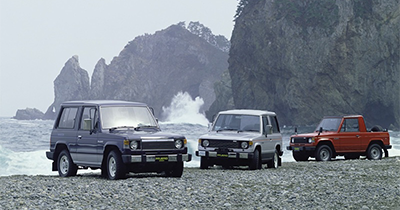
When the Pajero debuted in 1982, it challenged those conventions. Building on the expertise Mitsubishi Motors had developed through years through of Jeep production, the Pajero successfully combined serious off-road capability with the ease of use required for daily driving.
“The Jeep was produced under a licensing agreement and sold as a Mitsubishi model, but it could only be sold domestically, and we had limited freedom to improve it. As such, one of the starting points was our desire to create an original vehicle of our own.” So recalls Yoshiki Nishioka, who spent many years involved in Pajero development.
There was another catalyst behind the project.
“One of our senior executives had remarkable insight. After seeing so many SUVs on American roads, he became convinced that Japan would eventually need vehicles like these as well. At first, it wasn’t an official company project, but over time it developed into a full-scale program.”
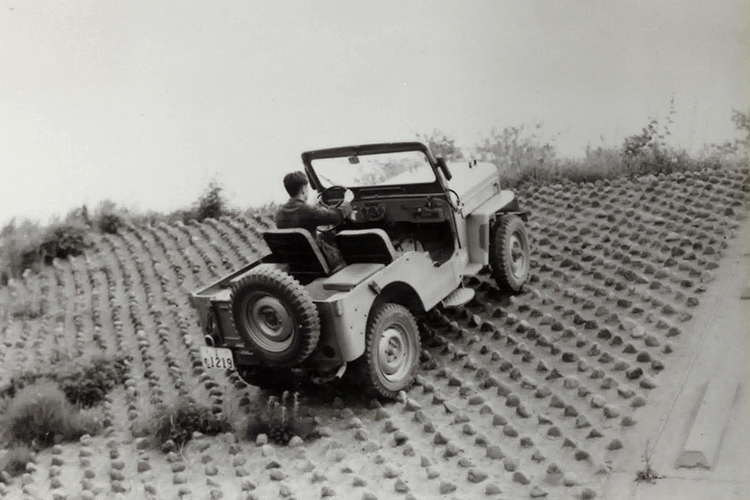

The goal was to create an original Mitsubishi Motors vehicle that anyone could drive with confidence.
Creating a four-wheel-drive vehicle that retained excellent off-road performance while being practical for everyday users meant carving out a new market, which was no easy challenge. While the Jeep delivered world-class performance on rough terrain, its very strength also made it difficult to handle on regular roads.
“The Jeep used a body-on-frame construction and rigid axles with leaf springs at both the front and rear. It was a vehicle that simply didn’t track straight very well. Driving it required constant steering corrections, which was exhausting. And because there was no power steering assistance, the steering itself was extremely heavy.”
While those characteristics made sense in harsh off-road conditions, they placed a significant burden on drivers on ordinary roads. To address this, the first-generation Pajero adopted an independent front suspension system. Because each wheel could move independently, it improved ride comfort by reducing vibration from the road surface while also delivering better straight-line stability and handling on paved roads. However, for a four-wheel-drive vehicle, maintaining solid tire contact with the ground even on rough terrain is essential. Improving comfort and on-road handling would mean little if off-road performance suffered. At the time, independent suspension was often viewed as less durable and less capable in challenging terrain.
“To overcome those concerns, we adopted torsion-bar springs to ensure sufficient suspension travel. One by one, we addressed the doubts surrounding independent suspension through engineering.”
As a result, the first-generation Pajero achieved levels of straight-line stability and drivability that had been impossible with the Jeep. The next challenge was balancing ride comfort with off-road capability.
“A rigid axle suspension with leaf springs offers long travel and excellent durability. It’s truly outstanding for off-road driving. But because the leaf springs rub against each other, the initial movement tends to be stiff, and the ride can feel bouncy. Starting with the later versions of the first generation, we switched the rear suspension to a three-link coil-spring setup and strengthened components such as the lower arms with forged parts. The goal was to achieve off-road performance, strength, and ride comfort all at once.”
The philosophy was never to sacrifice one attribute in pursuit of another. Pajero development focused on preserving the essential capabilities expected of a serious four-wheel-drive vehicle while steadily adding the qualities that ordinary drivers needed to drive it with confidence.
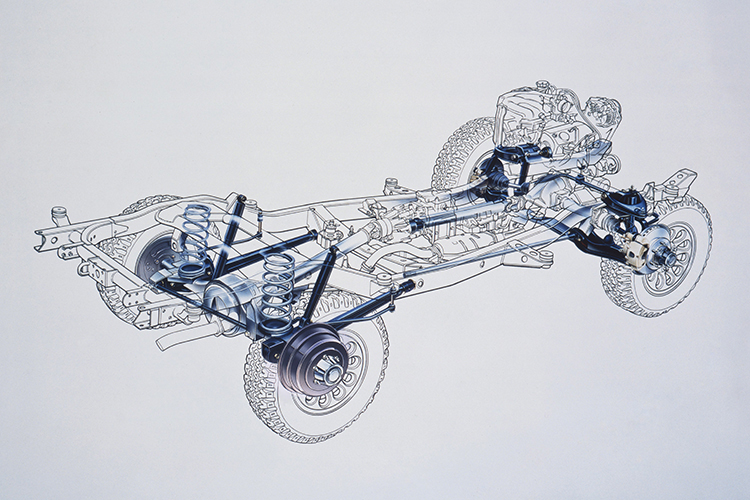
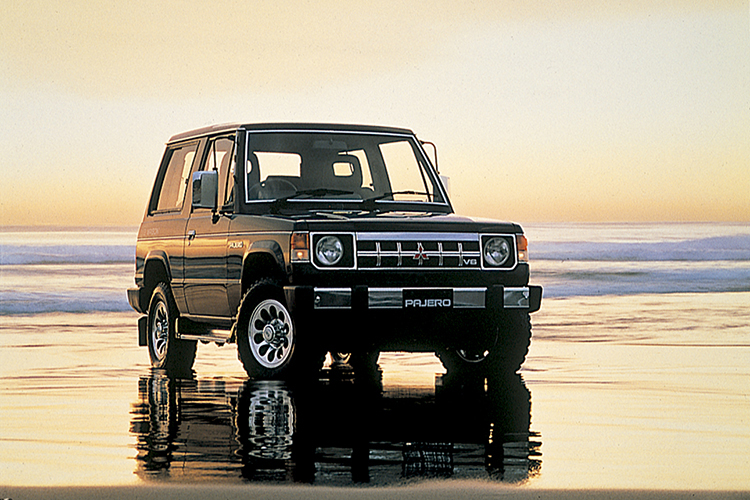
The facelifted first-generation Pajero adopted an independent front suspension and a three-link coil-spring rear suspension.
Hiroshi Funo, who has evaluated numerous Mitsubishi vehicles including the Pajero, sees that same approach, unchanged from the first generation, when looking over development documentation from the time.
“Whether you look at the first generation or the second, off-road performance always appears near the top of the development objectives. That was something they were never willing to compromise. On top of that foundation, they worked to improve on-road performance, comfort, and safety.”
That philosophy took a major leap forward with the introduction of the world’s first Super Select 4WD system on the second-generation Pajero. In the city, it delivered the driving feel of a rear-wheel-drive passenger vehicle. On highways and slippery surfaces, it provided the stability of four-wheel drive, and when venturing onto rugged terrain, it offered the capability expected of a genuine off-roader.
Looking back, Nishioka describes Super Select 4WD as “a technology that broadened the appeal and accessibility of four-wheel-drive vehicles.”
The goal was to ensure that off-road capability was not reserved for a select few. Instead, Mitsubishi Motors sought to make that capability accessible to more people without diminishing its effectiveness. Starting with the technologies and expertise inherited from the Jeep, the company continually challenged itself to solve that difficult equation. That pursuit became the foundation of what the Pajero stands for today.
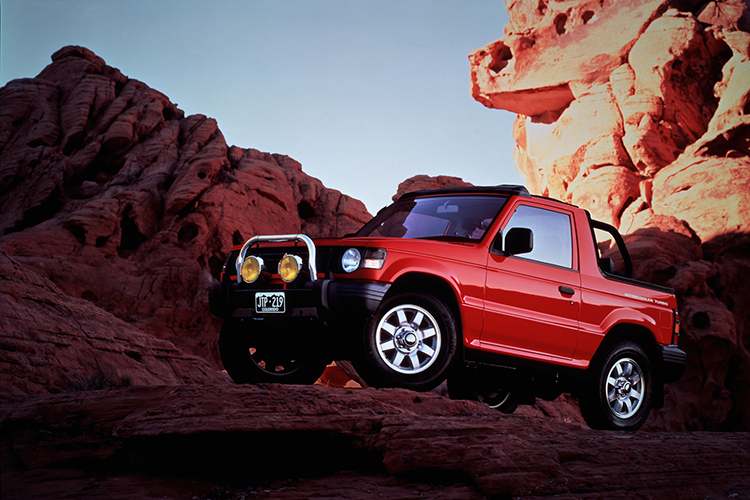
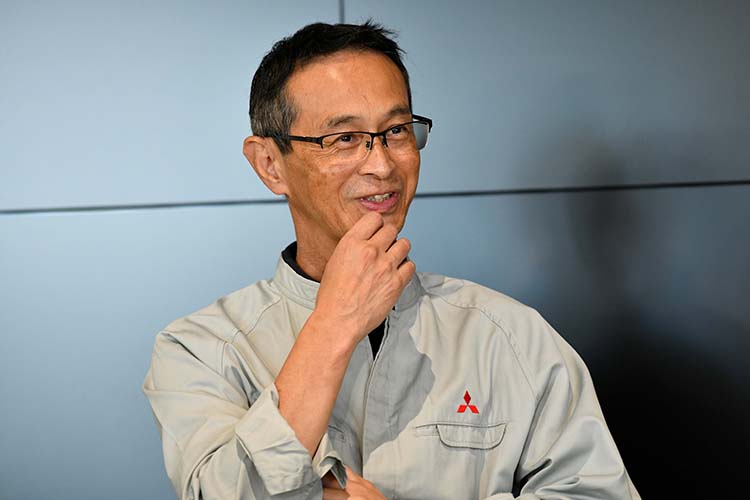
The second-generation Pajero took Mitsubishi Motors’ philosophy to a new level, enhancing on-road performance, comfort and safety without compromising its legendary off-road capability.
A Vehicle Designed Not Just to Withstand Damage, but to Bring You Home Safely
The Pajero was shaped by another principle that has been passed down through generations of engineers. For a four-wheel-drive vehicle intended to operate in harsh environments, durability alone is not enough. Engineers must also consider what happens if something does go wrong, ensuring that the vehicle does not become immobilized when it is needed most.
Nishioka still remembers the lessons he learned from his predecessors.
“For example, we were taught that if the transfer case ever failed, it should fail in a way that leaves the vehicle locked in four-wheel drive. The idea was to ensure that even in failure, the vehicle could still get you home.”
This mindset went beyond simply preventing failures to consider what comes next. That is, whether the vehicle could bring its occupants home safely when the unexpected occurred. This approach was evident not only in major systems like the drivetrain but also in features that, at first glance, might seem unrelated to the essence of a four-wheel-drive vehicle.
“When power door mirrors first began appearing, the Pajero adopted electrically operated retractable mirrors. It wasn’t simply because they were convenient, but because they could be folded away to prevent them from getting caught on branches during off-road driving. That’s the kind of thinking the engineers of the time used when deciding on vehicle features.”
What did each feature mean in harsh real-world conditions? What Nishioka inherited from his seniors was not just individual technical skills, but also a rigorous commitment to thinking about how vehicles are actually used. “No matter what happens, it keeps moving. No matter what happens, it gets you back home. That’s the philosophy I think has been passed down over the years.”
From its first generation onward, the Pajero has pursued far more than the ability to conquer difficult terrain. Its mission has always been to take people safely to their destination and bring them back again. To achieve that, Mitsubishi Motors continually enhanced durability and handling stability, steadily building up the necessary technologies one by one.
-

-
Yoshiki Nishioka
A veteran engineer who was continuously involved in Pajero development from the updated second-generation model through to the fourth generation. His career also includes development of drivetrain systems for rally vehicles, the launch of the first-generation Pajero Sport, the diesel program for the Delica D:5, and leadership of that model’s major design update.
-

-
Hiroshi Funo
A product evaluation specialist responsible for assessing the overall competitiveness and customer appeal of Mitsubishi vehicles. He was involved in product evaluations for the third- and fourth-generation Pajero and is currently engaged in motorsports vehicle development.
Oct. 2026

