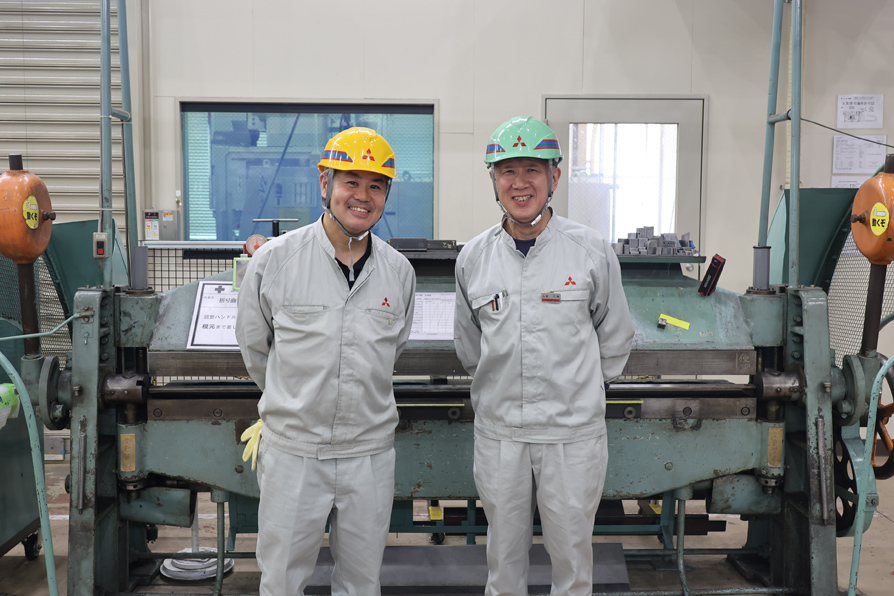
How are Mitsubishi Motors vehicles built? Behind every vehicle lies an intricate process that brings together research, planning, design, engineering, prototyping, testing, procurement, production, distribution, and sales. At every stage, skilled professionals contribute their expertise to turn concepts into vehicles. This series introduces the people behind Mitsubishi Motors worksites. In Part 2, we continue our conversation with members of the Prototype Department, shedding light on the early phases of vehicle development.(Read Part 1 here.)
The Roots of Each Sheet-Metal Fabricator
Kaji, who served as Yamamoto’s mentor, joined Mitsubishi Motors' Nagoya Plant, as it was known then, in 1981. After completing the company’s technical trainee program, he was assigned to the Prototype Department, where he has worked in sheet-metal fabrication ever since.
"I wasn't particularly interested in cars," Kaji recalls. "I grew up in Nagoya and my father worked for Mitsubishi Motors, so he encouraged me to join. I probably shouldn't be saying this, but there are still many things about cars that I don't know. But sheet-metal work happened to suit me. I enjoyed the work, and before I knew it, years had turned into decades."
"Back in the day, the department employed thirty to forty sheet-metal workers across two teams," Kaji continues. "At the time, sheet-metal fabrication was the centerpiece of prototype manufacturing. New employees were typically assigned here first and then rotated to other teams after a few years. Somehow, I ended up spending my entire career in sheet metal."
Yamamoto's story was different.
"I graduated from an industrial high school's automotive program, so I always knew I wanted to work in the automotive industry," Yamamoto says. "When I was eighteen, the Pajero was at the height of its popularity, and I admired Dakar Rally driver Kenjiro Shinozuka. Back then, I dreamed of being involved in developing vehicles, or perhaps become a test driver myself."
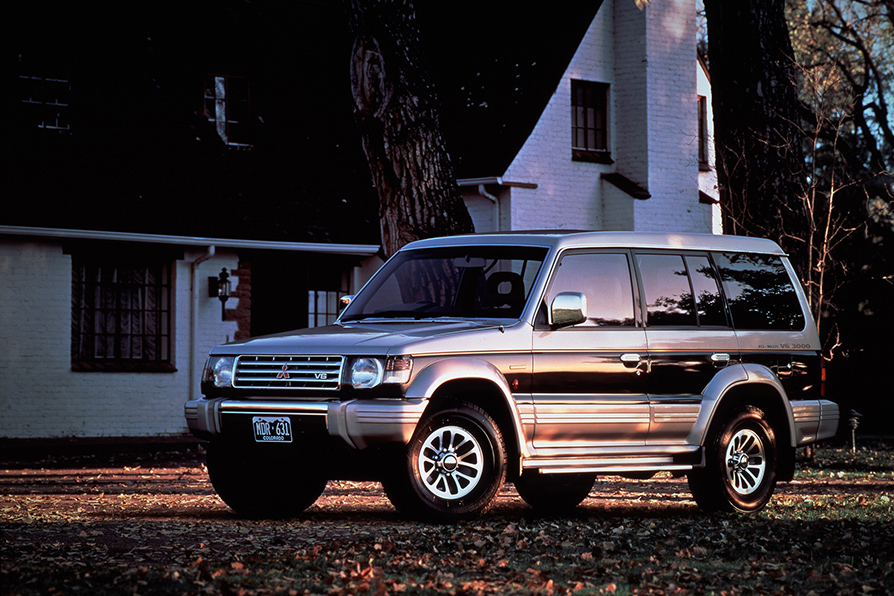
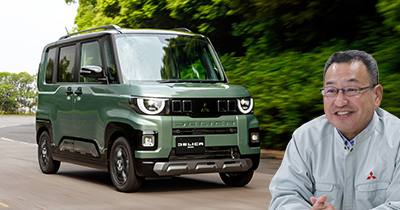
Pajero
Yamamoto's career took an unexpected turn during his time as a trainee.
"As trainees, we rotated through different departments and experienced a wide range of work. During one rotation in the Prototype Department, I spent time shaping steel sheet by hand. One instructor told me I was good with my hands and encouraged me to join the department. I've always loved making things, and I never forgot how much his praise meant to me. There was also a real sense of accomplishment in seeing a job through to completion. It wasn't the most glamorous department, but something about it just felt right."
After completing his trainee program, Yamamoto joined the Prototype Department's sheet-metal team. In 2002, he transferred to the Body Team, where he worked in sheet-metal fabrication and welding. Two years later, he moved to the Quality Control Team, conducting pre-shipment vehicle inspections. Since returning to the Body Team in 2020, he has served as a supervisor while continuing to work alongside fellow fabricators on the shop floor.
Mastery Honed Through Trial and Error
Despite the nearly fifteen-year gap between them, Kaji and Yamamoto experienced a similar workshop culture. Looking back on the history of sheet-metal craftsmanship at Mitsubishi Motors, Kaji begins with his years as a trainee.
"Our seniors taught us the basics, such as how to weld, how to hold a soldering iron, and how to use shears," Kaji recalls. "Beyond that, however, it was very much a watch-and-learn world. There were days when I was simply told to observe, and that was all I did for the entire day. I watched how different specialists worked and I copied their techniques. Over time, I refined what I had copied, adapting those techniques and developing methods of my own."
One memory from his younger days remains especially memorable.
"A senior technician handed me a drawing and told me to build the part myself. Even though I didn't know how, I was expected to figure it out on my own. At first, I was completely at a loss. But I didn’t stop trying. I created paper patterns, cut them out, assembled them, and checked whether the shape matched the drawing. The component was small but extremely complex. After a week of trial and error, I finally managed to complete it. The sense of accomplishment when I saw the finished piece was incredible. Moments like this are what have kept me passionate about this work to this day."
According to Kaji, it takes around five years before a sheet-metal technician can confidently fabricate intricate components such as brackets used inside a vehicle. Exterior body panels such as doors and roofs require even greater experience. Senior technicians would say 'you'll need ten years before you touch an exterior panel.'
It was no different for Yamamoto, when he joined the company at the age of 18 more than two decades ago.
"Back then, the sheet-metal shop was filled with large presses," he recalls. "All day long we worked with steel panels coming off those machines and processed them by hand. Just as it was in Kaji's era, we learned by watching others and figuring things out through practice."
Today, there are still times when the two work together.
"There are tasks that simply cannot be done alone," Yamamoto says. "In such cases, Kaji takes the lead and I support him. During heat-forming work, for example, one person heats the material while the other shapes it. We communicate through signals as we build the part together. There have also been times when Kaji stepped in to help correct my mistakes."
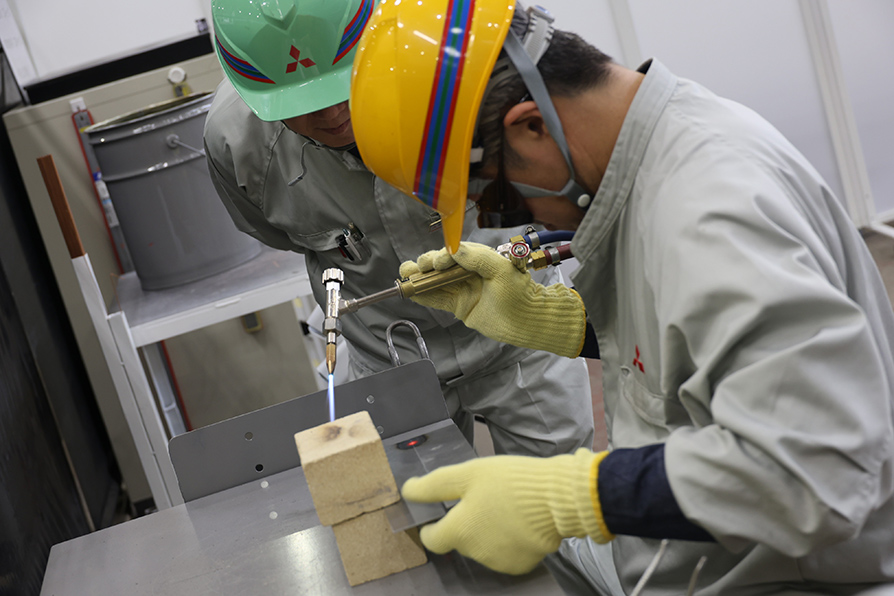
Yamamoto learning gas welding from Kaji.
The Skill to Balance Precision and Speed
Asked what makes Kaji exceptional, Yamamoto answers without hesitation.
"His precision and speed. Achieving a high level of accuracy takes time, but development schedules are fixed and there is only so much time available. You need to determine which tools and equipment to use and how to achieve a high level of accuracy as efficiently as possible. Kaji understands those methods thoroughly. Planning the fabrication process requires a great deal of experience and knowledge, and that's where you really see the difference between technicians."
Kaji, however, believes that even someone like Yamamoto, with more than a decade of sheet-metal experience, still has room to grow.
"Yamamoto learned the basics at a time when many of the veteran technicians were still around, so he has a solid foundation as a fabricator," Kaji says. "But there are still areas where he needs to grow. This is what I'm helping him with now, one step at a time. Although he's spent more than ten years working in sheet-metal fabrication, there was a period when he was assigned to other teams. Because of that, there are situations he hasn't encountered yet, and there are times when he's still searching for the right approach. If I had one hundred drawers of experience to draw from, he might have ten."
Despite the respect he receives from those around him as a master fabricator, Kaji remains humble.
"I'm still learning myself," he says. "Even now, whenever I think there may be a better way, I don't hesitate to change my approach."
Kaji's commitment to continuous improvement speaks volumes about his pride in his craft and his sense of responsibility as a technician. Rather than relying solely on the skills he has accumulated over the years, he continues to challenge himself, always searching for better methods and better results. That mindset inspires the people around him and serves as a powerful example for the next generation. For Yamamoto and many others who work alongside him, Kaji's example is a guiding light for the future.
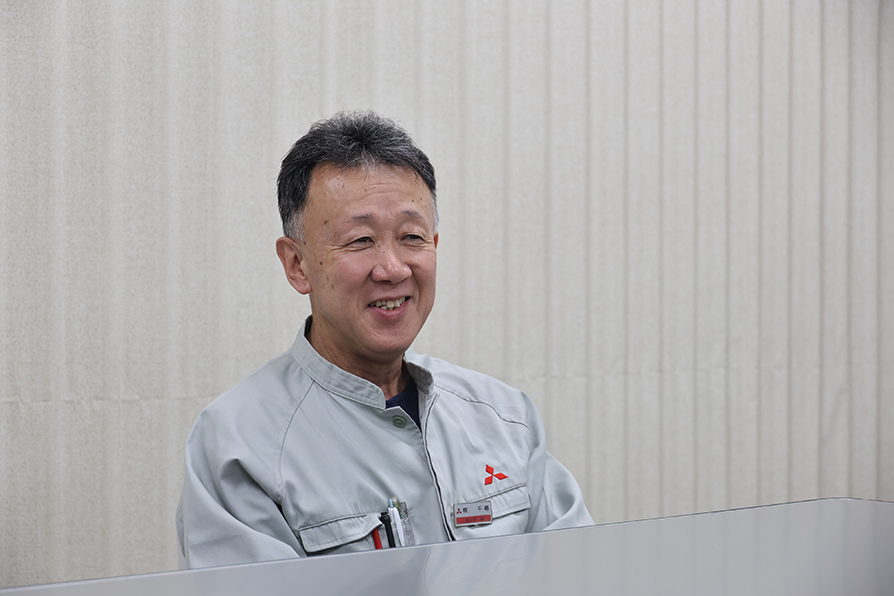
Chihiro Kaji, Prototype Department
Passing Skills from Master to Apprentice
As this series has shown, every stage of vehicle development is supported by highly skilled technicians. At the same time, the retirement of experienced employees in recent years has made the transfer of expertise an increasingly important challenge. To help preserve and pass on critical skills, the Vehicle Engineering Development Division, including the Prototype Department, has introduced a training framework known as the Master Evaluator program, which pairs mentors and apprentices to facilitate hands-on skill development.
In sheet-metal fabrication, advances in digital engineering have reduced the number of specialists engaged in traditional hands-on forming work. Today, Kaji represents the last remaining member of the department's oldest generation of sheet-metal specialists, with Yamamoto among the next generation carrying those skills forward. As a mentor, Kaji is passing on his knowledge not only to Yamamoto, but also to younger employees.
Yamamoto explains why sheet-metal expertise remains vital.
"Advances in digital analysis and press technology have significantly shortened prototype development timelines," Yamamoto explains. "Even so, there are always subtle differences between simulation results and actual components. Experienced sheet-metal technicians can identify how materials behave and how they change during processing, drawing on years of hands-on experience. This ability remains essential for ensuring quality and solving problems. Today, sheet-metal technology is once again being recognized within the company as an irreplaceable core capability, making skill transfer more important than ever."
"After decades of experience, I have a lot of accumulated experience to draw from, and now I'm opening my drawers and sharing what’s inside," Kaji adds. "But my methods may not always be correct. The basics are the same, yet sheet-metal work is more like language than mathematics. There are many ways to express the same result. I want Yamamoto to observe how I work, learn from it, and then find his own way."
Yamamoto describes just how much skill lies behind work that may appear simple from the outside.
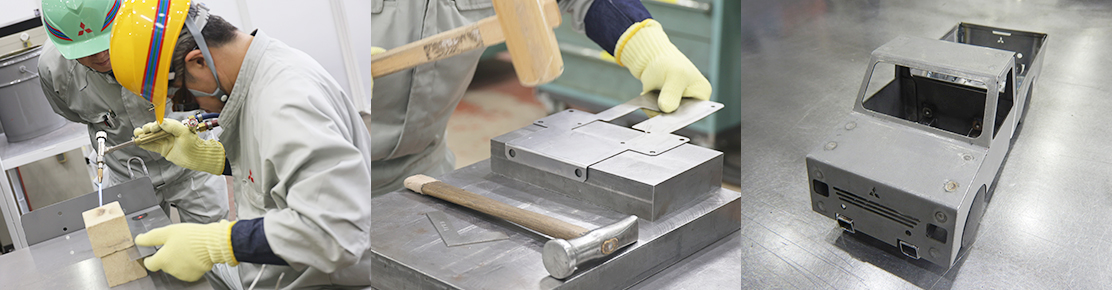
"Sheet-metal fabrication is extremely delicate. Something as simple as where you strike the material, how many times you strike it, and how much force you apply to it can dramatically affect the outcome. Each hammer blow causes the steel to deform, permanently altering its shape. It may look as though we're simply hammering metal, but we are actually visualizing how the material will deform before each strike. After every strike, we carefully examine subtle changes in shape, dents, and reflections of light. Without the ability to sense these changes and strike accurately, it is impossible to create the desired form. Producing a component by hand exactly as specified in the drawing requires a very high level of skill."
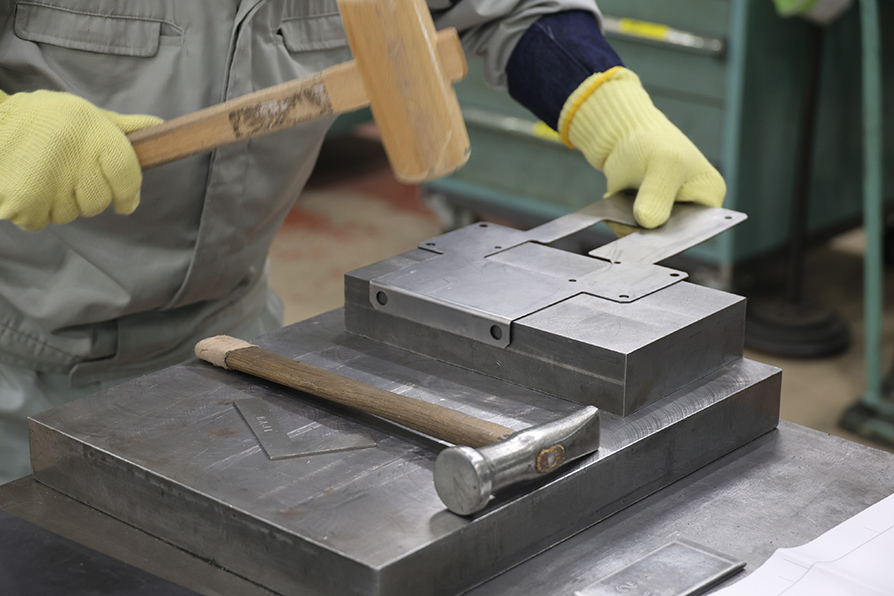
Training materials used in the Master Evaluator program, demonstrating panel-shaping techniques using a hammer.
"In the past, people gained experience simply by handling large volumes of work," Kaji says. "There was a lot to learn from repetition. Today, the workload is different, so we need a different approach. That is why we set aside dedicated training time. During these sessions, I share as much knowledge as I can from my own experience. After that, it's up to each individual to think for themselves and continue growing. Everyone is putting in the effort."
Finally, the two reflect on what makes Mitsubishi Motors unique.
"For me, it's vehicle performance," says Kaji. "The attention to detail in every aspect of the vehicle development process is remarkable. It’s not just the prototype work. Throughout the process, including many areas that customers never see, everyone is constantly striving to make things better. That dedication is part of what makes Mitsubishi Motors what it is."
Yamamoto concludes:
"People come together as one team. It's not only the Prototype Department. Everyone works to build the best possible vehicle before it reaches the customer. The commitment to quality, precision, and craftsmanship to meet our customers’ expectations is what defines Mitsubishi Motors."
The Prototype Department brings together highly specialized skills. Even though the team is located within a manufacturing plant, it is very much part of vehicle development. Without prototypes, vehicles cannot be created. The expertise accumulated by generations of skilled professionals remains one of Mitsubishi Motors' most valuable assets.