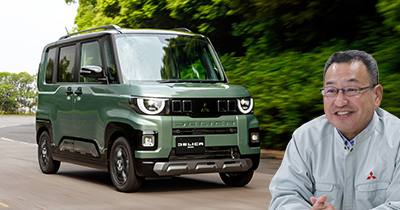
How are Mitsubishi Motors vehicles built? Behind every vehicle lies an intricate process that brings together research, planning, design, engineering, prototyping, testing, procurement, production, distribution, and sales. At every stage, skilled professionals contribute their expertise to turn concepts into vehicles. Among them is the Prototype Department, where hand-built prototype vehicles are produced in response to requests from engineering teams. Only after a prototype has been built and tested is a model ready for mass production. In this story, we venture into a department that is rarely seen beyond Mitsubishi Motors' doors and meet the people working at the forefront of vehicle development.
All Sheet-Metal Fabrication and Welding at the Prototype Stage Is Done by Hand
At the Okazaki Plant in Aichi Prefecture stands a building that houses the Prototype Department. Because the work carried out here is highly confidential, security is extremely tight and access is strictly limited. Roughly 100 employees work across several specialized teams in the department. These include the Body Team, responsible for vehicle bodies; the Powertrain Team, which assembles engines; the Assembly Team, which installs everything from engines to lighting equipment and completes the vehicle; and the Quality Control Team, which inspects prototype quality.
The rhythmic sound of hammers striking steel panels echoes across the first-floor workshop, while sparks scatter from welding benches where formed panels are being joined together. Employees here perform both sheet-metal fabrication and welding, and the sight of craftsmen quietly concentrating on their work gives the workshop the feel of a traditional neighborhood metalworking shop.
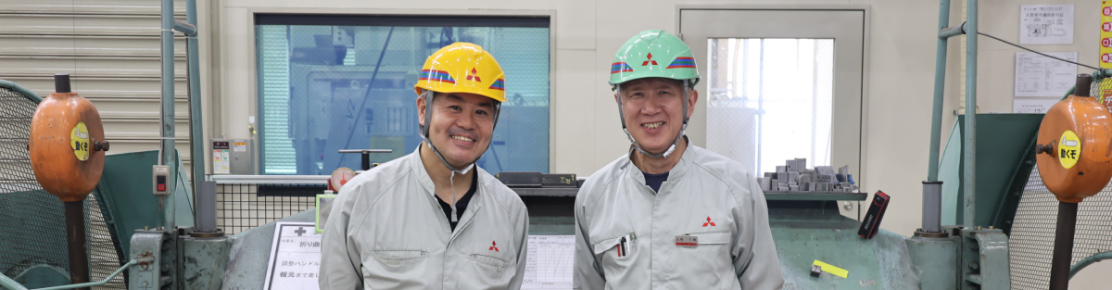
During our visit, we spoke with Chihiro Kaji and Toshihiko Yamamoto of the Body Team, both highly experienced technicians who fabricate parts for prototype vehicles.
Sheet-metal work is often associated with large presses shaping exterior body panels. In addition to welding parts supplied by external vendors, the Prototype Department also handcrafts a number of small components used in the vehicle.
Yamamoto explains:
"For example, a drawing for a bracket1 comes down from the engineering division. Based on that drawing, we fabricate the component from a flat sheet of steel."
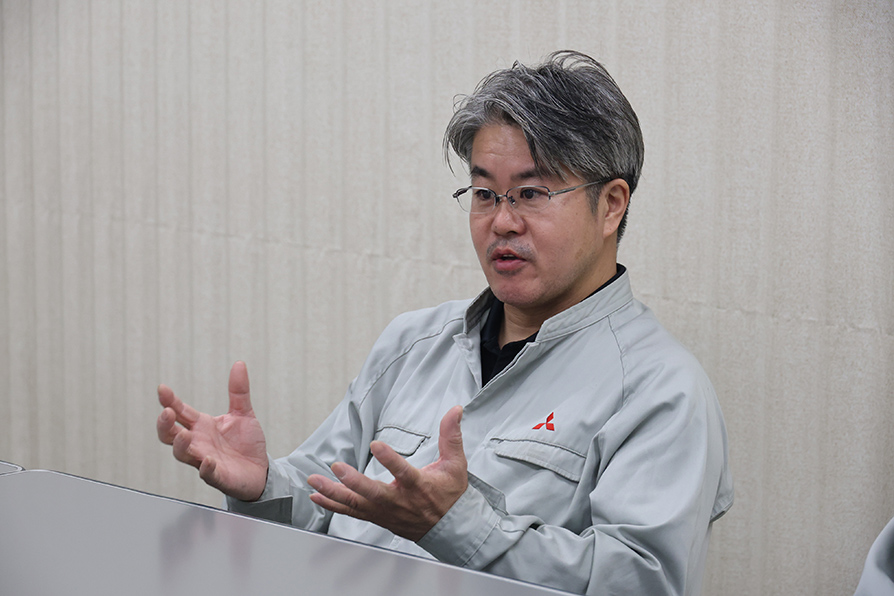
Toshihiko Yamamoto, Prototype Department
A veteran craftsman who joined Mitsubishi Motors in 1996, Yamamoto has spent his entire career in prototype manufacturing. Large components such as roof panels and door panels are outsourced for forming, but much of the work carried out here involves producing unique metal parts specifically for prototype vehicles. Flat steel panels of varying thickness are cut using laser equipment or shears, then hammered, bent, stretched, shrunk, and welded into three-dimensional components.
In mass production, parts are formed using dies and robots perform the welding. At the prototype stage, however, every sheet-metal and welding operation is carried out by hand.
"Take the installation of an O2 sensor2, for example. Engineers first determine the type of bracket needed to support the sensor. Then they translate their concept into a 3D model and ultimately into a single engineering drawing. This drawing is then brought to us with a request to build the part."
How does a single drawing become a finished component?
"The first step is to draw a flat pattern on a sheet of steel based on the drawing. We then cut the sheet using a laser machine or shears. Referring back to the engineering drawing, we shape the material by bending, stretching, shrinking, and hammering it by hand with a hammer. Once the part is complete, we compare it against the drawing and use measuring instruments to verify that all of the dimensions are accurate. Sometimes we are asked to make just one part, while in other cases we may produce ten or twenty identical pieces. After the component has been finished to specification, it is handed over to the Assembly Team or to the departments responsible for testing. Because every step is carried out by hand, creating the exact shape requested can take a considerable amount of time.
Depending on the component, it can sometimes take as long as a week to complete a single part."
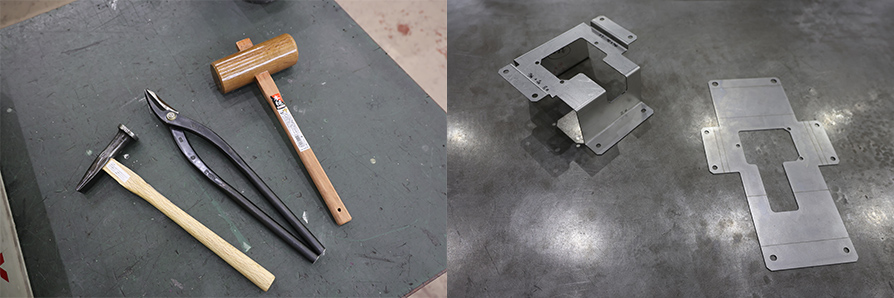
Using tools such as hammers and shears, fabricators transform flat patterns
(on the right) into finished components
"We're Old-School Sheet-Metal Fabricators Through and Through"
When people hear the term prototype vehicle, they often think of a new model. In reality, the work includes much more than that. From building test vehicles for crash testing to producing parts for future model updates, the team receives a constant stream of requests.
"Project teams come to us with ideas for the next round of improvements. For example, if they want to increase the vehicle width, we literally cut the vehicle, extend it, and insert steel panels to achieve the desired width. We also receive requests for parts that are small enough to be made by hand, parts with highly complex shapes, components that have to be produced quickly before production tooling can be prepared, or small parts that are just for testing. We really are old-school sheet-metal fabricators through and through."
The Prototype Department supports vehicle development from its very earliest stages. How were these skills developed, and how have they been passed down over the years?
In Part 2, we take a closer look at the people behind the craft and the efforts being made to preserve and pass on these specialized skills.
- A metal fitting used to mount, support, or connect other components.
- A sensor that measures the oxygen content in a vehicle's exhaust gases, used to help control the air-fuel ratio in gasoline engines.

