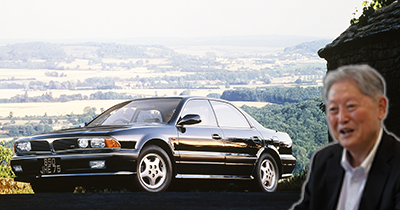
How exactly are Mitsubishi Motors vehicles made? Professionals with highly advanced skills oversee every step in the series of processes from research to planning, design, engineering, prototyping, testing, purchasing,
production, distribution, and sales. In this series, we feature individuals from Mitsubishi Motors worksites. This time we will hear from Tetsuo Shinozaki, Manager of the Product Planning Department in the Product Strategy Division, who was in charge of product planning for the Outlander PHEV.
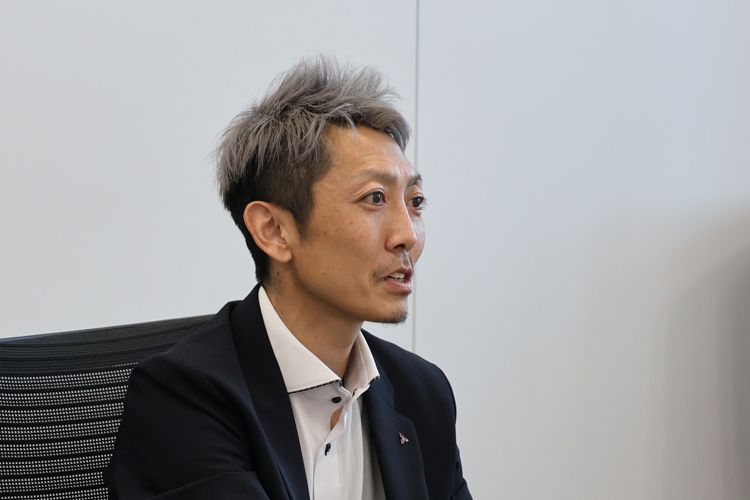
Shinozaki was studying hydrodynamics as an engineering student in graduate school when he saw a Mitsubishi car competing in the Dakar Rally and thought, “Wow, I didn’t know a car could do that!” This gave him the feeling that “Rather than simply making cars that customers find agreeable, Mitsubishi Motors goes a step beyond. This is a company that truly makes cars for thrills and joy, and to excite people.” Based on that, he chose Mitsubishi Motors as the place where he wanted to work.
Shinozaki joined the company in April 2005. He was assigned to the Product Planning Department in the Product Strategy Division, and his first assignment was to handle the planning for the Delica D:5 (launched in 2007).
“I joined the company while the project leading up to the launch of the Delica D:5 model was in progress, and I was put in charge of planning in a two-person team with the manager. The previous generation model was the Delica Space Gear, an interesting car with a built-in ladder frame structure. It was characterized as being a family car that could also drive off-road. However, when redesigning the model as the Delica D:5, we thought it needed an evolution to stay up with the times. We significantly changed the platform by making it fully monocoque structure to improve ride comfort and fuel economy.”
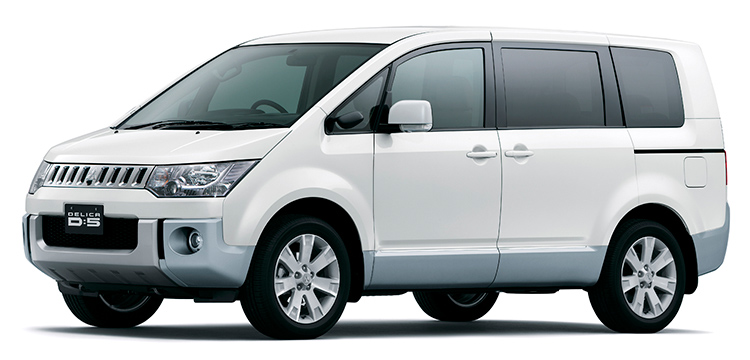
The switch to full monocoque structure was the first major redesign of the Delica Space Gear in 13 years.
However, it was apparently not received very well at first.
“Not only our customers but all kinds of people inside the company were also telling us, ‘This isn’t what Delica is all about!’ The perception of the Delica with its previous frame structure as a car that could drive anywhere using off-road functionality derived from the Pajero really seemed to have become entrenched.”
However, the new model’s reputation gradually improved.
“Those of us from the planning, development, and design departments that are involved in manufacturing worked together to propose as many new things as we could each do, based on our shared desire to bring enjoyment, amazement, and excitement to our customers. The new Delica was the result of those efforts. For us, the solution that meets the needs of the times might have changed, but the Delica value proposition was the same: to transport our customers to all types of places so that they create new memories together and build closer connections. People’s responses were initially negative, but then they began to appreciate it and even gradually began trading in their old vehicles for it. Now, it stands as one of the iconic models of the Mitsubishi Motors brand. That experience taught me the importance of continuously making proposals that exceed customers’ expectations in car development.”
The Outlander PHEV was the model that got back to customers’ expectations, putting value into tangible form
He worked on various models after that, often involved particularly in the initial stages of thinking up the product concept. Some projects ended up vanishing even after the plan came together because profitability could not be established. Among those, the Outlander PHEV (launched in January 2013) was the project he had been waiting for.
“Normally, development on a new car model starts four or five years before its eventual launch. Consideration for this model also began around the year 2008. We already had an SUV called the Outlander, but SUVs are heavier than sedans and hatchbacks, with relatively worse fuel economy. The idea was to give it a PHEV system with technology that incorporates fuel-efficient elements of electric vehicles, achieving the best of both worlds as an ‘SUV, but with good fuel economy.’ Since we own the technology that brought the world its first mass-produced electric vehicle, the i-MiEV, along with a battery that delivers enough range for city driving and a motor with superior drive power, we started with the idea that we could make an intriguing vehicle by equipping these onto an SUV with four-wheel control technology. We thought that we might be able to come up with the perfect vehicle, one capable of offering the driving enjoyment and utility of a PHEV system.”
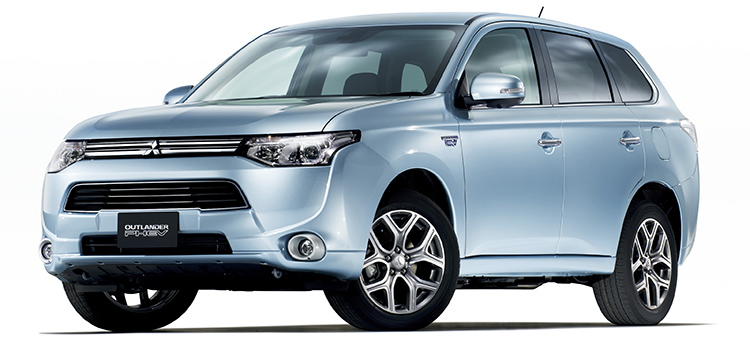
The technology for PHEV systems was already there, and cars that were marketed for their good fuel economy already existed throughout the world. However, no other companies had the idea for an SUV-type 4WD PHEV. Mitsubishi Motors was the first to try making one. That being said, it could not be accomplished simply by equipping an SUV with a battery and electric motor. There were a number of technological problems that first had to be resolved.
“We had expertise in electric vehicles and understood the characteristics of electric motors. However, as simple as the word ‘battery’ might sound, batteries in PHEV systems have different characteristics from those in purely electric vehicles. In an electric vehicle, the battery is essentially depleted and then recharged, but a PHEV system can charge the battery using power generated by the engine, and power can be transferred to or from the battery while driving. On top of that, the characteristics and precision can also differ depending on which company manufactures the battery. Using batteries was not easy as a car company that had never dealt with them before. We struggled to determine which one was the most suitable.”
The biggest struggle in development was in figuring out how to control the combination of engine and motor powered driving.
“Simply put, hybrid vehicles fundamentally run on the electric motor at first while traveling at speeds up to 10 or 20 km/h, and use the engine at speeds higher than that. Use the electric motor at lower speeds and gasoline at high speeds—it’s easy to understand. On the other hand, PHEV systems have a large battery capacity, meaning they can run on the electric motor up to around 100 km/h. Thus, they must be controlled more meticulously to determine which type of driving is optimal. The electric motor and engine have entirely different characteristics, and they perform better at different speeds. What we focused on was raising the speed of the smooth, quiet electric motor drive as much as possible, and figuring out how smooth we could make the transition to the engine so that no shocks could be felt. We struggled the most with figuring out how to configure controls such as these.”
Development would not be easy. In the beginning, unexpected defects were popping up one after another.
“Anticipating that customers might use the car in various ways, we drove it all over Japan during development and repeatedly tested out various phenomena. We also encountered quite a few unanticipated situations, but the Outlander PHEV that we have today took shape as we overcame them one by one.”
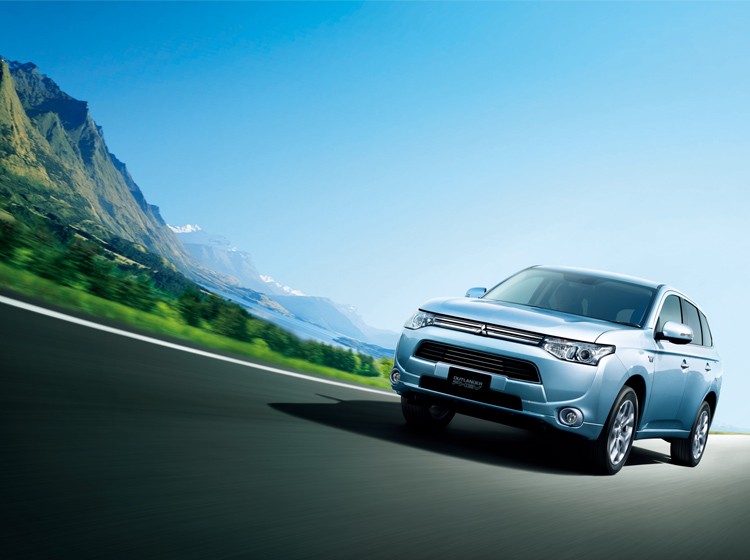
Through repeated trial and error, we were finally able to overcome the technological problems. However, an issue in the planning was that the retail price would be 1 to 1.5 million yen higher than the normal gasoline version of the Outlander. Even though the fuel cost would be lower, would that fall far short of justifying the price? Or, would we be able to deliver an appealing value proposition that would make customers want to buy it? The struggle on the planning side was with how customers would appreciate the value of the PHEV system itself.
“From that point, we got back to customers’ expectations all over again. Beyond just fuel economy, the smooth acceleration of electric motor drive that cars with gasoline engines can’t emulate could also be a customer value proposition for the PHEV system. As an electric motor, it also offers a comfortable ride without shifting gears, and stays quieter at speeds that don’t activate the engine, among other benefits. On top of that, the electric motor also exerts precise, pinpoint control on the four-wheel drive. We brainstormed together to work out how we could truly help customers understand these advantages of the PHEV system and be willing to pay for them, recognizing the value and the fairness of the price.”
“The planning department would offer new technological propositions from the development department as new concepts aligned with customer needs. Just being able to manufacture by having the departments involved work together like this, out of a genuine shared desire to satisfy, even surprise our customers: I think that's one of the great things about Mitsubishi Motors. It’s one of our strengths.”
Doing things this way also led to more propositions for new ways to utilize the cars.
“Since the battery contains electricity, that can be tapped into for new types of experiences during outdoor excursions. For example, you could boil water for coffee, use an air conditioner to get comfortable, or use electric cookware to prepare meals without an open fire. If a disaster strikes, it can be used as a new lifeline. In addition to lower maintenance costs, we created stories to also have these new advantageous features reflected in the price, and we promoted this new value.”
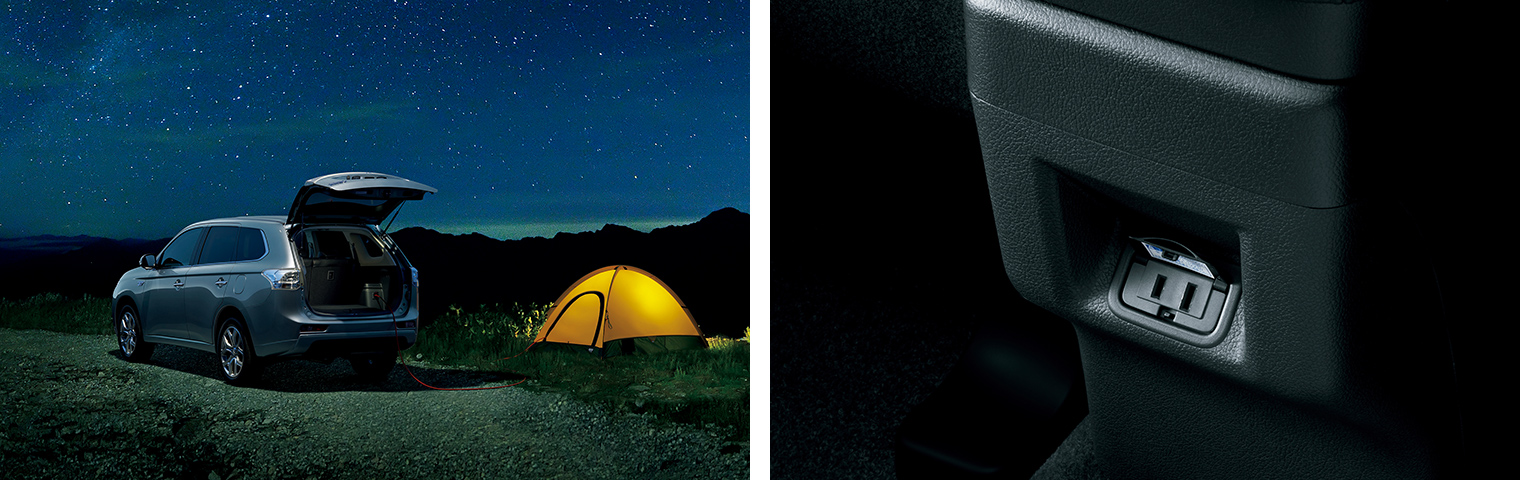
Featuring an on-board 100V (1500W) AC outlet that can supply power for electrical appliances, etc
“Launched in January 2013, it went on to win the Japan Car of the Year Innovation Award that year. It was recognized as excellent for successfully integrating the advantages of a PHEV and an SUV to offer new usage propositions for cars, for its balance of fuel economy and road performance, and for its large capacity battery output along with the ability to charge its own battery.
As the car’s reputation rose along with its price, customers such as import car enthusiasts who shop in price ranges beyond those offered at our dealerships started recognizing the appeal of the Outlander PHEV, and they started visiting Mitsubishi Motors. I think the Outlander PHEV was probably the first model that brought about this type of change in Mitsubishi Motors clientele.”
Shinozaki has been working on planning for future products since 2023. He has also handled the planning for concept cars at the Japan Mobility Show events held in 2023 and 2025. His department pursues the distinctive essence of Mitsubishi Motors, with their sights set on the future.
-
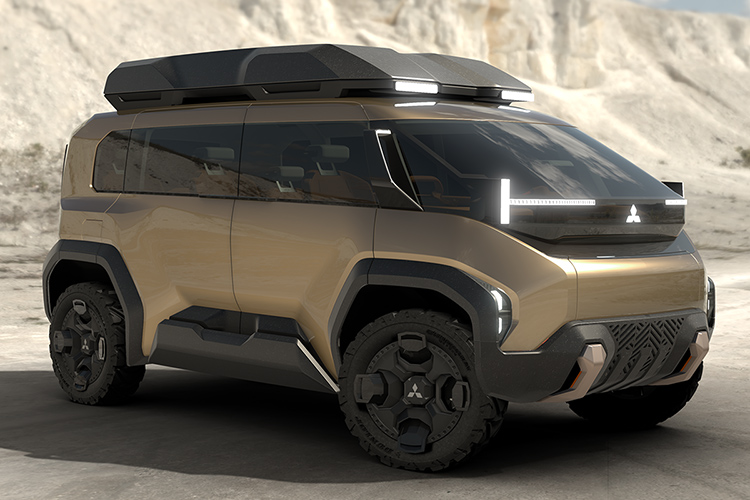
『MITSUBISHI D:X Concept』 -
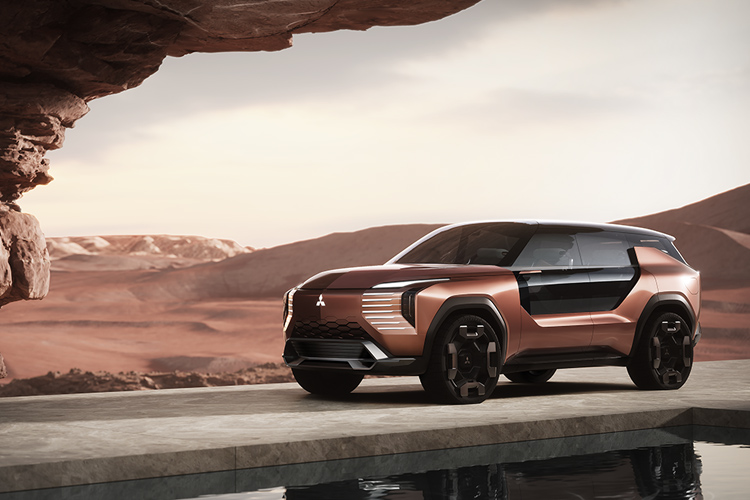
『MITSUBISHI ELEVANCE Concept』
“Our department sketches out the vision for how the lineup of cars that embody the distinctive essence of Mitsubishi Motors will look a decade form now. We set out a direction, then incorporate that into the manufacturing. In order to survive, it is imperative for us to make cars that lean into the distinctive characteristics of Mitsubishi Motors. The Mitsubishi Group has a history and philosophy of channeling the world’s most advanced technologies into the general public and making the world better. As part of that, Mitsubishi Motors also channels cutting-edge technologies into commercial models to offer to our customers. Excitement that anyone can enjoy with reassurance—that’s what I think the distinctive essence of Mitsubishi Motors is all about.”
More than just technological capabilities, but also the passion to deliver amazement and enjoyment that exceed customers’ expectations, and the determination to continue offering new value. The combination of those could be considered what Mitsubishi Motors is all about.

