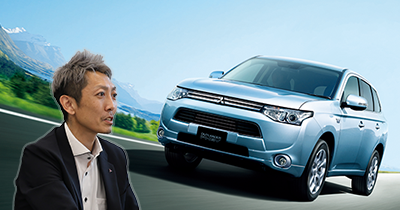
How exactly are Mitsubishi Motors cars made? At each step in the series of processes from research to planning, design, engineering, prototyping, testing, purchasing, production, distribution, and sales, there are professionals with highly advanced technical skills overseeing each respective process. In this series, we feature individuals from Mitsubishi Motors worksites. In this installment, we speak with Masato Kojima, who works with the Assistant Division General Manager of the Product Strategy Division, and who oversaw product planning for the Diamante, a premium four-door hardtop*1 that astonished the world and redefined a category dominated by compact cars (5-number vehicles)*2.

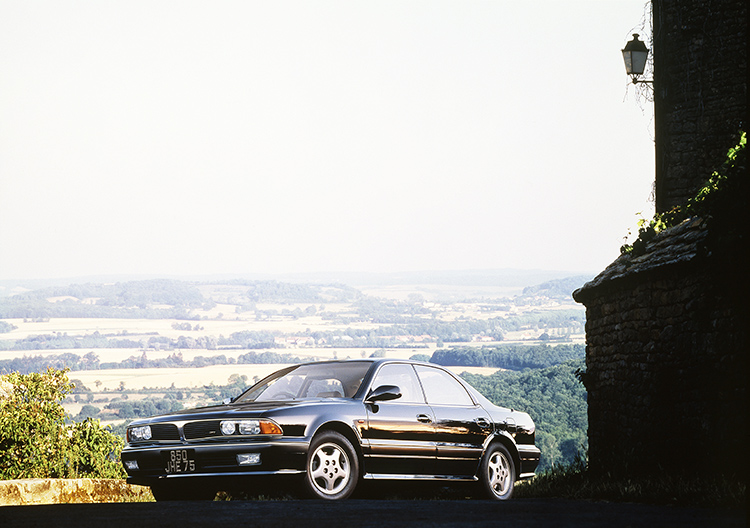
The Diamante was a new premium four-door hardtop car launched by Mitsubishi Motors in May 1990. For the Diamante, Mitsubishi Motors adopted a wide body designed specifically as a 3-number vehicles (standard cars), setting it apart from the 5-number vehicles available at the time. Its imposing appearance and premium styling were a good fit for customers who desired a high-end sedan while offering a competitive price with 5-number rivals, making it popular across a broad customer base. The Diamante earned Mitsubishi Motors its second Car of the Year award. By developing a wide-body model ahead of its competitors, Mitsubishi Motors reshaped the Japanese automotive market from the 1990s onward, as the Diamante both anticipated and verified a shift in customer demand driven by tax reform that earned it a reputation as a “game-changer.”
Furthermore, in addition to the powerful performance delivered by its 2.5-liter V6 engine, the Diamante offered a spacious, elegant interior with genuine woodgrain panels and seats upholstered with 100-percent pure wool fabric. It also incorporated advanced technologies typical of Mitsubishi Motors, including first-in-class full-time 4WD and a proprietary traction control system.
- *1 A four-door hardtop car is a four-door car without door window frames .
- *2 Under Japan-specific automobile regulations, a compact car (5-number vehicles) is a vehicle with a total length of 4.7 m or less, a total width of 1.7 m or less, and an engine displacement of 2.0 L or less. If any of these specs are exceeded, the car becomes a standard cars (3-number vehicles). Up until April 1989, standard cars incurred a significantly higher commodity tax, which was included in the price tag of a new vehicle, as well as annual automobile taxes and insurance premiums, compared to 5-number vehicles. Consequently, demand for such vehicles was extremely low, and the bodies of even domestic luxury sedans were generally being developed within the compact car category.
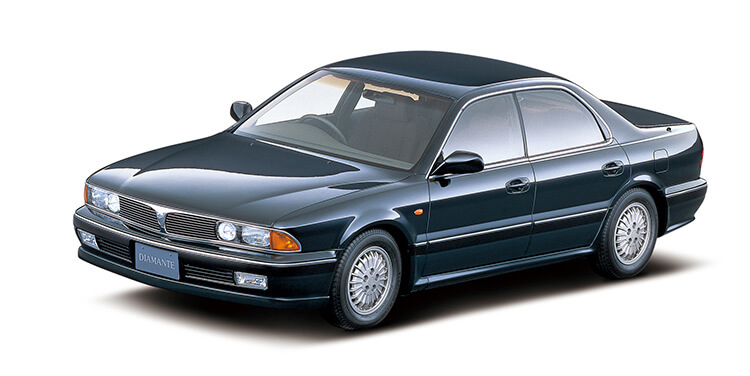
Diamante
Kojima, a self-described fan of Mitsubishi cars since his student days and former Lancer EX driver, joined Mitsubishi Motors in 1982. He was seconded to Nishi Nihon Mitsubishi Motor Sales in 1984 and tasked with selling new vehicles. In 1987, at the age of 28, Kojima returned to Mitsubishi Motors and was assigned to the Passenger Vehicle Product Planning Department, where he worked on product planning for individual models until 2004, at which point he was 45 years old. The first vehicle he worked on was the Diamante.
“As Japan’s economy expanded in the 1980s, demand for premium vehicles in the domestic market saw remarkable growth. One of our competitors at the time was selling as many as 600,000 units per year, including sibling models sold through affiliated sales channels. We wanted to break into the premium market somehow, and to do that, we needed to develop a car that would be competitive. At the time, Mitsubishi Motors had been selling the Galant Sigma, a car that boasted a spacious interior but lacked a decisive selling point. To satisfy the expectations of premium car users, we needed a vehicle with not only a more high-quality interior and exterior but also one with a feature that was groundbreaking.”
Kojima recalled an unforgettable experience from his time as a salesman at a dealership.
“At the dealership, I did everything I could to sell the Galant Sigma. On one occasion, I found myself in fierce competition with another company during a sales negotiation. I visited the customer several times and painstakingly explained the spaciousness of the interior, the Galant Sigma’s main selling point, and I offered a significant discount that made the total cost 500,000 yen less than competing models. In spite of all that, the customer went with the competitor’s vehicle.
The customer told me that I offered a very reasonable price, but it wasn’t about the money. It was a crushing defeat. This experience left me questioning what it is that customers truly value, and I had to dig deeper. The first thing I realized is that we needed to make products that could hold their own in a competitive market. I also realized that if we could make such cars, then we could sell them at fair prices without lowering our prices.”
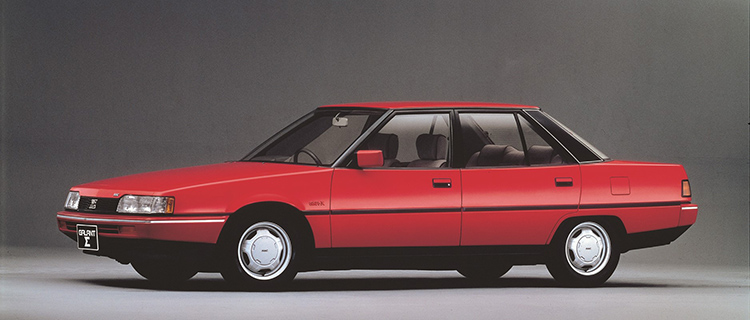
Galant Sigma
The Product Planning Division, which is responsible for planning product lineups and individual models, has now expanded to over 120 employees, but at that time, it was only a quarter of its current size.
“The division had fewer employees than it does now, and we were developing and marketing more car models back then. I think my passion back then was because of how much I love cars. Our main task in product planning was to submit proposals, but that alone isn’t enough to get the job done. We cannot make cars on our own. We cannot create a car that truly resonates with our customers without creating a proposal document and thoroughly explaining the concept behind it to the personnel in development, design, sales, and other departments in order to gain their understanding and cooperation so we can work together with our goals aligned.”
What kind of car did Kojima and his team aim to create?
“At the time, the people who were buying luxury domestic cars and foreign brands were mainly self-employed people and doctors who would write off some of the car’s cost as a business expense. On the other hand, the main buyers of premium vehicles were corporate managers and department heads — a demographic that was highly sensitive to vehicle prices and maintenance expenses. However, both of these groups had a similar idea about the kind of car they wanted: one that was restrained and dignified with a sense of stability and a high-class feel. Mitsubishi Motors would be able to compete even as a latecomer in this segment if we could successfully offer a groundbreaking car in the premium sedan segment whose sense of prestige could rival luxury cars. With the planning, development, and design teams having a shared vision, we took on the challenge of making a car that could compete.”
How should they approach this task? Kojima kept coming up with concrete ideas.
“At the time, domestic luxury cars were 5-number vehicles (compact cars) with long, narrow shapes. By comparison, cars manufactured by foreign brands had wide bodies with more imposing shapes. It occurred to me that that was the kind of car we should try making. This seemed like the way to go if we were concerned with not only a sense of luxury and sophistication but also the powerful driving performance Mitsubishi Motors was known for. We also needed to figure out the design. Three departments — product planning, development, and design — worked as a single team to discuss ideas and brainstorm together. We had so many great team members.”
For this project, they settled on designing a wide-body 3-number (standard) car as their approach. However, they faced a major obstacle.
“At the time, we were deeply concerned. Developing a special wide-body vehicle in the 3-number category was an impossible challenge by the standards of that time. However, as a latecomer challenging the overwhelmingly popular premium models of our competitors, we needed to offer a vehicle whose appeal would surpass even theirs in order to stand a chance. One promising solution was to adopt a wide body design that was too large for the 5-number classification. We thought that this would allow us to offer bold styling, a spacious interior, and a superior driving experience. However, at the time, Japan had a commodity tax rather than a consumption tax. Cars of the 3-number category were subject to extremely high taxes, and owners also had to pay higher automobile tax and insurance premiums.”
Kojima’s team created full-scale design models and conducted repeated surveys both inside and outside the company. The wide-body model in the 3-number category was widely praised, being seen as “cool” and something people were eager to buy, but when the purchase cost was revealed, people would respond that it was unaffordable, and that was the sentiment that overwhelmingly dominated survey results.
“It was a car that wouldn’t sell right now, even if we made it. We persisted and conducted repeated verification work, but we eventually reached the point where we would have to make a decision to prevent development from falling behind schedule.”
About one year had passed since the original concept was developed, and the release date had been pushed back from 1989 as initially planned to 1990. The deadline for making a decision finally arrived in fall 1987, and Kojima’s team gave up on the 3-number car idea.
“We ended up making the difficult decision to develop a narrow car in the 5-number category.”
Abandoning conventional approaches and pursuing new ideas to satisfy customer needs
Kojima’s team had no choice but to abandon their original plan. However, one month later, in late November 1987, Kojima was reading a newspaper during his morning commute to work on the Yamanote Line when he came across something that stunned him. An article on the front page jumped out at him. It was reporting on a complaint by the EU to GATT*3 that Japan’s high automobile taxes and expensive insurance premiums on domestic 3-number vehicles constituted a non-tariff barrier against European cars. Kojima’s instincts told him that the market was at a turning point. If the tax system changed, it would be possible to reduce the various expenses related to 3-number cars.
“The cost of making our car a wide-body vehicle wouldn’t be that significant. When I got to work, I immediately coordinated with the development project and design personnel to reassess once more the potential to generate demand with a 3-number car, as well as the development schedule, the impact on costs, and the design approach. In December, I took that documentation to the company president to make a direct appeal. I said, ‘I want you to let us halt our development of a 5-number car and resume development of a 3-number car.’ The president answered, ‘Let’s give it one more shot.’”
In March 1988, the official decision was made to restart development of a 3-number car. It would go to market 26 months later. In 1989, a consumption tax was introduced, and the commodity tax was abolished. The same tax rate applied to the purchase of both 3-number and 5-number cars. The automobile tax was now based on engine displacement only. This meant that 3-number vehicles could be sold within the same price range as competing models. We had already invested in development costs, such as the building of prototype vehicles, but Kojima’s priority was to deliver a car that truly met the needs of the target customers.
This new vehicle still didn’t have a name. Ultimately, naming is also a product planning-related task, even though the final decision rests with the company president. Why was the name “Diamante” chosen?
“Because it was a critical moment with everything on the line, someone suggested naming the car after the diamond, the symbol that represents Mitsubishi. However, “Diamond” was already a registered trademark and unavailable for us to use. Then someone suggested “Diamante,” which mean “diamond” in Spanish. When we looked into it, we discovered that Mitsubishi Motors had already trademarked that name back in the 1970s. I was surprised, but it turned out to be a name that was easy to market.”
Once everything was in order, the Diamante was launched in May 1990. The response was tremendous.
“It was a full-fledged premium wide-body hardtop vehicle specially designed as a 3-number vehicle, yet it entered the market at a price competitive with 5-number vehicles. Other car manufacturers must have been thinking, ‘We never imagined Mitsubishi Motors would go this far!’ We received a surge of orders immediately upon launch, selling 10,000 cars in no time. At the time, the higher grades featured luxurious wood grain panels in the interior, but due to material shortages, customers had to wait a year for delivery.
We received reports on a daily basis that luxury car users were visiting dealerships in large numbers. The car was priced in a range of 2 million to 3.5 million yen (excluding tax). The higher grades offered a V6 3.0-liter engine that rivaled those of luxury cars, as well as full-time 4WD and comprehensive safety features. By offering so much value in a single vehicle, we earned overwhelming support from customers with sophisticated preferences.”
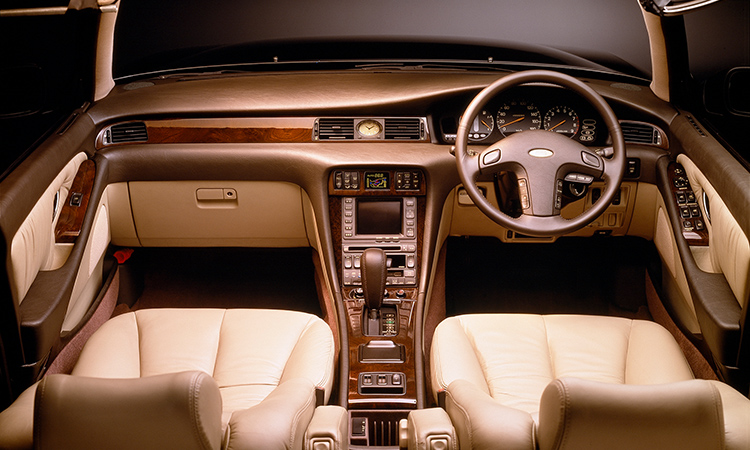
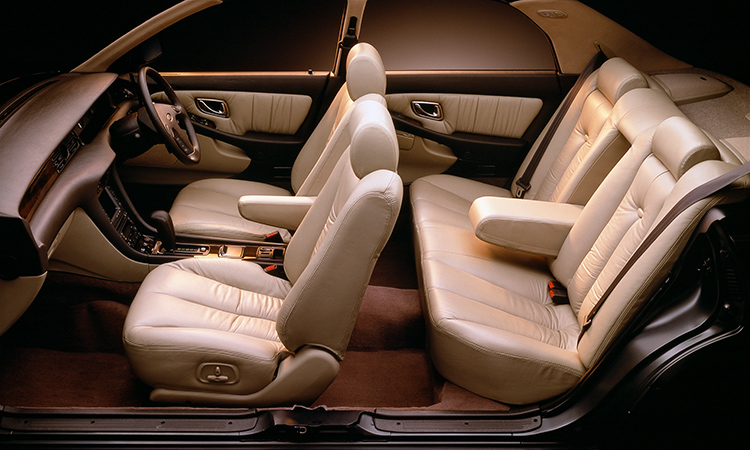
In November 1990, the Diamante won the 11th Car of the Year award. It was the second time Mitsubishi had earned that accolade. Thirty years later, wide-body 3-number sedans are now the norm in Japan, making the Diamante a truly ground-breaking vehicle that ushered in a new era in Japan’s premium car market.
Kojima says, “To compete with rivals, we needed to think outside the box and create a car that would be a ‘game-changer’.” What does Kojima think makes “Mitsubishi Motors-ness”?
“From our perspective, I think that what makes “Mitsubishi Motors-ness” is our ability to create new value through free thinking, unrestricted by existing categories and hierarchies, and to offer that value to our customers. And that is Mitsubishi Motors’ strength.
For example, for the first-generation Pajero, Mitsubishi Motors promoted recreational use as a new purpose for four-wheel-drive vehicles, which had previously been mainly for professional use, thereby pioneering an entirely new market. The Diamante also discarded the conventional wisdom regarding 5-number vehicles and offered new value in a premium car. That’s what Mitsubishi Motors is about. Going forward, it’s my hope that young people in particular continue to take on challenges that require outside-the-box thinking.”
Vehicles that Kojima has been involved with include the first-generation Pajero Mini, the Dion, and the Outlander*4, and in 2015, he was appointed general manager of the Product Strategy Department. In 2019, he became an advisor to the Corporate General Manager and is currently assigned to that office. Kojima points to the Outlander PHEV and the i-MiEV, the world’s first mass-produced electric vehicle, as other ground-breaking cars. In our next installment, we’ll feature an employee who was involved in the development of the Outlander PHEV.
- *3 GATT: General Agreement on Tariffs and Trade A legal agreement related to tariffs
February 2026

