15 Years of Disaster Relief with Mitsubishi Motors' PHEVs

When disaster strikes, someone always needs that single vehicle.
It may bring light to an evacuation shelter during a power outage, charge a smartphone so people can let family members far away know they are safe, or even provide power for medical equipment. For years, Mitsubishi Motors’ PHEVs have supported people’s lives in disaster-affected areas, going far beyond transportation.
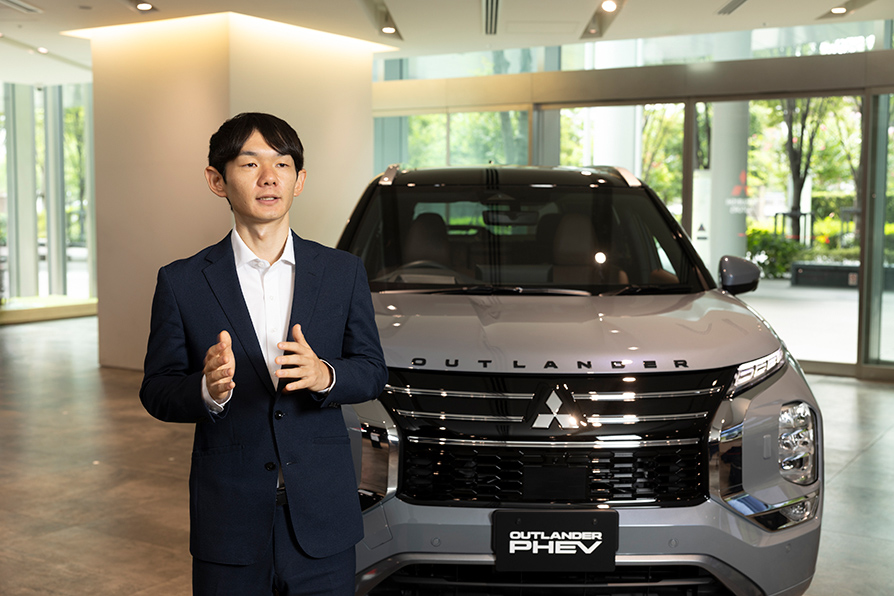
Getting those vehicles to where they are needed most takes a dedicated team. Behind them are employees who continue to work closely with local governments and Mitsubishi Motors dealerships. One of them is Takeshi Ota, who is responsible for municipal sales and planning within the Domestic Regional Operations Department.
Through Ota’s dedicated efforts to rush vehicles to disaster-affected areas and past examples of the company’s support, we explore Mitsubishi Motors' long-standing disaster-relief initiatives and the philosophy driving them today.
In Part 1, we look at the origins of these efforts, the systems that support them, and Mitsubishi Motors’ response to the Noto Peninsula Earthquake.
It All Began in 2011:
One Simple Request to “Use the Vehicle’s Electricity”
The history of Mitsubishi Motors’ disaster-relief cooperation with local governments dates back to the Great East Japan Earthquake of 2011.
At the time, approximately 90 Mitsubishi Motors i-MiEV battery electric vehicles were dispatched to affected areas.
“From what I have heard, the vehicles were not used as a source of electricity at the time,” says Ota. “Fuel shortages were a major issue, so they were primarily used as a means of transportation.”
What came back from disaster-affected areas, however, was an unexpected request.
“It would be great if we could draw electricity from the i-MiEV.”
It was the people affected by the disaster themselves who first recognized the value of EVs not only as vehicles, but also as mobile power sources.
In response to that feedback, Mitsubishi Motors introduced the MiEV Power Box in September 2012, a power supply unit capable of drawing electricity from a vehicle’s drive battery. In the same month, the company signed its first Disaster Cooperation Agreement with Kyoto Prefecture utilizing electrified vehicles.
This marked the beginning of Mitsubishi Motors’ efforts to deliver not only mobility, but also electricity.
- A Disaster Cooperation Agreement is a framework designed to eliminate delays that can occur after a disaster by enabling electrified vehicles to be delivered quickly to disaster-affected areas and evacuation shelters.
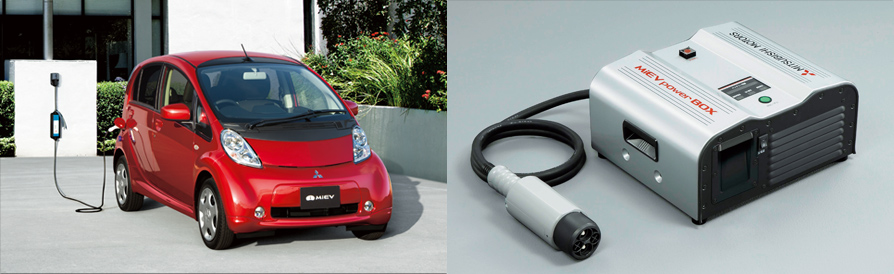
i-MiEV and the MiEV Power Box power supply unit
For several years, progress remained gradual. The next major turning point came from an internal initiative.
A new employee participating in a company program called the Problem-Solving Sheet proposed expanding Disaster Cooperation Agreements across Japan.
The proposal was simple:
“Shouldn’t Disaster Cooperation Agreements be expanded nationwide?”
That idea gained momentum, and in 2019 Mitsubishi Motors began actively expanding its network of agreements throughout the country.
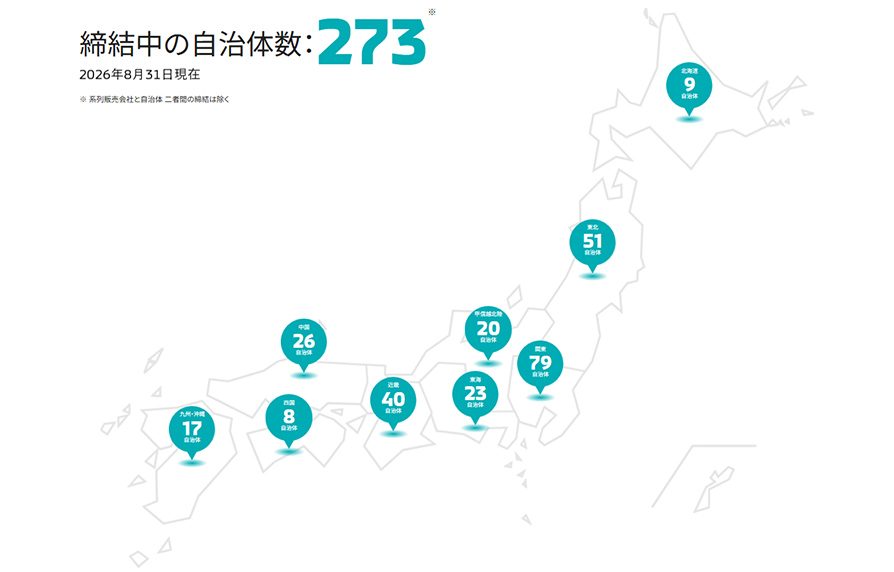
Fifteen years after the Great East Japan Earthquake, Mitsubishi Motors has signed Disaster Cooperation Agreements with municipality in all 47 prefectures in Japan. As of August 31, 2026, the total number of participating municipalities has reached 273.
Since 2019, Mitsubishi Motors has stepped up efforts to sign agreements with municipalities across the country, all while sharpening its capability to rush support vehicles to disaster-affected areas without delay.
In recent years, not only earthquakes and typhoons but also record-breaking rainfall events have become increasingly common. In Hyogo Prefecture, for example, awareness of disaster preparedness among local governments increased around the 30th anniversary of the Great Hanshin-Awaji Earthquake in 2025, resulting in new Disaster Cooperation Agreements being signed throughout the prefecture.
“Awareness of disaster preparedness among municipalities is definitely increasing,” says Ota.
Supporting People’s Lives During Disasters
Ota joined Mitsubishi Motors in July 2023 after beginning his career in banking.
Following his arrival at the company, he was assigned to a municipal sales and planning team, where he became responsible for promoting the adoption of electric vehicles and PHEVs among local governments.
“I first learned about Mitsubishi Motors’ Disaster Cooperation Agreement initiatives while considering a career change,” he says.
“What attracted me was the fact that the company was doing more than simply selling vehicles. It was taking actions that genuinely support people’s lives.”
Moving from the banking industry, a completely different field, into work focused on supporting people during emergencies, Ota now spends his days visiting municipalities throughout Japan.
In addition to helping forge Disaster Cooperation Agreements, he also coordinates vehicle deployments when disasters occur, serving as one of the key people behind Mitsubishi Motors’ disaster-support operations.
“I frequently have opportunities to speak with municipal disaster-prevention officials,” he says. “Whenever I do, I feel that they recognize Mitsubishi Motors not only as an automaker, but also as a company with strengths in disaster preparedness and response.”
Whenever a major disaster strikes, Ota’s team works intensively to arrange vehicles and coordinate with municipalities and dealerships.
“Personally, I am rarely required to respond during the middle of the night because of my role,” he says. “But for managers overseeing frontline operations, there is always a possibility that calls could come in at any hour.”
Whenever a disaster occurs somewhere in Japan, the team closely monitors news reports and outage information, identifying the areas where support is most urgently needed.
For many people, a disaster may feel like something happening far away.
For those involved in this work, however, it is always personal.
The People and Systems Behind Rapid Support
When disaster strikes, Mitsubishi Motors' support activities generally follow two paths.
The first begins with a direct request from a municipality that has signed a Disaster Cooperation Agreement. Through a call center that operates 24 hours a day, 365 days a year, requests are received from local governments, after which Mitsubishi Motors coordinates vehicles and arranges for them to be delivered where they are needed.
The second is what Ota describes as proactive support.
"We gather information from news reports and other sources, including the extent of damage and the scale of power outages, and determine which areas are most in need of support," he explains.
Immediately after a disaster, municipal disaster-prevention officials are often overwhelmed responding to urgent situations. In many cases, they may not even have time to determine where support should be requested.
"When that happens, we make sure to reach out ourselves and ask, 'Are you okay? Is there anything you need?'"
One of the defining characteristics of Mitsubishi Motors' Disaster Cooperation Agreements is their three-party structure involving local governments, Mitsubishi Motors, and local dealerships.
"In many cases, agreements are signed between a municipality and a local dealership," Ota explains.
"In our case, responsibilities are clearly divided. The municipality uses the vehicle, Mitsubishi Motors coordinates vehicle allocation, and the local dealership delivers the vehicle to the designated location. Because all three parties work together, we are able to respond quickly and support a wide range of needs."
This close collaboration between municipalities, Mitsubishi Motors, and local dealerships has become the foundation of the company's disaster-relief activities.
The Noto Peninsula Earthquake:
Reassurance That Could Never Be Taken for Granted
The true strength of Mitsubishi Motors' disaster-response network was tested during the Noto Peninsula Earthquake, which struck on January 1, 2024.
As power outages spread across Niigata Prefecture, Mitsubishi Motors received a request from the prefectural government and delivered a PHEV to Kashiwazaki City on the very same day.
It was an extraordinary response, particularly at a time when many people were away from work for the New Year holidays.
Immediately after the earthquake, Kashiwazaki City's Disaster Prevention and Nuclear Safety Division contacted the Niigata Prefectural Government requesting emergency power support because widespread outages had left many areas without electricity.
Officials from the prefectural government then approached Mitsubishi Motors and Chuetsu Mitsubishi Motors Sales Corporation.
A dealership representative set out for the designated community center serving as an evacuation shelter. Reaching the destination, however, was far from easy. With roads and buildings shrouded in darkness due to the blackout, the driver lost his way several times and had to repeatedly stop to confirm directions.
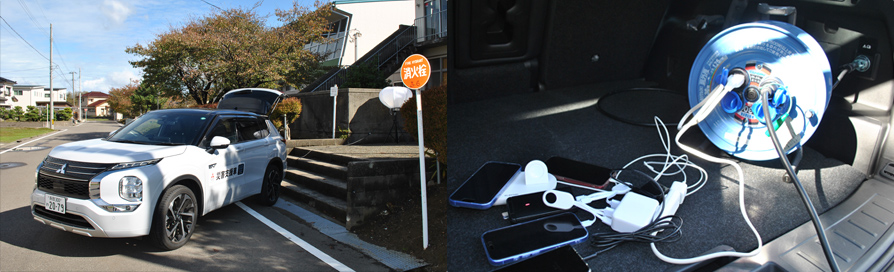
The vehicles eventually delivered were an Outlander PHEV and an Eclipse Cross PHEV.
The community center already had a generator, but the number of electrical outlets available was limited. Many evacuees were unable to charge their smartphones.
As soon as the PHEVs arrived, power-supply operations began.
Electricity was also supplied to lighting equipment, helping illuminate the shelter.
Residents expressed visible relief.
"Now we can contact our relatives and friends and let them know we're safe."
Kashiwazaki City later shared its appreciation as well.
"The PHEVs provided reassurance as mobile generators and energy-storage systems."
"Despite it being New Year's Day, Mitsubishi Motors responded quickly regarding vehicle availability, demonstrating the strength of its cooperation with local dealerships during emergencies."
"Road conditions included snow and ice, but because the vehicles were SUV-type PHEVs, they were able to travel over difficult terrain and provide support when it was needed."
Looking back, Ota still remembers how much those comments meant to him.
"I later had opportunities to speak with officials from the Niigata Prefectural Government, and they expressed tremendous appreciation for our response during a holiday period when most people were off work. Knowing that the vehicles helped provide reassurance to people spending anxious hours in evacuation shelters made me genuinely happy. When I heard their words of gratitude, I was deeply moved."
Vehicles deployed during disaster-relief operations and a power-supply demonstration
For Ota, the Noto Peninsula Earthquake carries special significance.
It was the first major disaster response he experienced after joining Mitsubishi Motors in July 2023.
"I visited Niigata Prefecture myself and had the opportunity to hear directly from people in Kashiwazaki City and at the Niigata Prefectural Government.
It was an experience that left a lasting impression on me.
In many cases, power outages are restored within about a week. If support arrives too late, our efforts to deliver electricity can no longer fulfill their intended purpose.
The experience reinforced my belief that the initial response phase is the most important stage following an earthquake."
That is why Mitsubishi Motors remains committed to delivering support when it matters most.
In Part 2, we explore the capabilities demonstrated by Mitsubishi Motors' PHEVs through examples from Sado City and the Kumamoto Earthquake, and look at how their role is expanding into healthcare and community disaster preparedness.

