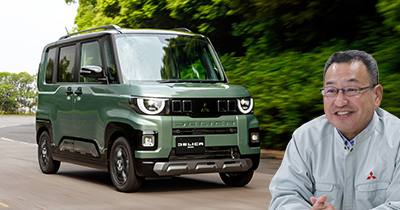
How are Mitsubishi Motors vehicles made? Behind every model is a series of processes from research to planning, design, engineering, prototyping, testing, procurement, production, distribution, and sales - each overseen by professionals with highly advanced technical expertise. In this series, we feature individuals from Mitsubishi Motors worksites.
We continue our talk with Yoichi Torii, a seasoned expert responsible for fine-tuning vehicles in the final stages to achieve easy handling and ride comfort. Joining him is Masaru Miyanishi, who works under Torii’s guidance in the Vehicle Performance Planning and Testing Department, the team responsible for carrying out final adjustments during the development phase before a vehicle enters mass production.(Read Part 1)
The Master Evaluator Program: Preserving Skills Through Mentorship
As we shared in the previous episode, the final fine-tuning in vehicle development is entrusted to seasoned specialists with exceptional engineering senses, grounded in both experience and expertise. At Mitsubishi Motors, there is a growing concern that these capabilities could be lost as experienced veterans reach retirement. To address this, Vehicle Engineering Development Division 1 - which oversees vehicle evaluation testing - launched the Master Evaluator program in 2023. With the Vehicle Performance Planning and Testing Department and the Prototype Department as model cases, the company is advancing a skills-transfer initiative that pairs mentors with apprentices. Here, "skill" refers to the ability developed through daily training, to engineer nuance, feel, and character that cannot be captured by numerical data alone.
A Master Evaluator is defined as a specialist who can - by relying on their five senses - accurately identify where a vehicle falls short, decide on corrective actions based on deep experience, and bring the vehicle to a finished state. Torii is now training engineers to become true Master Evaluators. One apprentice chosen for this role is Masaru Miyanishi.
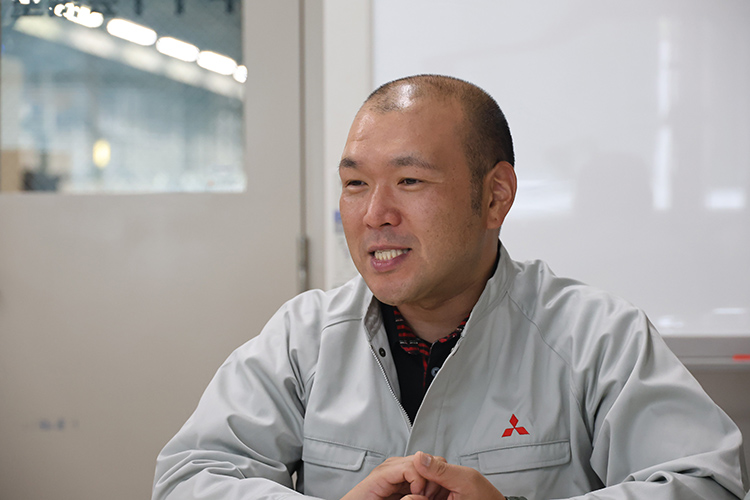
Masaru Miyanishi
Miyanishi joined the company in April 2007. In October that year, he was assigned to a team overseeing handling stability and ride comfort technologies in the Vehicle Testing Department. In 2023, he was nominated as Torii’s successor. Since then, he has been honing his skills in the Handling & Brake performance planning/testing team within the Vehicle Performance Planning and Testing Department.
"I’ve always loved cars," Miyanishi explains. "After graduating with an engineering degree, I wanted to join an automaker. More specifically, I was looking for a job where I could be involved in testing firsthand and work closely in developing vehicles. Mitsubishi Motors felt like a company I’d genuinely enjoy working for because each engineer handles a wide range of tests, and the scope of what I could take on is broad."
Now in his 18th year at the company, Miyanishi has already built a solid track record.
"The vehicles I feel the strongest personal attachment to are the current Outlander and Outlander PHEV. These were models I led as the primary engineer in charge after stepping into a senior role, working alongside Torii. We started by prioritizing ride comfort, including the tires. The final specification reflects what we set out to achieve, and we finished by testing at the Tokachi Research Center. There, we tuned the ride to stay comfortable on everything from well-maintained paved roads to rougher surfaces. I think we managed to capture what we consider a Mitsubishi Motors ride."

Outlander PHEV
How Do You Put "Ride Feel" Into Words?
Even with Miyanishi’s experience, Torii still sets a high bar.
"If a Master Evaluator’s skill level is 100 percent, Miyanishi is probably at about 70 percent. What remains is that final step of refinement - and that last step is the hardest."
Because achieving great ride feel ultimately depends on the trained senses of a veteran engineer like Torii, passing that feel on to the next generation isn’t easy.
"In our department, we use equipment that measures the damping characteristics of shock absorbers," Torii says. "We make adjustments while reviewing the various graphs it gives us. But that’s only part of the process. What we really have to convey to our suppliers is the ride feel itself - and that’s extremely hard to communicate."
"If you feel a sudden jolt while driving, you might describe it as 'hard' or 'harsh,' but someone else might say, 'It hurts.' People put it in different words, so simply telling a supplier, 'It’s hard,’ doesn’t necessarily get the message across."
So how does he put it into words?
"For example, if you go to the supplier and say, 'This wasn’t good,' they’ll ask, 'What wasn’t good?' So I’ll add, 'This part is a little too loose.' And if you say, 'It’s like a lightweight guy who can’t quite get his feet under him,' they might respond, 'Then let’s add some muscle.' I use all kinds of expressions."
"I may be a bit unusual in that sense, but I’ll also say things like, 'Put some backbone into it,' or 'Put some muscle into it.' I use every bit of vocabulary I have to share what I’m sensing."
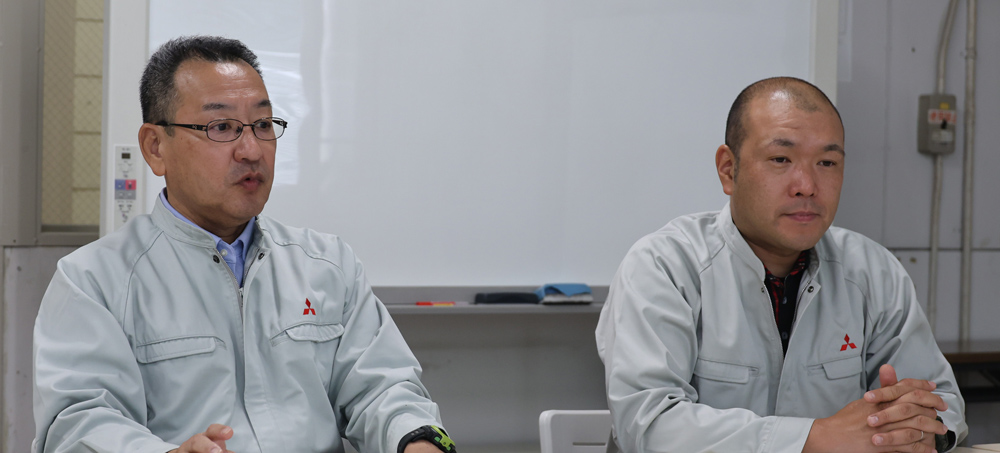
(From left) Yoichi Torii, Masaru Miyanishi
Technical knowledge matters. But so does the ability to translate what you feel into words, and to communicate it clearly to a supplier.
Asked what makes the work difficult, Miyanishi doesn’t hesitate to answer. "When you evaluate parts one by one, the feeling and nuance you convey to the supplier can vary depending on who’s describing it. But when Torii gives feedback, the end result is always good. The difference isn’t just in how we phrase it. There’s a difference in what he feels and what I feel."
"I feel like I’m noticing the same things, but the depth of his observation is on a completely different level. That’s what makes it hard. The extent to which we can build that into the parts - and the specific adjustments we decide on - inevitably differ between Torii and me."
He gives an example. "Say you drive a short distance and come back. At our level, if we feel a jolt from a bump when we go over a step, we focus on that and tell our supplier, 'That hit is hard,' or 'It feels soft.' But Torii looks at it from many angles in a single run - how it feels below 10 km/h, how it feels at 40 km/h, and so on. And instead of stopping at 'hard' or 'soft,' he also considers why it feels that way. That depth of analysis is decisively different from those of us who are learning."
"Even over a short distance, you gather a lot of information," Torii says. "The question is how much of it you can process while you’re driving. You start to feel like one of the car’s sensors. Even when I’m driving my own car, I always try to be that sensor. If a tire is even slightly low on air, I can tell right away."
Torii’s Apprenticeship and How He Mentors Others Today
Torii became the engineer he is today through years of demanding work as an apprentice. In 1992, after completing training at the company’s training center, he returned to the Vehicle Testing Department and met a senior colleague who would become his mentor.
"For more than 10 years after that, we were together - closer than family, in a way," Torii recalls. "He never compromised and never cut corners. Everything was thorough. He trained me in everything, from how I dressed to how I spoke. He was so strict that I would come home every day crying, even though I had a child. That’s how grueling it was."
How did he learn a world of sensations that can’t be fully put into words?
"More than anything, I just had to ride in cars over and over again," he says. "Without taking a break, I was constantly immersed in thinking about cars. I didn’t know when ideas might come, so I was thinking even during meals at home and on my days off."
"It was an era when work was paramount, and I was always with my mentor, so I tried to absorb whatever I could. I learned by watching him - by 'reading his back,' as we’d say in Japanese. He was tough, but he wasn’t unreasonable. When I was late coming home from work, he would often call my wife and tell her, 'He’s just working late, so don’t worry.'"
Back then, Torii spent every day on the test course with his mentor to develop his senses for ride feel.
"When I drove, my mentor sat diagonally opposite in the rear seat," Torii says. "As we drove, he would write down his assessment. When he couldn’t write clearly, he’d say, 'This car is no good.' When he could write, he’d say, 'It might be all right.' If the car was shaking, he couldn’t write, so being able to write meant the ride was stable. In other words, he was telling me to learn by building up countless real experiences."
"Today, vehicle development is becoming more efficient, and there are fewer opportunities to build experience through gritty, hands-on repetition in the field. That’s why I deliberately formed the Master Evaluator training team, and I teach by creating practical experiences however I can."
To do that, Torii has Miyanishi, along with two more junior team members, run the test course every day.
"Actually, since last year, I’ve been having the team do repeated drills every day," Torii says. "I tell them to ride in cars after tuning is complete, and they do it every day. In Japanese we call this 'senbon knock' - endless practice reps. If they drive with real focus, Mitsubishi Motors’ ride feel should eventually sink in."
"Every day, whenever work allows, they drive for 30 minutes to an hour. Since last year, they’ve driven about 6,000 kilometers in total. And I tell them, 'That’s not enough - keep going until you’ve logged over 10,000.' Four or five times a year, I also take them to the Tokachi Research Center and give them specific tasks to work on."
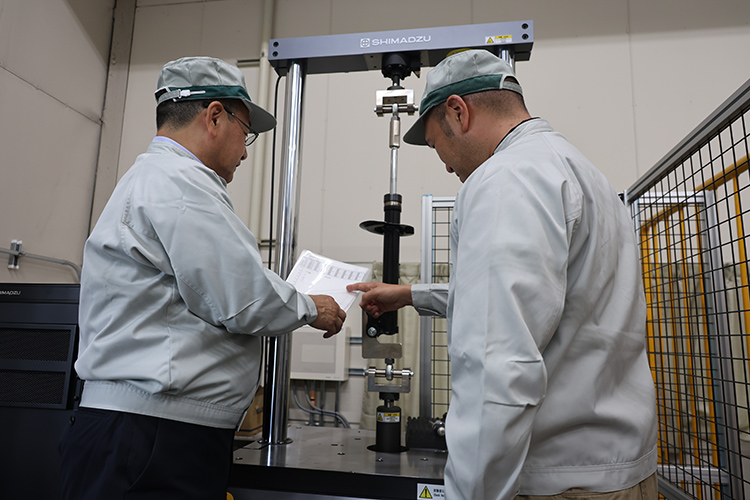
Miyanishi receiving instruction from Torii
There are several hurdles to clear in order to be recognized as a Master Evaluator, but Miyanishi has persevered to the point where it is now within reach. What does he aim for next?
"When I joined the company and was working in dealership sales, the manager there asked me, 'What do you want to be?' Looking back now, I remember answering, 'I want to be like a craftsman.' I’d always admired the idea of being someone you could say, 'It turned out this good because we left it to him.' Since my path has unfolded the way I had hoped back then, what I want to be now is someone like Torii - someone who can take a prototype vehicle and, in two or three days, bring it to a level ready for our customers. I hope to become a specialist people can rely on like that."
Finally, we asked Torii and Miyanishi what defines Mitsubishi Motors’ signature ride feel—the feel they’ve internalized through years of driving.
"This is just my personal view," Torii says, "But what we’re aiming for is comfort whether on-road or off-road. What matters is stroke - Mitsubishi Motors builds vehicles that let the suspension do its job. As a company whose vehicles travel roads around the world, I believe our identity lies in letting the suspension work freely - giving it room to move - so the vehicle can take you wherever you want to go."
"I agree," Miyanishi adds. "What matters is how consistent the ride feels, regardless of the road surface. Most vehicles can feel smooth on good roads, but far fewer stay comfortable when the surface gets rough. In the area we’re responsible for, Mitsubishi Motors’ signature is comfort - whether you’re on smooth pavement, rough pavement, or unpaved roads." Mitsubishi Motors’ distinctive ride feel is brought to life by seasoned specialists like these.

