How exactly are Mitsubishi Motors cars made? Each step in the series of processes from research to planning, design, engineering, prototyping, testing, purchasing, production, distribution, and sales is overseen by professionals with highly advanced skills. In this series, we feature individuals from Mitsubishi Motors worksites. In this article, we take a look at Mitsubishi Motors Corporation’s largest manufacturing center: the Okazaki Plant.
The Okazaki Plant in the city of Okazaki, Aichi Prefecture was originally established in 1962 as a test course. Automobile production began in 1977 with the completion of a factory. The site is approximately one million square meters in area. The Okazaki Plant produced its seven millionth vehicle in October 2024. Takashi Saito, who serves as the Vice plant general manager, shared insights into the Okazaki Plant. First, we asked what is distinctive about the plant.
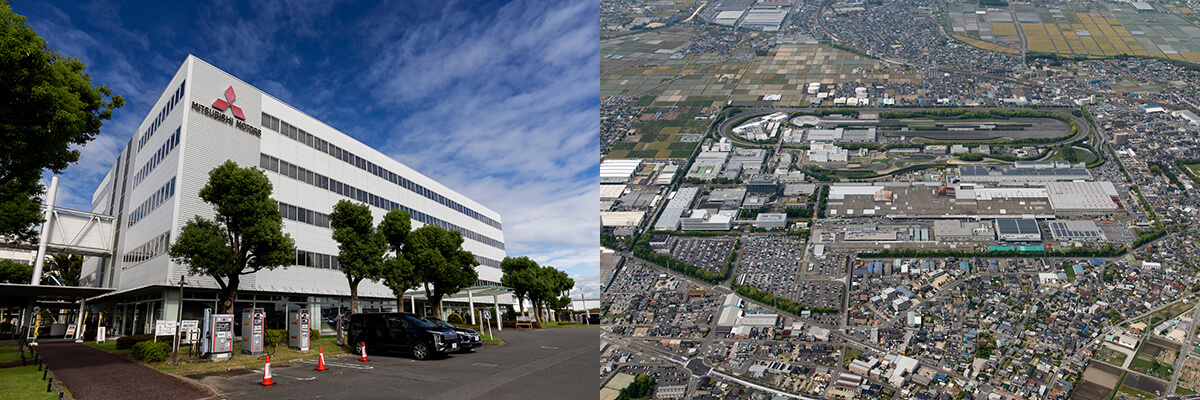
Okazaki Plant
“The Okazaki Plant is an integrated production facility that manufactures components from raw materials and assembles them. For example, bumper production is done entirely in-house, from resin molding to painting. This approach is called “mixed model production,” and what people from plants belonging to other manufacturers are most surprised by when they come for plant tours is our process by which vehicles from different models are produced on the same assembly line. It requires a lot of wisdom and ingenuity on the part of Mitsubishi Motors.”
What is mixed model production? The Okazaki Plant produces five different passenger vehicle models: gasoline engine and PHEV variants of the Outlander, the Eclipse Cross and the Delica D:5. On the production line, you can see a mix of vehicle models with bodies of different sizes and paint colors.
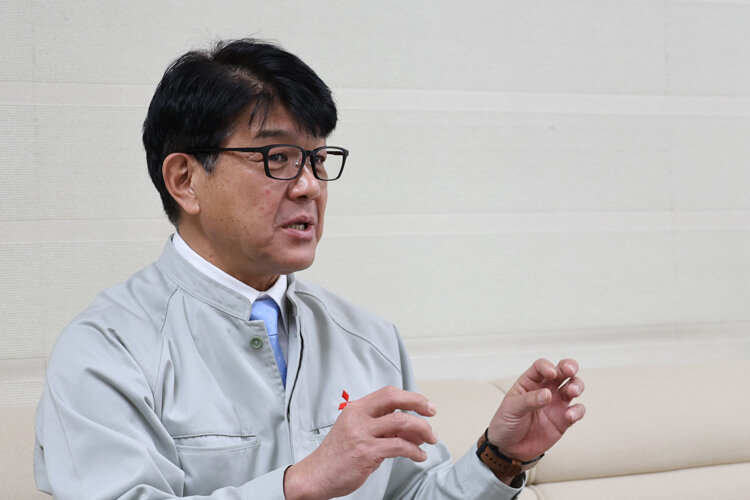
“It would be ideal to have a dedicated line for a specific model if production scale was large enough, but at Mitsubishi Motors, global production volume is approximately one million vehicles per year, of which 200,000 are produced by the Okazaki Plant. The components used even in the same vehicle model can vary according to the trim level, and the number of parts also varies according to each country’s safety standards. We have to produce cars of multiple configurations on the same production line, but in order to avoid quality defects and keep costs down, we’ve had to figure out the best way to do it. The current method is the result of that.”
Now, let’s take a look at some examples of “wisdom and ingenuity.” During the assembly process, it is truly impressive to see the workers skillfully attaching different parts to different car models as they come down the production line. If you look closely, you’ll notice that carts carrying the parts for different cars arrive at the production line in order according to the type of car coming down the line (a process called parts kitting). Workers take the parts off those carts and attach them to the vehicle as part of the assembly process. Workers at the kitting station load the parts indicated by lamps onto carts. Because the task of selecting parts and the task of assembling them have been completely separated, assembly line workers are able to work more efficiently without the need to do part selection.
Naturally, the production process is continually becoming more mechanized, but human labor remains necessary for some processes. One reason for this is to ensure our techniques are passed on to future workers. Because Mitsubishi Motors has overseas production plants in ASEAN countries, particularly Thailand, technical instruction at those locations is essential.
“The welding process is one that is about 99 percent carried out by robots. At present, we have about 744 robots, and a robot performs roughly between 4,000 and 4,500 spot welds on a single car. Even so, there are some overseas production plants where that task has not been automated. That’s why it will be hard to provide technical instruction overseas if we don’t preserve traditional hand-manufacturing techniques. In the painting process as well, we have maintained a manual process for sealing the door area to prevent water leaks. Our automation rate is about 90 percent. Naturally, we have a responsibility to pass on these skills, so we are preserving advanced techniques that rely on human expertise.”
Welding assembly line
Note: This is an excerpt from the Kuruma Zukuri Meister Virtual Plant Tour.
“When I joined the company, every plant was pushing for more automation in the assembly process. However, the current trend is toward semi-automation, which involves the manual handling of heavy items with the help of assistive devices. At the Okazaki Plant, our automation rate is about two percent. In terms of quality assurance, this work is generally easier for humans to do than robots. For example, if there are five nuts, each one will have a different tightening force. Every time a new car model comes along, the settings for the robots need to be changed, but human workers can adapt immediately if they have been trained, minimizing both time and cost.”
From the customer’s perspective, the most important thing is quality assurance. That’s why Mitsubishi Motors has taken the lead over other companies in incorporating an automation framework into its final inspection system.
“As a basic concept, we have adopted a policy of completing everything within the production process. Products with defects should not be sent on to the next production stage. If that happens, we stop the production line. For example, when we tighten nuts, a beep sounds for each one when the specified torque is used, and once everything is complete, a green light comes on, and the product continues on to the next process line. This means that the quality of the finished product is guaranteed within the process.”
“Inspectors equipped with tablets are assigned to the final inspection process. Only inspectors certified by us can carry out inspections, and tablets can be accessed only by registered users via fingerprint authentication (the e-check system). Tablets display the inspection items that correspond to the cars coming through the production line. If any inspection items entered into the tablet do not get a passing grade, the product cannot be shipped in the end.”
At this point, we would like to touch on Takashi Saito’s career, as he is the one who has combined these systematized technologies and manages the workers who use them. Saito is from the city of Kurashiki, Okayama Prefecture. He has a strong attachment to his hometown, and after he graduated from university in Tokyo, he aspired to work for Mitsubishi Motors, which has a production plant in Kurashiki: the Mizushima Plant. He joined the company in April 1992.
“The time when I joined was the height of the Japanese economic bubble. I was hired for a technical position at the head office. I was one of about 400 new employees, including both administrative and technical personnel, who were hired at the same time. My colleagues wanted to work in development at the head office or in Aichi, but I wanted to go back to my hometown, so I asked if I could work at the Mizushima Plant.”

Mizushima Plant
Saito started out in the stamping section at the Mizushima Plant’s Vehicle Production Department, where he gained experience in assembly, painting, welding, and other aspects of the workplace. He was transferred to the Okazaki Plant in 2018. He became deputy general manager and division general manager before assuming his current position in April 2024. Twice over that time period, he was assigned to a Mitsubishi Motors factory in Thailand. Saito looks back at his early days in the company with fondness.
“My first work station was the press. At the time, I was part of a team that was constantly making parts from sheet steel, and the other people around me were like craftsmen, causing me to feel a bit out of place. Every day, I worked until my skin was blackened with dust.”
As mentioned earlier, Mitsubishi Motors has established plants in ASEAN countries. The Okazaki Plant oversees other plants in Thailand and Vietnam, while the Mizushima Plant oversees plants in Indonesia and the Philippines. These relationships include communication for technical purposes. There are three plants in Thailand. They produce the Pajero Sport,the Mirage and Attrage for ASEAN markets, as well as the Triton, which is also sold in Japan as of last year. Saito was stationed at a plant in Thailand for four years starting in 2012.
“At the Mizushima Plant, I moved from assembly to the Painting Section, and after spending one year as the section general manager, I was posted to Thailand. Thailand’s third plant was just in the process of being built, so I was put in charge of setting up the paint station, even though I only had one year of experience in painting. After that, I gained experience in setting up a plastics factory for making bumpers. Starting from scratch on an empty plot of land, I designed the factory layout, installed bumper molding machines, and added a painting booth. I was working together with support personnel from Japan as well as Thai personnel, but it was hard work. Although we faced endless challenges, we worked together as a team with an emphasis on viewing and considering things together with the personnel on the plant floor. Once I had established the bumper factory in Thailand, I returned to the Mizushima Plant and became the section general manager in charge of welding.”
Following Saito’s transfer from the Mizushima Plant to the Okazaki Plant in 2018, he was assigned to Thailand for the second time in 2021. During his three-year stay there, he oversaw the launch of the Triton, which went on sale in Japan in 2024. Saito’s strengths lie in his extensive experience working at plants both overseas and in Japan, where he was responsible for a wide range of operations.
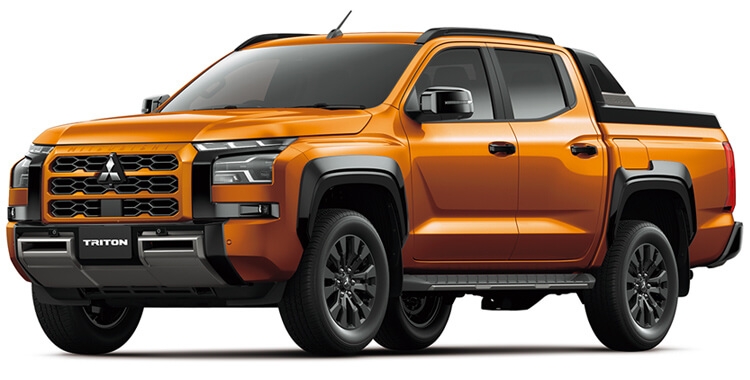
Triton
“All my jobs have involved working on the plant floor. At Mitsubishi Motors, there are a great many artisans who have spent 30 years working only in assembly, for example, and I don’t think there are many others who have experienced every process like I have. Because of my experience, I want to continue the same approach in my management: viewing and considering things together with the personnel on the plant floor. Viewing the plant from an overall perspective allows me to handle challenges immediately through two-way communication and participate in a frank exchange of opinions with the workers instead of taking a top-down approach. That’s my work motto. I believe that the employees benefit from having managers who are familiar with the plant floor, and I would like to continue making that a priority in the future.”
Saito concluded his remarks with a strong and confident message.
“Looking back at the history of Mitsubishi Motors, we’ve faced many difficulties, but we have overcome them time and time again. Now, as we face the world, we can say with confidence that we provide great cars for our customers.”
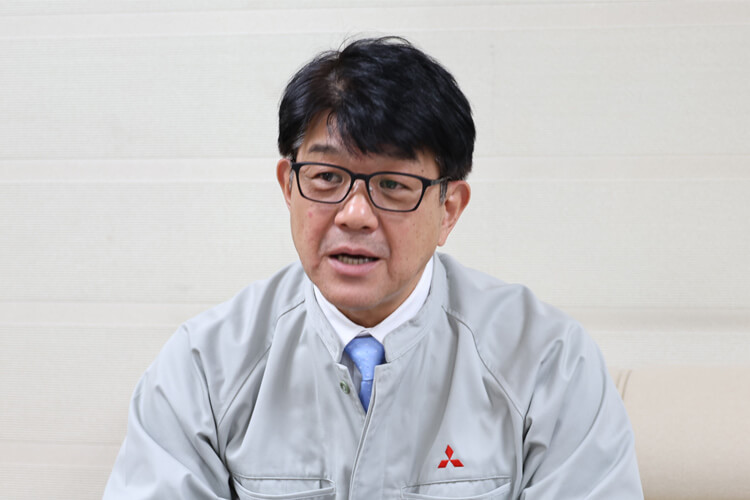
At Mitsubishi Motors, vehicle development depends on the latest technology, traditional skills, and direct involvement by the people who make all of that possible, as well as dialogue between people. That includes the knowledge cultivated by experiencing the manufacturing process, the communication that happens in the workplace, and the transmission of techniques and knowledge to younger generations. All of these factors can be considered relevant to vehicle development.